
800 VDC Architecture for Next-Generation AI Infrastructure
NVIDIA · Jared Huntington, Mike Tu
NVIDIA's October 2025 white paper argues for 800 VDC facility-to-rack distribution plus layered energy storage for megawatt-class AI racks. It uses numbers to show why rack power density is outgrowing AC distribution.
On this page
Overview
The paper opens with the step changes in rack power that come from growing NVLink domains. Moving from Hopper to GB300, TDP rose 75%, performance about 50x and rack power density 3.4x, because four separate 8-GPU NVLink domains became one 72-GPU domain. The authors conclude that this trajectory cannot be sustained on 415/480 VAC distribution and that megawatt-class racks need a different distribution voltage.
The second theme is load dynamics. Synchronised LLM training swings rack power from roughly 30% at idle to 100%, with transients as fast as about 400 microseconds, idle gaps up to 100 ms, checkpointing pauses of 1-5 s and ramps over minutes. A 50% duty square wave whose peak is 50% above the average raises RMS losses by 25%, so upstream equipment has to be sized for both peak and RMS effects. The proposed remedy is capacitors near the racks and a BESS at the utility/generator interface.
The comparison table centres on conductor utilisation: power per mm2 of conductor is 0.6 kW at 415 VAC, 0.8 kW at 480 VAC (+16%), 1.7 kW at 800 VDC (+157%) and 3.1 kW at 1500 VDC (+382%). Typical AC whips are capped at 60 A or 100 A (IEC 60309), which constrains AC delivery to MW-class racks. The paper also reviews rival DC schemes (750 VDC, +/-400 VDC, 1500 VDC) and explains why it picked single-ended 800 VDC: widely available two-pole breakers and no pole load balancing.
On the architecture side, the 800 VDC MGX rack steps directly from 800 V to 12 V with a 64:1 LLC converter, saving about 1% efficiency and 26% area versus multistage conversion. The migration path runs from side power racks to facility rectifiers and then MV rectifiers or solid-state transformers: LV rectifier strings target about 1.5 MVA at roughly 99% efficiency, MV units up to 7.5 MVA at 98.5% or better, for example converting 35 kV AC to 800 VDC. It is a vendor paper, and timelines depend on NVIDIA's own roadmap.
Key points
- Hopper to GB300: TDP +75%, performance ~50x, rack power density 3.4x.
- Synchronised LLM load swings rack power between about 30% and 100%; transients ~400 us, idle gaps ~100 ms, checkpointing 1-5 s.
- A 50% duty square wave with peak 50% above average raises RMS losses by 25%.
- Power per conductor area: 415 VAC 0.6, 480 VAC 0.8, 800 VDC 1.7, 1500 VDC 3.1 kW/mm2.
- Typical AC whips are limited to 60 A or 100 A (IEC 60309).
- LV rectifier strings ~1.5 MVA at ~99%; MV rectifier/SST up to 7.5 MVA at >=98.5%.
- In-rack 64:1 LLC conversion from 800 VDC to 12 V saves ~1% efficiency and 26% area.
- Single-ended 800 VDC was chosen over +/-400 VDC; 1000 V-class parts near term, 1500 VDC a possible long-term target.
Using it in design
- Add a single-ended 800 VDC distribution option to the electrical model, with rectifier blocks of ~1.5 MVA (LV) and up to 7.5 MVA (MV/SST) and the stated efficiencies.
- Model AI racks with a dynamic profile (30-100%, millisecond scale) instead of flat kW, and size upstream gear for peak and RMS uplift.
- Warn when planned rack kW exceeds what 60 A or 100 A AC whips can deliver.
- Represent storage in two layers: rack-side capacitors and a BESS at the utility/generator boundary.
- Use the kW/mm2 ratios as a first estimate for DC conductor sizing.
Monthly newsletter · free
Keep your reading list current
Once a month: new library sources, changes to Turkish regulations and upcoming data centre events.
SoSo CAD
Review your power design in SoSo CAD
Inspect supply paths, equipment loads and UPS failure scenarios in one model.
Request a demo
Who should read it
Design engineers and decision makers choosing electrical distribution for AI campuses.
Related standards
- IEC 60309
- IEC 62477-1
- NEC Article 690
- VDE-SPEC 90037
- UL 62368-1
Publication details
- Authors
- Jared Huntington; Mike Tu
- Publisher
- NVIDIA
- Year
- 2025
- Document language
- English
- Source type
- Manufacturer
- Access
- Free to read
- Licence
- Copyright retained; citation only — the publisher’s terms apply to the original document
Citation
Jared Huntington; Mike Tu (2025). 800 VDC Architecture for Next-Generation AI Infrastructure. NVIDIA. https://dam-cdn.nvd.orangelogic.com/AssetLink/qq0vy0u48xfr0c81i2m1781pwea64n8v.pdf
Events on this subject
- Electricity Eurasia 2027
- ELECO 2026 Elektrik-Elektronik ve Biyomedikal Mühendisliği Konferansı
- The smarter E Europe (Intersolar Europe, ees Europe, Power2Drive, EM-Power)
All content and rights belong to the respective authors and publishers. SoSo CAD provides only the citation, its own summary and a link to the source, and is not responsible for the sources' content.
Related sources
All sources on this topic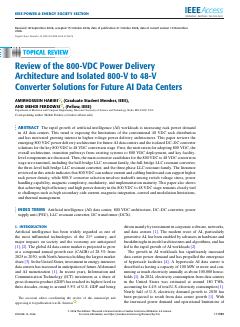
IEEE Access (Institute of Electrical and Electronics Engineers (IEEE)) 2026
Review of the 800-VDC Power Delivery Architecture and Isolated 800-V to 48-V Converter Solutions for Future AI Data Centers
Define 800 VDC unipolar, ±400 VDC bipolar and 48/54 VDC busbar as separate voltage classes in the single-line diagram, each with its own conductor ampacity, breaker pole count and clearance (IEC 60664-1) checks.
- The OCP Open Rack V3 PSU specification targets above 97.5% peak efficiency and at least 96.5% across 30%-100% load.
NVIDIA 2026
800 VDC Architecture: Industry Alignment & Execution
Define four electrical templates for AI halls: AC baseline (480 VAC, 100 A whips, 4M3), Power Rack, 2 MW Power Center and 4.8 MW DC Power Block with 4+1 catcher.
- AC baseline: 480 VAC, 100 A whips, 4-to-make-3 rack feed.
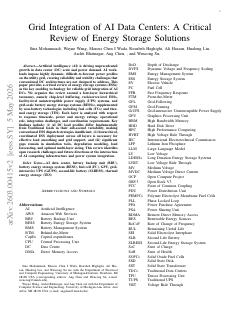
arXiv preprint (University of Michigan) 2026
Grid Integration of AI Data Centers: A Critical Review of Energy Storage Solutions (arXiv preprint)
Layer storage by timescale (chip/server sub-ms to ms, rack ms to seconds, UPS and GiUPS sub-second to 10 s, BESS minutes to hours) and show each layer's duty in the coordination scheme.
- Rapid AI load variations often induce 5-10% voltage swings within milliseconds.
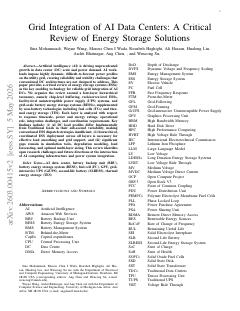
Advances in Applied Energy (Elsevier BV) 2026
Grid Integration of AI Data Centers: A Critical Review of Energy Storage Solutions
Layer storage by timescale: GPU/server supercapacitors for sub-second swings, rack BBUs for minutes, facility GiUPS and BESS for grid services and longer durations; show each layer's duty and coordination separately in the architecture.
- BESS cost fell from about $7,500/kWh in 1991 to $133/kWh in 2024, with about $80/kWh projected by 2030.
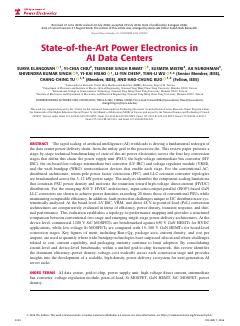
IEEE Open Journal of Power Electronics (Institute of Electrical and Electronics Engineers (IEEE)) 2026
State-of-the-Art Power Electronics in AI Data Centers
In rack power templates, model PSU count per shelf and the 33 kW shelf limit for AC distribution, and check busbar, PDU and cooling impact together for racks that exceed 100 kW with several shelves.
- AI rack density is 30-100+ kW against 7-10 kW for traditional racks; an 8-GPU DGX H100 draws around 10,200 W.
arXiv preprint (National Laboratory of the Rockies) 2026
Measurement of Generative AI Workload Power Profiles for Whole-Facility Data Center Infrastructure Planning
Size AI data-centre facility power with measured profiles rather than the rated design: even with all servers utilised, facility power reached only 73-80% of rated design.
- Online inference server power saturated near 2.8 kW at modest request rates.