
State-of-the-Art Power Electronics in AI Data Centers
IEEE Open Journal of Power Electronics (Institute of Electrical and Electronics Engineers (IEEE)) · Surya Elangovan, Yi-Chia Chiu et al.
This IEEE Open Journal of Power Electronics review benchmarks the AI power chain from grid to processor across four conversion stages: PSU, high-voltage IBC, on-board low-voltage IBC and VRM, and the wide-bandgap devices behind them.
CC BY 4.0 — share with attribution
On this page
Overview
The study asks where the AI power chain hits scaling limits as workloads push rack power toward the megawatt level. Its method is a stage-by-stage comparison of recent publications and product data on efficiency, power density and semiconductor choice: 3-12 kW rack PSUs built on totem-pole PFC and LLC resonant converters, 800 V HVDC intermediate bus converters, 50 V to 12 V server-tray converters and VRMs, and the SiC and GaN devices that enable them. As a review it contains no measurements of its own.
In the AC-distributed rack, each shelf holds six 3-5.5 kW PSUs delivering up to 33 kW, and several shelves push the rack above 100 kW. 50 VDC-output PSUs of 3-12 kW keep peak efficiency around 96%-98% and full-load efficiency around 96%-96.6%. The authors show that component count, cooling, copper and rack space strain this architecture and motivate the move to HVDC distribution.
In the 800 V architecture, input-series-output-parallel (ISOP) GaN LLC converters are reported to reach more than 20 times the power density of conventional PSUs at comparable efficiency, with densities above 2000-2600 W/in³. On the board, 50 V to 12 V intermediate converters reach peak efficiencies above 98-99% and densities above 5000 W/in³, while VRM topology choice follows output current: SC-based below 10 A, and multiphase buck, TLVR and hybrid designs at high current.
Limits: the compared designs come from different laboratories and test conditions, so efficiencies are not strictly like for like. The DC fault-protection section is a systematic survey rather than a validated protection design. No single architecture maximises efficiency, power density, transient response and thermal performance together; direct 50 V to PoL conversion will grow in highly integrated packages, but the two-stage chain stays the most practical near-term solution.
Key points
- In AC-distributed AI racks, each shelf houses six 3-5.5 kW PSUs delivering up to 33 kW, and multiple shelves can push rack power above 100 kW.
- 50 VDC-output PSUs of 3-12 kW reach peak efficiency of about 96%-98% and full-load efficiency of about 96%-96.6%; 80 PLUS Titanium (230 V input) requires 90% at 10% load, 96% at 50% and 91% at full load.
- Isolated HV IBCs can supply up to 90 kW per shelf at rack level, and an HVDC IBC design reached 98.4% efficiency at 10 kW.
- ISOP-based GaN LLC converters reach more than 20 times the power density of conventional PSUs at similar efficiency (2000-2600 W/in³ and above).
- 50 V to 12 V LV IBCs (resonant SC, LLC, hybrid) reach peak efficiency above 98-99% and densities above 5000 W/in³, with MHz-class GaN defining the density frontier.
- DC networks have no natural current zero, so faults are harder to interrupt and can arc persistently; rack-scale 800 V fault currents may reach 10-20 kA peak and pole-to-ground and pole-to-pole faults often need detection in under 1 ms.
- Protection options for 800 V racks include hot-swap ICs with microsecond turn-off, solid-state and hybrid breakers, DC-rated fuses and current-limiting reactors.
- AI rack density is 30-100+ kW against 7-10 kW for traditional racks; an 8-GPU DGX H100 draws around 10,200 W.
Using it in design
- In rack power templates, model PSU count per shelf and the 33 kW shelf limit for AC distribution, and check busbar, PDU and cooling impact together for racks that exceed 100 kW with several shelves.
- In 800 VDC rack design, add the DC fault current (10-20 kA peak) and sub-1 ms detection requirement as protection-selection checks; do not carry over AC breaker logic unchanged.
- Record PSU and converter efficiency at load points (10%, 50%, full load) rather than as a single number, using 80 PLUS Titanium thresholds as a reference.
- When comparing 800 VDC with AC distribution on rack space, copper and efficiency, report the density advantage of ISOP GaN IBCs together with their maturity risk.
Monthly newsletter · free
Keep your reading list current
Once a month: new library sources, changes to Turkish regulations and upcoming data centre events.
SoSo CAD
Review your power design in SoSo CAD
Inspect supply paths, equipment loads and UPS failure scenarios in one model.
Request a demo
Who should read it
Power-electronics and electrical design engineers evaluating PSU, intermediate-bus and VRM choices for high-density AI racks.
Document contents
- I. Introduction
- II. Power Supply Unit (PSU): power factor correction (PFC), LLC, PSU semiconductor and thermal analysis, no room in rack for high power demand
- III. High Voltage Intermediate Bus Converter (HV IBC): HVDC IBC topologies, traditional PSU versus HVDC IBC
- IV. On-Board Power Conversions in AI Server (two-stage versus single-stage conversion for PoL)
- V. Semiconductor Analysis for Powering AI (HV and LVDC semiconductor analysis)
- VI. Conclusion
Related standards
- 80 PLUS Titanium
- OCP Open Rack V3
Read the document
ai-dc-power-electronics-state-of-art-2026.pdf
CC BY 4.0 — share with attribution
The document is provided unaltered because its licence permits redistribution.
Publication details
- Authors
- Surya Elangovan; Yi-Chia Chiu; Tejender Singh Rawat; Susmita Mistri; Aji Nurohman; Shivendra Kumar Singh; Yi-Kai Hsiao; Li-Yin Chen; Tian-Li Wu; Chang-Ching Tu; Hao-Chung Kuo
- Publisher
- IEEE Open Journal of Power Electronics (Institute of Electrical and Electronics Engineers (IEEE))
- Year
- 2026
- Volume
- 7
- Pages
- 2434-2463
- Document language
- English
- Source type
- Scientific
- Access
- Open licence — downloadable
- Licence
- CC BY 4.0 — share with attribution
- Licence evidence
- ieeexplore.ieee.org
Original licence note
Abstract page states '© 2026 The Authors. This work is licensed under a Creative Commons Attribution 4.0 License'.
Citation
Surya Elangovan; Yi-Chia Chiu; Tejender Singh Rawat; Susmita Mistri; Aji Nurohman; Shivendra Kumar Singh; Yi-Kai Hsiao; Li-Yin Chen; Tian-Li Wu; Chang-Ching Tu; Hao-Chung Kuo (2026). State-of-the-Art Power Electronics in AI Data Centers. IEEE Open Journal of Power Electronics (Institute of Electrical and Electronics Engineers (IEEE)). 7, 2434-2463. https://doi.org/10.1109/OJPEL.2026.3720942
Events on this subject
- Electricity Eurasia 2027
- ELECO 2026 Elektrik-Elektronik ve Biyomedikal Mühendisliği Konferansı
- The smarter E Europe (Intersolar Europe, ees Europe, Power2Drive, EM-Power)
All content and rights belong to the respective authors and publishers. SoSo CAD provides only the citation, its own summary and a link to the source, and is not responsible for the sources' content.
Related sources
All sources on this topic
IEEE Access (Institute of Electrical and Electronics Engineers (IEEE)) 2026
Review of the 800-VDC Power Delivery Architecture and Isolated 800-V to 48-V Converter Solutions for Future AI Data Centers
Define 800 VDC unipolar, ±400 VDC bipolar and 48/54 VDC busbar as separate voltage classes in the single-line diagram, each with its own conductor ampacity, breaker pole count and clearance (IEC 60664-1) checks.
- The OCP Open Rack V3 PSU specification targets above 97.5% peak efficiency and at least 96.5% across 30%-100% load.
IEEE Access (Institute of Electrical and Electronics Engineers (IEEE)) 2021
A Novel Reliability Index to Assess the Computational Resource Adequacy in Data Centers
Set the number of spare PSUs/servers in a rack with a LOWP-style calculation from target service reliability and the load duration curve, avoiding unnecessary overprovisioning.
- The rack model assumes 10 blade servers rated 800 W each (400 W idle) with 40 local fans.
arXiv preprint (National Laboratory of the Rockies) 2026
Measurement of Generative AI Workload Power Profiles for Whole-Facility Data Center Infrastructure Planning
Size AI data-centre facility power with measured profiles rather than the rated design: even with all servers utilised, facility power reached only 73-80% of rated design.
- Online inference server power saturated near 2.8 kW at modest request rates.
International Energy Agency 2026
Key Questions on Energy and AI (World Energy Outlook Special Report)
For on-site generation sizing, when users choose islanded or behind-the-meter gas, apply an N+x overbuild check (30-70% above load per IEA) and model BESS for AI power swings.
- AI server power density rose 11 times in 2020-2025 and rises a further four times by 2027.
arXiv preprint (Stanford University / Microsoft Azure Research) 2026
From Servers to Sites: Compositional Power Trace Generation of LLM Inference for Infrastructure Planning
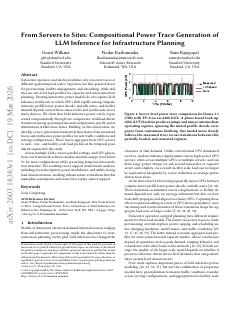
For an AI inference facility, set interconnection capacity from traces generated from the workload, not nameplate TDP or mean power; TDP sizing gave 1.19 MW against 0.75 MW trace-based (about 60% too much).
- Generated facility traces show a peak-to-average ratio of 1.19, a load factor of 0.84 and a maximum 15-minute ramp of 0.11 MW.
Environmental Research: Energy (IOP Publishing) 2025
Empirically-Calibrated H100 Node Power Models for Reducing Uncertainty in AI Training Energy Estimation
Calculate AI training cluster energy and power demand from measured node power (here 7.3-7.79 kW in training, 76% of TDP) rather than TDP; a TDP-based estimate inflated a 20,000-GPU cluster by 19 GWh.
- Even computationally intensive training workloads operated at only 76% of the 10.2 kW node TDP rating.