
Key Questions on Energy and AI (World Energy Outlook Special Report)
Original title Key Questions on Energy and AI
International Energy Agency
The IEA's April 2026 follow-up to Energy and AI. It reports data-centre electricity up 17% in 2025 to 485 TWh with 950 TWh projected for 2030, and covers design effects such as rack power density, battery storage and the overbuild needed for on-site gas generation.
CC BY 4.0 — share with attribution
On this page
Overview
The report gathers new questions and data since the 2025 study around 11 questions: the demand outlook, efficiency, clustering, data-centre design, electricity procurement, on-site generation, financial markets, electricity prices, AI in the energy sector, physical AI and the GDP effect. Capital spending by the largest technology companies exceeded USD 400 billion in 2025 and is expected to jump another 75% in 2026; five companies alone spend more than global oil and gas production investment. IEA satellite tracking shows the capacity of AI factories has more than tripled in 18 months.
On demand: global data-centre electricity grew 17% in 2025 and consumption of AI-focused data centres grew 50%. The central projection is roughly a doubling from 485 TWh in 2025 to 950 TWh in 2030, about 3% of global demand, with AI-focused data-centre consumption tripling. Bottlenecks reduce the likelihood of aggressive near-term scenarios, though an upside case after 2030 is possible. A shortage of high-bandwidth memory is expected to last at least to end-2027. Energy per AI task is falling at least an order of magnitude a year, but video generation, reasoning and agentic tasks can use hundreds or thousands of times more energy per query than simple text.
On design and density, AI factories combine very high power density with sharp swings in IT load. Nvidia's Ampere (2020) used about 400 W chips and 32 chips per rack for about 13 kW per rack, Blackwell uses 1,000 W chips and 72 chips for 130 kW per rack, and the announced Rubin reaches 600 kW per rack, paving the way to 1 MW. AI server power density rose 11 times in 2020-2025 and rises four times more by 2027. Because GPUs run synchronously, large power swings occur from microseconds to minutes, with potential grid-stability effects. 400 V AC-centred transitional architectures will persist, but ultra-dense deployment at scale would give strong incentives for new architectures.
On procurement and on-site generation: the tech sector signed about 40% of global corporate renewable PPAs in 2025, and the SMR offtake pipeline grew from about 25 GW at end-2024 to 45 GW at end-2025 (first projects around 2030). With slow grid connections, about one-fifth of US projects are advancing with on-site natural gas, and IEA analysis finds that reliable on-site gas power for critical, variable load requires overbuilding generation 30-70% relative to demand. By 2030 about 15-27 GW of on-site gas (equivalent to 9-20 GW of demand) and 20-25 GW of data-centre batteries are expected. China holds large shares of power-electronics supply (99% of refined gallium, about 99% of LFP battery manufacturing capacity).
Other conclusions: data-centre emissions double in IEA projections to about 350 Mt in 2035, still about 2% of electricity-sector emissions. Whether data centres raise prices depends on the supply-demand balance and policy: tight systems need new investment, systems with excess supply use capital more efficiently. An AI-driven GDP boost could raise 2035 energy demand by only 1-4%. The largest barrier to AI use in the energy sector is lack of digital skills, and only 10% of global electricity consumption is covered by open electricity data policies.
Key points
- Global data-centre electricity grew 17% in 2025 and AI-focused data-centre consumption grew 50%.
- The central projection is 485 TWh in 2025 to 950 TWh in 2030 (about 3% of global demand); AI-focused consumption triples.
- Capex of the largest technology companies exceeded USD 400 billion in 2025 and is expected to rise 75% in 2026.
- Energy per AI task falls at least an order of magnitude a year; simple text queries use less than a television, but video, reasoning and agentic tasks can use hundreds or thousands of times more.
- Nvidia examples: Ampere about 13 kW per rack, Blackwell 130 kW, announced Rubin 600 kW; by 2027 one advanced rack could peak at the demand of about 65 households.
- AI server power density rose 11 times in 2020-2025 and rises a further four times by 2027.
- Synchronous GPU workloads create power swings from microseconds to minutes; battery storage is critical to supply reliability.
- Reliable on-site gas supply for critical, variable data-centre load requires overbuilding generation by 30-70% relative to demand.
- By 2030 about 20-25 GW of batteries and 15-27 GW of on-site gas could be installed; the SMR offtake pipeline grew from 25 GW to 45 GW.
- Data-centre emissions reach about 350 Mt in 2035, about 2% of power-sector emissions; an AI GDP boost raises 2035 energy demand by only 1-4%.
Using it in design
- For on-site generation sizing, when users choose islanded or behind-the-meter gas, apply an N+x overbuild check (30-70% above load per IEA) and model BESS for AI power swings.
- Support very high-density AI racks (hundreds of kW; 130 kW, 600 kW and beyond) in the rack catalogue.
- In power and cooling design account for synchronous AI load swings (microseconds to minutes) and evaluate UPS and battery sizing against that profile.
- Flag concentration in the power-electronics and battery supply chain (gallium, SiC, ferrite cores, LFP) as a procurement risk.
- For projects delayed by grid connection, compare hybrid solutions (on-site generation and storage, later grid connection) as an option.
Monthly newsletter · free
Keep your reading list current
Once a month: new library sources, changes to Turkish regulations and upcoming data centre events.
SoSo CAD
Compare the cost of design decisions
Evaluate equipment costs, energy expenses and total cost of ownership (TCO) using your inputs and assumptions in SoSo CAD.
Request a demo
Who should read it
Engineers, investors and policy makers designing AI-focused high-density data centres and deciding on power supply and on-site generation.
Document contents
- Executive Summary
- Introduction
- In light of recent market trends, has the IEA adjusted its data centre demand outlook?
- To what extent can efficiency improvements moderate AI electricity growth?
- Are new data centres moving to locations beyond existing clusters?
- How is AI changing data centre design?
- How are data centre operators procuring the electricity they need?
- Why are some data centre developers considering onsite generation?
- What are financial markets telling us about the impact of AI on the energy sector?
- Are data centres raising electricity prices?
- How can AI enhance energy security and sustainability?
- What does the rise of physical AI and robotics mean?
- If AI drives a boom in productivity and GDP, what would it mean for energy demand?
- Annexes
Related standards
- ISO 8528
Read the document
iea-key-questions-energy-ai-2026.pdf
CC BY 4.0 — share with attribution
The document is provided unaltered because its licence permits redistribution.
Publication details
- Authors
- International Energy Agency
- Publisher
- International Energy Agency
- Year
- 2026
- Document language
- English
- Source type
- Government / public
- Access
- Open licence — downloadable
- Licence
- CC BY 4.0 — share with attribution
- Licence evidence
- www.iea.org
Original licence note
Landing page states 'Licence CC BY 4.0'; PDF pages carry 'IEA. CC BY 4.0'. Licence text: https://creativecommons.org/licenses/by/4.0/
Citation
International Energy Agency (2026). Key Questions on Energy and AI. International Energy Agency. https://www.iea.org/files/3179f7f8-01f6-4dd6-bffa-c9f7b73f1dc9/KeyQuestionsonEnergyandAI.pdf
Events on this subject
- Electricity Eurasia 2027
- ELECO 2026 Elektrik-Elektronik ve Biyomedikal Mühendisliği Konferansı
- The smarter E Europe (Intersolar Europe, ees Europe, Power2Drive, EM-Power)
All content and rights belong to the respective authors and publishers. SoSo CAD provides only the citation, its own summary and a link to the source, and is not responsible for the sources' content.
Related sources
All sources on this topic
IEEE Access (Institute of Electrical and Electronics Engineers (IEEE)) 2026
Review of the 800-VDC Power Delivery Architecture and Isolated 800-V to 48-V Converter Solutions for Future AI Data Centers
Define 800 VDC unipolar, ±400 VDC bipolar and 48/54 VDC busbar as separate voltage classes in the single-line diagram, each with its own conductor ampacity, breaker pole count and clearance (IEC 60664-1) checks.
- The OCP Open Rack V3 PSU specification targets above 97.5% peak efficiency and at least 96.5% across 30%-100% load.
IEEE Open Journal of Power Electronics (Institute of Electrical and Electronics Engineers (IEEE)) 2026
State-of-the-Art Power Electronics in AI Data Centers
In rack power templates, model PSU count per shelf and the 33 kW shelf limit for AC distribution, and check busbar, PDU and cooling impact together for racks that exceed 100 kW with several shelves.
- AI rack density is 30-100+ kW against 7-10 kW for traditional racks; an 8-GPU DGX H100 draws around 10,200 W.
arXiv preprint (National Laboratory of the Rockies) 2026
Measurement of Generative AI Workload Power Profiles for Whole-Facility Data Center Infrastructure Planning
Size AI data-centre facility power with measured profiles rather than the rated design: even with all servers utilised, facility power reached only 73-80% of rated design.
- Online inference server power saturated near 2.8 kW at modest request rates.
arXiv preprint (Stanford University / Microsoft Azure Research) 2026
From Servers to Sites: Compositional Power Trace Generation of LLM Inference for Infrastructure Planning
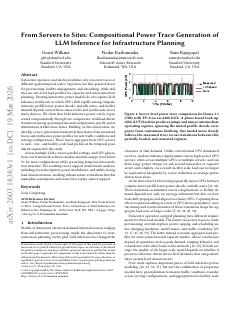
For an AI inference facility, set interconnection capacity from traces generated from the workload, not nameplate TDP or mean power; TDP sizing gave 1.19 MW against 0.75 MW trace-based (about 60% too much).
- Generated facility traces show a peak-to-average ratio of 1.19, a load factor of 0.84 and a maximum 15-minute ramp of 0.11 MW.
Environmental Research: Energy (IOP Publishing) 2025
Empirically-Calibrated H100 Node Power Models for Reducing Uncertainty in AI Training Energy Estimation
Calculate AI training cluster energy and power demand from measured node power (here 7.3-7.79 kW in training, 76% of TDP) rather than TDP; a TDP-based estimate inflated a 20,000-GPU cluster by 19 GWh.
- Even computationally intensive training workloads operated at only 76% of the 10.2 kW node TDP rating.
Electronics (MDPI AG) 2025
Two-Stage Power Delivery Architecture Using Hybrid Converters for Data Centers and Telecommunication Systems
In rack power-chain efficiency calculations, treat the number of stages and each stage's efficiency as separate inputs, and show the benefit of fewer stages at load points (low and high current).
- End to end, direct conversion from about 110 VAC to 1 VDC peaked at 84.1% efficiency at 50 A and fell to 73.5% at 160 A.