
Liquid Cooling Commissioning: Lessons Learned @LRZ (EE HPC WG session, SC13)
Energy Efficient HPC Working Group · Detlef Labrenz
A short LRZ deck from the EE HPC WG session at SC13 on commissioning the warm-water cooling plant for SuperMUC, with the lesson that sensors and controls specified by equipment makers must be enforced through commissioning.
On this page
Overview
This document is a short LRZ presentation given in the EE HPC WG workshop session at SC13 (ACM/IEEE Supercomputing 2013, Denver). Its subject is commissioning the warm-water cooling plant for SuperMUC, an IBM iDataPlex system with direct water cooling. The deck shows LRZ's four temperature-level cooling layout: warm water 30/36 C, cold water 14/20 C, very cold water 4/10 C, plus a glycol/heating loop.
In the first case, unexplained make-up water loss was traced to an incorrectly sized cooling-tower level sensor. The cooling-tower loop has a fill volume of 7 m3 with typical feed above 1 m3/h, and losses of 1-2 m3 over hours to days were observed. The root cause was that the main contractor fitted a level sensor of the wrong dimensions rather than the one recommended by the cooling-tower manufacturer.
The second case was an operating-control test: a -20 K inlet temperature step was applied on one cluster loop, and the response and COP (cooling capacity over power input) of the warm-water plant were tracked. The lesson is that sensors and controls specified by equipment makers must be enforced through commissioning. On the closing slide, LRZ frames efficiency with a four-pillar model: building infrastructure (PUE), system hardware, system software and applications. As a short presentation it contains no detailed measurement data; only the record's summary and key facts were used here.
Key points
- LRZ runs four loops: warm water 30/36 C, cold water 14/20 C, very cold water 4/10 C, plus a glycol/heating loop.
- Cooling-tower loop fill volume is 7 m3 with typical feed above 1 m3/h; losses of 1-2 m3 over hours to days were observed.
- Root cause: the main contractor fitted a level sensor of the wrong dimensions rather than the one recommended by the cooling-tower manufacturer.
- The operating-control test applied a -20 K inlet temperature step on one cluster loop and tracked the warm-water plant response and COP.
- LRZ frames efficiency with four pillars: building infrastructure (PUE), system hardware, system software and applications.
Using it in design
- In commissioning checklists the tool generates for liquid-cooled plants, include verification that instrumentation matches manufacturer specifications.
- Include step-response tests of supply-temperature control in the checklist.
- Make make-up water metering a required point on cooling-tower loops.
Monthly newsletter · free
Keep your reading list current
Once a month: new library sources, changes to Turkish regulations and upcoming data centre events.
SoSo CAD
Bring standards pre-checks into your project
Review model-based TS EN 50600 and Tier pre-checks, missing inputs and items requiring engineering review in SoSo CAD.
Request a demo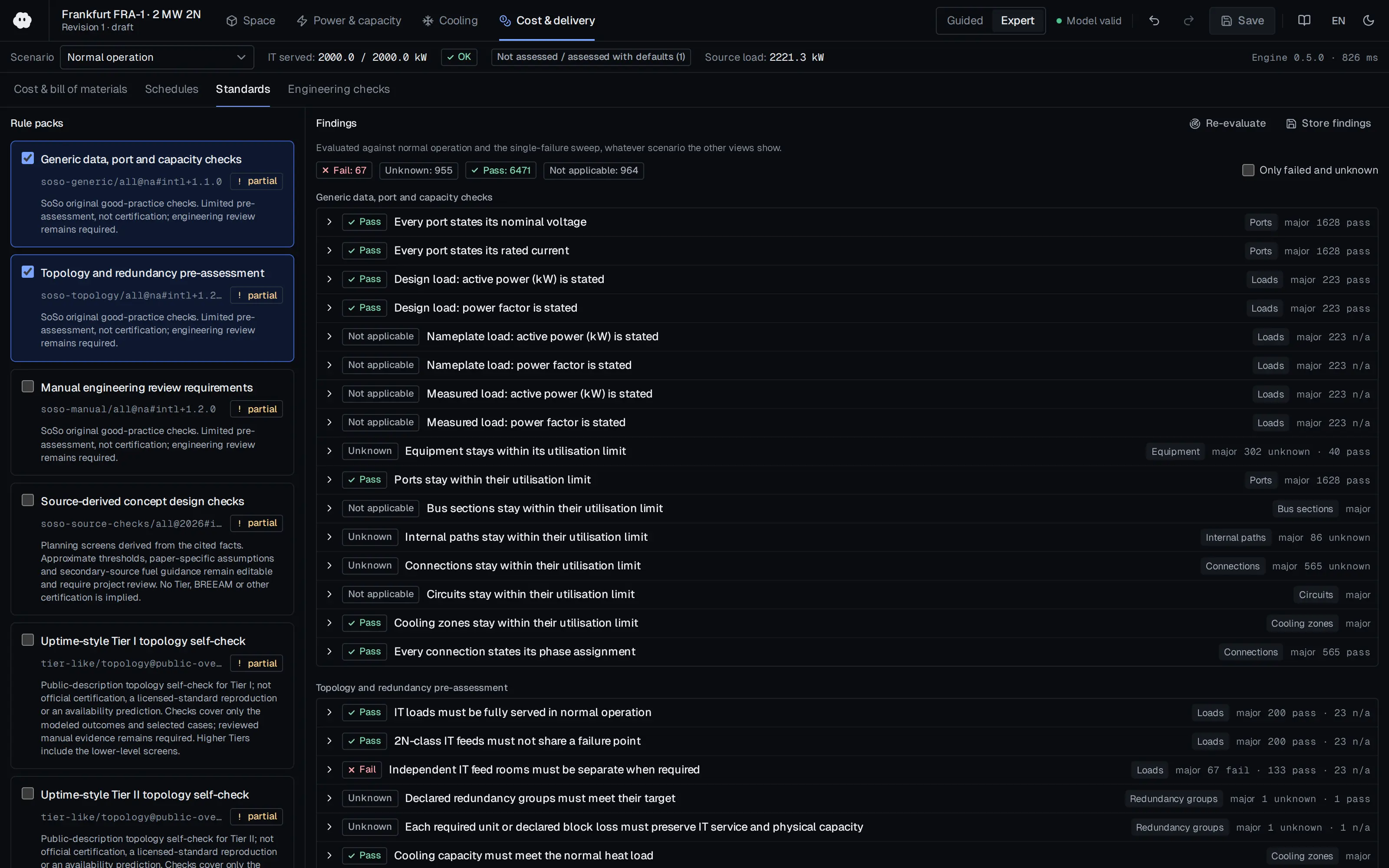
Who should read it
Engineers who commission, operate or specify liquid-cooled plants.
Related standards
- ASHRAE Guideline 0
- ASHRAE Liquid Cooling Guidelines
Publication details
- Authors
- Detlef Labrenz
- Publisher
- Energy Efficient HPC Working Group
- Year
- 2013
- Document number
- SC13 workshop presentation wp135s1
- Event
- SC13 (ACM/IEEE Supercomputing 2013), Denver - EE HPC WG workshop
- Document language
- English
- Source type
- Industry body
- Access
- Free to read
- Licence
- Copyright retained; citation only — the publisher’s terms apply to the original document
Citation
Detlef Labrenz (2013). Liquid Cooling Commissioning: Lessons Learned @LRZ (EE HPC WG session, SC13). Energy Efficient HPC Working Group. SC13 workshop presentation wp135s1. SC13 (ACM/IEEE Supercomputing 2013), Denver - EE HPC WG workshop. https://www.sc13.supercomputing.org/sites/default/files/WorkshopsArchive/pdfs/wp135s1.pdf
Events on this subject
Browse the events calendarAll content and rights belong to the respective authors and publishers. SoSo CAD provides only the citation, its own summary and a link to the source, and is not responsible for the sources' content.
Related sources
All sources on this topic
Open Compute Project Foundation 2023
Guidelines for Using Water-Based Transfer Fluids in Single-Phase Cold Plate-Based Liquid-Cooled Racks
Write the Table 1 targets (TSS, TDS, conductivity, copper and iron, pH, hardness, turbidity, bacteria, azole inhibitor, chloride) into the fluid specification as acceptance criteria and request a certificate of analysis from the supplier.
- pH 8.0-10.5; total hardness below 30 ppm (below 2 ppm for fresh fill); turbidity below 5 NTU.

Open Compute Project Foundation 2022
Leak Detection and Intervention, Revision 1.0 (OCP Advanced Cooling Solutions white paper)
Run a probability-and-impact leak risk analysis at project start, specify BSPP/O-ring joints for serviceable connections and check the O-ring compound against the coolant chemistry using the full wetted-materials list.
- A UQD2 dry-break quick disconnect is specified to drip less than 0.063 cc when disconnected at 200 psi.
Open Compute Project Foundation 2021
Liquid Cooling Integration and Logistics White Paper, Revision 1.0
Add mechanical, hydraulic, electrical and network inspection protocols and a recorded pressure-decay test to the delivery and commissioning plan for rack acceptance.
- Coolant shipped inside L10/L11 systems should be chosen to avoid freezing during transport.
Open Compute Project Foundation Year not stated
Guidelines for Using Propylene Glycol-Based Heat Transfer Fluids in Single-Phase Cold Plate-Based Liquid Cooled Racks (OCP white paper)
Write the PG25 or PG55 choice into the fluid specification according to the freeze protection the climate needs, and record that keeping glycol above 25% by volume removes the need for biocide.
- Maximum corrosion rates under ASTM D8040-17: copper 0.22 mpy (5 mg/coupon), brass 0.46 mpy (10 mg/coupon).
Uptime Institute Journal 2026
IT-agnostic DLC systems: key considerations (Daniel Bizo)
Catalogue DLC loops with coolant type (PG25/DI), filtration rating (default 25 micron) and wetted materials.
- Industry-standard filtration for water DLC networks is 25 microns, usually full-flow at the CDU; side-stream filtration helps in multi-MW networks.
Schneider Electric 2025
Direct Liquid Cooling System Challenges in Data Centers
Use the eight challenges as a DLC readiness checklist in the commissioning and design-review module.
- Heat capture ratio defines the air share: 80% liquid capture leaves 20% for air cooling.