Topic guide

Liquid cooling

Find publications on direct-to-chip cooling, immersion and liquid loops. Investigate temperature conditions, facility interfaces and maintenance requirements for high-density data centre designs.

Sources
153
Downloadable PDFs
48
Years
2011–2026

Start here

Technical guidePDFEditor’s pick

Open Compute Project Foundation 2023

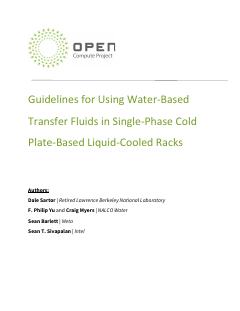
Guidelines for Using Water-Based Transfer Fluids in Single-Phase Cold Plate-Based Liquid-Cooled Racks

Write the Table 1 targets (TSS, TDS, conductivity, copper and iron, pH, hardness, turbidity, bacteria, azole inhibitor, chloride) into the fluid specification as acceptance criteria and request a certificate of analysis from the supplier.

  • pH 8.0-10.5; total hardness below 30 ppm (below 2 ppm for fresh fill); turbidity below 5 NTU.
Monthly newsletter · free

Keep your reading list current

Once a month: new library sources, changes to Turkish regulations and upcoming data centre events.

All sources

1–24 / 153

Technical guidePDFEditor’s pick

Open Compute Project Foundation 2023

Guidelines for Using Water-Based Transfer Fluids in Single-Phase Cold Plate-Based Liquid-Cooled Racks

Write the Table 1 targets (TSS, TDS, conductivity, copper and iron, pH, hardness, turbidity, bacteria, azole inhibitor, chloride) into the fluid specification as acceptance criteria and request a certificate of analysis from the supplier.

  • pH 8.0-10.5; total hardness below 30 ppm (below 2 ppm for fresh fill); turbidity below 5 NTU.
Research paperPDF

Fluids (MDPI AG) 2026

A Review of Thermal Management in Modern Data Centres: Water Usage Effectiveness and Heat Transfer Coefficients

Set WUE targets from the heat-rejection topology (dry, free-cooling, hybrid, evaporative) and not only the server-side cooling technology; WUE depends on the share of heat rejected by evaporation.

  • Dry facilities with closed-loop liquid cooling need essentially no water, while evaporative systems typically report WUE up to 2.5 L/kWh.
Research paperPDF

Technology Review for Carbon Neutrality (Tsinghua University Press) 2025

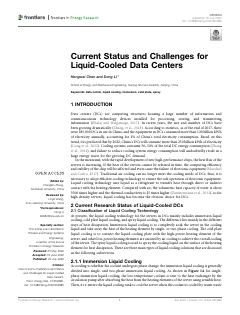
Accelerating liquid cooling adoption in data centers: necessity, challenges and solutions

For racks where GPU/accelerator thermal design power exceeds 1,200 W, take liquid cooling as a mandatory design input, and weigh the initial cost (about 1.9-2.2 times air cooling) against TCO (up to 20% lower after 4 years, vendor figure).

  • Cooling systems in air-cooled data centres consume around 40% of total data-centre energy.
Research paperPDF

Energies (MDPI AG) 2023

Cooling Technologies for Internet Data Center in China: Principle, Energy Efficiency, and Applications

In China, define project design targets from GB 50174-2017 temperature and humidity limits (18-27 °C, dew point 5.5-15 °C, RH at most 60%) and provincial PUE caps (for example Guangdong 1.25).

  • Cooling accounts for about 35-40% of total IDC energy consumption, the second largest consumer after IT equipment.
Research paperPDF

IEEE Transactions on Components, Packaging and Manufacturing Technology (Institute of Electrical and Electronics Engineers (IEEE)) 2021

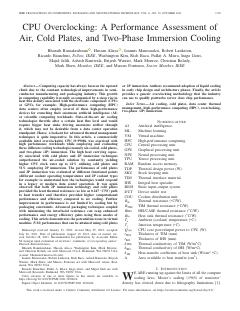
CPU Overclocking: A Performance Assessment of Air, Cold Plates, and Two-Phase Immersion Cooling

For high-heat-flux chips, compare the point at which air cooling throttles (here 3.3-4 GHz) with the clock-rate gain from cold plates or 2P immersion (41-51%) in cooling technology selection.

  • Compared with air cooling, cold plates gave up to 41% and 2P immersion up to 51% higher CPU clock rates.

All content and rights belong to the respective authors and publishers. SoSo CAD provides only the citation, its own summary and a link to the source, and is not responsible for the sources' content.