
Accelerating liquid cooling adoption in data centers: necessity, challenges and solutions
Technology Review for Carbon Neutrality (Tsinghua University Press) · David Zhou, Liguang Du et al.
Intel authors argue that the move from air to liquid cooling in data centres is now unavoidable for AI accelerators, and list what slows it down: higher capital cost, leak and corrosion risk, coolant environmental and chemical concerns, missing standards and a shortage of skilled staff.
CC BY 4.0 — share with attribution
On this page
Overview
The paper states that cooling systems in air-cooled data centres consume around 40% of total data-centre energy, and that optimising cooling strategies is crucial to the world's carbon footprint with the explosive growth of AI. Liquid cooling is described as a must-have when GPU/AI accelerator thermal design power exceeds 1,200 W (for example Nvidia GB300 and beyond). After about 4 years of operation, TCO with liquid cooling can be up to 20% lower than with air cooling (a cited vendor figure).
Challenges: for a typical deployment where 80% of rack heat is removed by liquid, initial cost of liquid cooling is about 1.9-2.2 times that of air cooling (citing a Schneider Electric analysis). Some polymers and elastomers absorb corrosion inhibitors from the coolant, lowering inhibitor concentration and accelerating corrosion of wetted materials. Immersion liquids should meet their property specifications under operating conditions for 10 years. Leak risk, lack of standards and a skilled-workforce shortage are also listed.
The proposed fixes are modular component-level liquid-cooled design, better cold plates (additive-manufactured and two-phase), negative-pressure CDUs, AI-driven pump, valve and temperature control, and interoperability programmes such as standardised universal quick disconnects (UQDs). Electrochemical additive-manufactured cold plates showed 21% lower thermal resistance and 201% better thermal uniformity than a straight-microchannel baseline (a cited study). A negative-pressure (vacuum) CDU makes any leak draw air into the loop instead of spilling coolant.
Limits: the paper is a short perspective rather than an experimental study; its numbers are cited from other sources and include vendor figures. The conclusion is that liquid cooling is critical for the rising power consumption and carbon emissions of GPUs and AI accelerators, but cost, leakage risk, standardisation and workforce shortages hinder adoption.
Key points
- Cooling systems in air-cooled data centres consume around 40% of total data-centre energy.
- Liquid cooling is described as a must-have when GPU/AI accelerator thermal design power exceeds 1,200 W (for example Nvidia GB300 and beyond).
- After about 4 years of operation, TCO with liquid cooling can be up to 20% lower than with air cooling (cited vendor figure).
- For a typical deployment where 80% of rack heat is removed by liquid, the initial cost of liquid cooling is about 1.9-2.2 times that of air cooling (citing a Schneider Electric analysis).
- Some polymers and elastomers absorb corrosion inhibitors from the coolant, lowering inhibitor concentration and accelerating corrosion of wetted materials.
- Immersion liquids should meet their property specifications under operating conditions for 10 years.
- Electrochemical additive-manufactured cold plates showed 21% lower thermal resistance and 201% better thermal uniformity than a straight-microchannel baseline (cited study).
- A negative-pressure (vacuum) CDU makes any leak draw air into the loop instead of spilling coolant.
Using it in design
- For racks where GPU/accelerator thermal design power exceeds 1,200 W, take liquid cooling as a mandatory design input, and weigh the initial cost (about 1.9-2.2 times air cooling) against TCO (up to 20% lower after 4 years, vendor figure).
- Add a negative-pressure CDU for leak risk and wetted-material compatibility (polymers absorbing corrosion inhibitor) to the design specification.
- Consider standardisation and interoperability (UQD) requirements in supplier selection for quick disconnects and coolant.
Monthly newsletter · free
Keep your reading list current
Once a month: new library sources, changes to Turkish regulations and upcoming data centre events.
SoSo CAD
Check cooling capacity alongside your design
Review zone heat loads, available capacity and the capacity balance after the largest unit is lost in SoSo CAD.
Request a demo
Who should read it
Designers and investment decision makers deciding the move from air to liquid cooling for AI racks.
Document contents
- 1. Necessity of transitioning from air cooling to liquid cooling
- 2. Challenges of deploying liquid cooling
- 3. Solutions (3.1 Advance new liquid cooling design, 3.2 Utilize AI-assisted liquid cooling, 3.3 Build data center liquid cooling ecosystem)
- 4. Conclusion
Related standards
- OCP ACS cold plate requirements
- OCP immersion fluid base specification
- ASHRAE TC 9.9
Read the document
accelerating-liquid-cooling-adoption-2025.pdf
CC BY 4.0 — share with attribution
The document is provided unaltered because its licence permits redistribution.
Publication details
- Authors
- David Zhou; Liguang Du; Ran Xu; Jiqiang Song; Na Chen; Shanshan Zheng; Yuehong Fan
- Publisher
- Technology Review for Carbon Neutrality (Tsinghua University Press)
- Year
- 2025
- Pages
- 9550014
- Document language
- English
- Source type
- Scientific
- Access
- Open licence — downloadable
- Licence
- CC BY 4.0 — share with attribution
- Licence evidence
- doi.org
Original licence note
Article states it is open access under a Creative Commons Attribution (CC BY / CC BY 4.0) licence (verified in PDF text).
Citation
David Zhou; Liguang Du; Ran Xu; Jiqiang Song; Na Chen; Shanshan Zheng; Yuehong Fan (2025). Accelerating liquid cooling adoption in data centers: necessity, challenges and solutions. Technology Review for Carbon Neutrality (Tsinghua University Press). 9550014. https://doi.org/10.26599/trcn.2025.9550014
Events on this subject
Browse the events calendarAll content and rights belong to the respective authors and publishers. SoSo CAD provides only the citation, its own summary and a link to the source, and is not responsible for the sources' content.
Related sources
All sources on this topic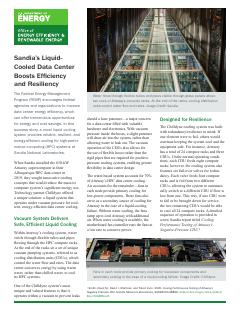
U.S. DOE FEMP 2021
Sandia's Liquid-Cooled Data Center Boosts Efficiency and Resiliency (FEMP success story, DOE/GO-102021-5582, July 2021)
Consider negative-pressure (vacuum) distribution as an option for reducing leak risk in direct liquid cooling; flexible hoses give layout flexibility.
- The system kept CPUs below 50 °C (122 °F); each CDU draws 3.4 kW at full load, about 1.6% of total system power.
STULZ 2026
Liquid Cooling Whitepaper - End-to-End Cooling: The Key to Resilient AI Data Centers
In the liquid-cooling module size TCS flow at about 1.5 L/min/kW by default and store CDU approach temperature and external static pressure.
- Rack heat densities from about 125 kW today to beyond 500 kW.
Huawei Digital Power 2024
Top 10 Trends of Data Center Facility 2024 White Paper
For lithium BESS/UPS rooms, require detection and segregation sized for a 30-60 s runaway escalation.
- Rack power expected to rise from 6-8 kW to 30-40 kW.
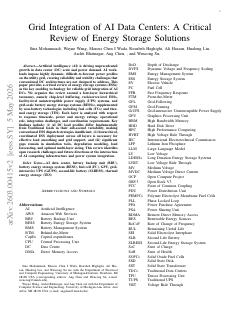
arXiv preprint (University of Michigan) 2026
Grid Integration of AI Data Centers: A Critical Review of Energy Storage Solutions (arXiv preprint)
Layer storage by timescale (chip/server sub-ms to ms, rack ms to seconds, UPS and GiUPS sub-second to 10 s, BESS minutes to hours) and show each layer's duty in the coordination scheme.
- Rapid AI load variations often induce 5-10% voltage swings within milliseconds.
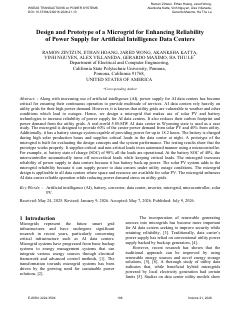
WSEAS TRANSACTIONS ON POWER SYSTEMS (World Scientific and Engineering Academy and Society (WSEAS)) 2026
Design and Prototype of a Microgrid for Enhancing Reliability of Power Supply for Artificial Intelligence Data Centers
Follow the energy-balance chain in a PV/BESS sizing helper (daily load split, conversion losses, usable depth of discharge, power rating against night peak); report usable-energy duration rather than nameplate duration and make DoD an explicit input.
- Covering 60% of demand needs 81,857 kWh/day from PV after 5% DC-AC and 10% battery losses.
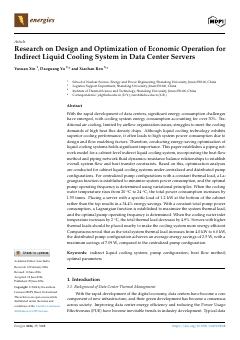
Energies (MDPI AG) 2026
Research on Design and Optimization of Economic Operation for Indirect Liquid Cooling System in Data Center Servers
In in-cabinet liquid cooling, place high-load servers near the supply side; locating a 1.2 kW server at the bottom cut total power by 34.4%.
- Cooling system energy is cited as accounting for over 30% of data-centre energy consumption.