Topic guide

Fire safety

Find references on fire detection, suppression and data centre fire safety. Implementation requires the original publication, project conditions and assessment by the responsible qualified specialists.

Sources
56
Downloadable PDFs
20
Years
2007–2026

Start here

Research paperPDF

Energies (MDPI AG) 2020

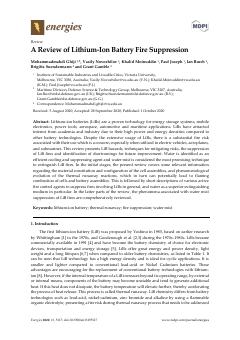
A Review of Lithium-Ion Battery Fire Suppression

In Li-ion UPS and BESS areas, set up detection with combined smoke-heat detectors; do not rely on heat detectors alone.

  • In DNV-GL tests, F500, FireIce, PyroCool foam, Stat-X aerosol and sprinklers all extinguished the fires, but the water-based systems cooled better over time.

Monthly newsletter · free

Keep your reading list current

Once a month: new library sources, changes to Turkish regulations and upcoming data centre events.

All sources

1–24 / 56

Research paperPDF

Energies (MDPI AG) 2020

A Review of Lithium-Ion Battery Fire Suppression

In Li-ion UPS and BESS areas, set up detection with combined smoke-heat detectors; do not rely on heat detectors alone.

  • In DNV-GL tests, F500, FireIce, PyroCool foam, Stat-X aerosol and sprinklers all extinguished the fires, but the water-based systems cooled better over time.
Technical guideFree to read

Consulting-Specifying Engineer 2016

Applying NFPA 75 in data centers

Define the IT room default as 1-hour separation, 3/4-hour doors and fire and smoke dampers at penetrations.

  • Doors in the separation must be 3/4-hour rated.
Research paperPDF

Journal of Physics: Conference Series (IOP Publishing) 2018

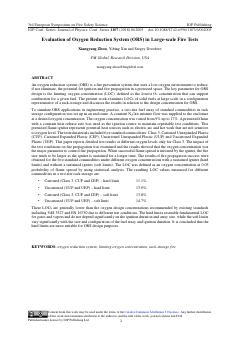
Evaluation of Oxygen Reduction System (ORS) in Large-scale Fire Tests

Compare ORS design concentration with the 15-16% standard-test values in VdS 3527 and EN 16750; since large-scale hard-limit LOCs (11.1% for cartoned commodities, 13.0% for uncartoned plastics) are lower, justify the design safety margin against them.

  • Earlier lab work found LOCs of 10-13% for cardboard, wood, PS and PE, below the 15-16% range from standard tests in VdS 3527 and EN 16750:2017.
Research paperPDF

Batteries (MDPI AG) 2025

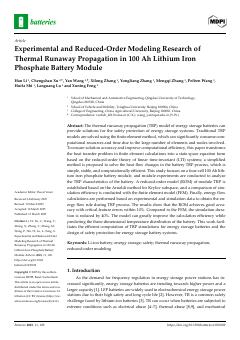
Experimental and Reduced-Order Modeling Research of Thermal Runaway Propagation in 100 Ah Lithium Iron Phosphate Battery Module

In LFP module design, evaluate inter-cell thermal resistance (interface insulation) together with measures that cut heat release to stop propagation; in the model an interface resistance of hR = 100 W·m^-2·K^-1 alone suppressed it.

  • Venting phases (vent opening to runaway) lasted 204 s, 399 s, 156 s and 309 s for cells 1-4.
Research paperPDF

Batteries (MDPI AG) 2026

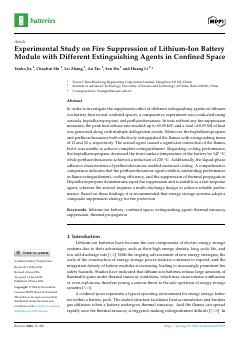
Experimental Study on Fire Suppression of Lithium-Ion Battery Module with Different Extinguishing Agents in Confined Space

For confined battery packs and cabinets, evaluate a fast flame-knockdown agent (such as heptafluoropropane) together with an agent or approach giving long-lasting cooling (such as perfluorohexanone); no single agent stopped heat transfer to neighbouring cells.

  • Without suppression, peak HRR reached 69.09 kW and total heat release was 8.05 MJ, with multiple deflagrations after venting in the confined space.
White paperFree to read

Schneider Electric 2018

FAQs for Using Lithium-ion Batteries with a UPS

Battery catalog: chemistry (VRLA, LFP, NMC, LMO, NCA, LTO, LCO), specific energy, design and cycle life, rated temperature, footprint and weight per kWh, recharge time and compatible UPS models.

  • Li-ion takes 50-80% less floor space and weighs 60-80% less.
White paperFree to read

Schneider Electric 2013

Implementing Hot and Cold Air Containment in Existing Data Centers

Build a retrofit wizard asking aisle arrangement (hot/cold yes/no), raised floor (yes/no, depth), drop-ceiling return (yes/no), rack-top-to-ceiling clearance (mm), columns in rows, overhead cabling and existing cooler type, mapped to one of the six containment types.

  • Containment raises cooling-unit deltaT and can add about 20% or more cooling capacity.

All content and rights belong to the respective authors and publishers. SoSo CAD provides only the citation, its own summary and a link to the source, and is not responsible for the sources' content.