
Fire protection systems to ensure safety for data centers (roundtable)
Consulting-Specifying Engineer · Chris Barth, Jarron Gass et al.
A 2025 roundtable in which practising fire protection and mechanical engineers discuss current data centre fire protection, with battery storage, UPS, suppression methods and detection in focus.
On this page
Overview
In this roundtable, practising fire protection and mechanical engineers discuss current fire protection practice in data centres. It was published in Consulting-Specifying Engineer in 2025. Participants identify battery energy storage and rack-level UPS as drivers for larger fire pumps, water storage and sprinkler density, often via local code amendments. The roundtable format places the experience of practitioners from different disciplines side by side, and the results are practice trends rather than firm rules.
Large centralized battery banks and rack UPS can force larger fire pumps, more on-site water storage and bigger sprinkler mains. Local amendments for electrochemical storage commonly demand sprinkler densities above base code values, so the adopted code should be re-checked throughout design. This means fire-water infrastructure needs to be accounted for early in data centre design. Local code amendments should be verified separately on each project.
Suppression methods are compared: recent projects favour water-based single- and double-interlock pre-action over clean agent systems, and these now dominate new projects. Water mist (NFPA 750) reduces water damage but costs more and may be less reliable in large fires. On detection, VESDA aspirating detection is far more common in data centres than standard spot detection, with calibration needed to avoid HVAC-induced false alarms. Participants also mention compartmentation and BIM coordination. The piece is a freely accessible expert-opinion article, not an official standard or calculation method. Only the record's summary and key facts were used here.
Key points
- Large centralized battery banks and rack UPS can force larger fire pumps, more on-site water storage and bigger sprinkler mains.
- Local amendments for electrochemical storage commonly demand sprinkler densities above base code values; re-check the adopted code throughout design.
- Recent projects favour water-based single- and double-interlock pre-action over clean agent systems.
- Water mist (NFPA 750) reduces water damage but costs more and may be less reliable in large fires.
- VESDA aspirating detection is far more common in data centres than standard spot detection; calibration is needed to avoid HVAC-induced false alarms.
Using it in design
- Make pre-action (single or double interlock) with aspirating detection the default white-space suppression option; keep clean agent and water mist selectable.
- When Li-ion UPS or BESS rooms are added, prompt for jurisdiction amendments.
- Increase sprinkler and fire-water demand estimates for those rooms.
- Plan aspirating-detection calibration together with HVAC airflow.
Monthly newsletter · free
Keep your reading list current
Once a month: new library sources, changes to Turkish regulations and upcoming data centre events.
SoSo CAD
Bring standards pre-checks into your project
Review model-based TS EN 50600 and Tier pre-checks, missing inputs and items requiring engineering review in SoSo CAD.
Request a demo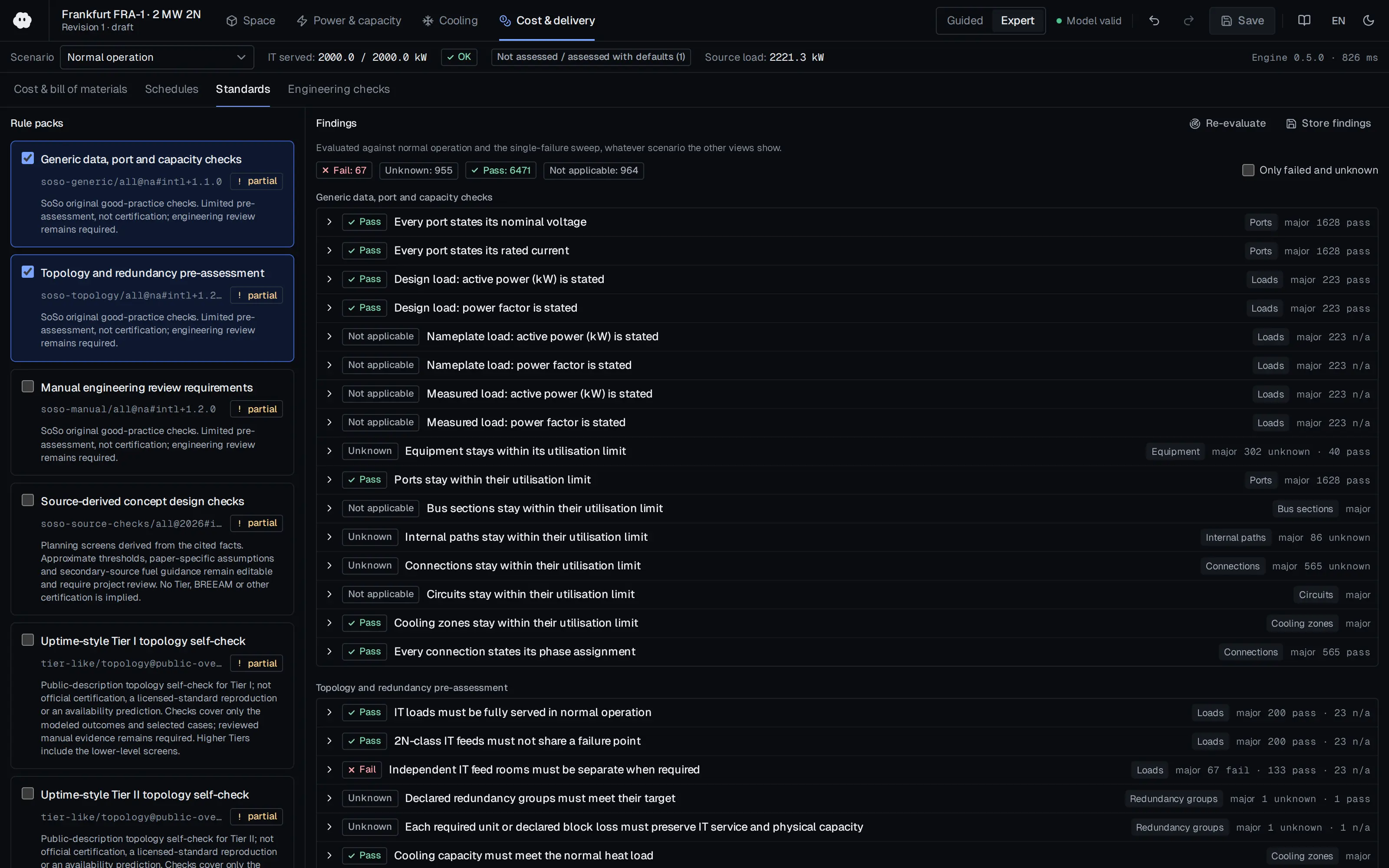
Who should read it
Engineers designing data centre fire protection, UPS and battery rooms.
Related standards
- NFPA 75
- NFPA 750
- NFPA 13
Publication details
- Authors
- Chris Barth; Jarron Gass; William Kosik; Corey Wallace
- Publisher
- Consulting-Specifying Engineer
- Year
- 2025
- Document language
- English
- Source type
- Expert / community
- Access
- Free to read
- Licence
- Copyright retained; citation only — the publisher’s terms apply to the original document
Citation
Chris Barth; Jarron Gass; William Kosik; Corey Wallace (2025). Fire protection systems to ensure safety for data centers (roundtable). Consulting-Specifying Engineer. https://www.csemag.com/fire-protection-systems-to-ensure-safety-for-data-centers/
Events on this subject
- Electricity Eurasia 2027
- The smarter E Europe (Intersolar Europe, ees Europe, Power2Drive, EM-Power)
- ISAF International 2027
All content and rights belong to the respective authors and publishers. SoSo CAD provides only the citation, its own summary and a link to the source, and is not responsible for the sources' content.
Related sources
All sources on this topic
Fire (MDPI AG) 2026
Probabilistic Risk Assessment of Grid-Scale Lithium-Ion Battery Energy Storage System Fire Hazards: Hydrogen Fluoride (HF) Toxicity, Suppression Effectiveness, and Comparative Compartment Design Analysis
Compare BESS compartmentation quantitatively: two compartments halve HF dose and IDLH clearance time, but IDLH is still exceeded for anyone in the room in full thermal runaway, so runaway prevention (BMS integrity, UL 9540A containment, emergency power off) must stay the primary control.
- Mean IDLH (25 mg/m³) clearance time with 9 ACH was 599 min for one compartment and 301 min for two; the probability of clearing within 5 min was 0% for both.
Batteries (MDPI AG) 2026
Numerical Study on Effect of Ventilation on Fire Characteristics of Lithium-Ion Battery in Energy Storage Cabin
Define a designed, buoyancy-driven vent or relief path at the top of a storage cabinet; in a closed cabinet H2 forms a flammable layer under the roof, so control gas and heat build-up.
- H2 rose quickly and formed a growing flammable layer under the roof of the closed cabinet.
Batteries (MDPI AG) 2026
Experimental Study on Fire Suppression of Lithium-Ion Battery Module with Different Extinguishing Agents in Confined Space
For confined battery packs and cabinets, evaluate a fast flame-knockdown agent (such as heptafluoropropane) together with an agent or approach giving long-lasting cooling (such as perfluorohexanone); no single agent stopped heat transfer to neighbouring cells.
- Without suppression, peak HRR reached 69.09 kW and total heat release was 8.05 MJ, with multiple deflagrations after venting in the confined space.
Open Compute Project Foundation 2026
White Paper: Requirements for Energy Storage Systems Used in Data Centers, Revision 1.0, Version 1.0 (OCP Ready Facilities, January 2026)
Fix the ESS architecture (DC or AC coupled, distributed or centralised, backup-only or grid-interactive), write the applicable NFPA 70, NFPA 855 and IEC 62933 parts into the design basis, and consult the authority having jurisdiction (AHJ) early.
- FM Global DS 5-33 (as cited) recommends battery installations in rooms with at least a 2-hour fire rating.
Batteries (MDPI AG) 2025
Experimental and Reduced-Order Modeling Research of Thermal Runaway Propagation in 100 Ah Lithium Iron Phosphate Battery Module
In LFP module design, evaluate inter-cell thermal resistance (interface insulation) together with measures that cut heat release to stop propagation; in the model an interface resistance of hR = 100 W·m^-2·K^-1 alone suppressed it.
- Venting phases (vent opening to runaway) lasted 204 s, 399 s, 156 s and 309 s for cells 1-4.
IEEE Open Journal of Industry Applications (Institute of Electrical and Electronics Engineers (IEEE)) 2025
Study of DC Arc Flash Phenomenon From 1000 V Lithium Ion Battery Systems
In arc flash estimation for high-voltage battery rooms, do not use the maximum-power method alone with an enclosure multiplier; cross-check unrealistic results with measurement-based models such as Ammerman's.
- 91 arc-flash experiments were performed on LFP and LTO lithium-ion battery sources at voltages up to roughly 1000 VDC.