
NFPA 2001, Standard on Clean Agent Fire Extinguishing Systems
NFPA · National Fire Protection Association
The NFPA standard for total-flooding and local-application clean agent systems, the typical suppression choice for data halls and electrical rooms.
On this page
Overview
NFPA 2001 is the standard for clean agent fire extinguishing systems. The text of the standard is therefore not reproduced here; what is given is the scope and edition information stated on the page. Systems of this kind are regarded as the typical suppression choice for data halls and electrical rooms.
The standard covers total-flooding and local-application clean agent (gaseous) systems. Its audience is broad: those who buy, design, install, test, inspect, approve, operate or maintain engineered or pre-engineered systems. This shows that the standard speaks not only to the designer but to every stakeholder across the system's life cycle. This wide audience also makes it natural to cite the standard for commissioning and periodic maintenance of the system.
On edition status, the current edition is 2025 and the next edition is 2028. The next edition falls in the Fall 2027 revision cycle and is listed on the page as accepting public comment. This is a reminder that the standard is updated at regular intervals and that designers should confirm the edition in force at the start of a project.
The limit of the record is that it holds no numerical requirements on agent types, design concentrations or discharge times; only scope and edition information is present. Related standards include ISO 14520-1, NFPA 75 and EN 15004. The source should be used as a starting point to establish which standard applies to which type of system, and the full text of the standard must be consulted for calculation and approval.
Key points
- Title: Standard on Clean Agent Fire Extinguishing Systems.
- Current edition 2025; next edition 2028.
- Covers total flooding and local application clean agent systems.
- Intended for purchasers, designers, installers, testers, inspectors, approvers, operators and maintainers of engineered or pre-engineered systems.
- The next edition is in the Fall 2027 revision cycle and is listed as accepting public comment.
- Related standards: ISO 14520-1, NFPA 75, EN 15004.
Using it in design
- In a suppression calculator, compute agent quantity from protected volume, design concentration and minimum room temperature.
- Add room-integrity (hold time) and over-pressure venting checks.
- Store the agent type to switch between NFPA 2001 and ISO 14520 parameters.
- Confirm the edition in force at the start of the project.
Monthly newsletter · free
Keep your reading list current
Once a month: new library sources, changes to Turkish regulations and upcoming data centre events.
SoSo CAD
Bring standards pre-checks into your project
Review model-based TS EN 50600 and Tier pre-checks, missing inputs and items requiring engineering review in SoSo CAD.
Request a demo
Who should read it
Engineers and fire safety specialists who design, approve and operate suppression systems for data halls and electrical rooms.
Related standards
- ISO 14520-1
- NFPA 75
- EN 15004
Publication details
- Authors
- National Fire Protection Association
- Publisher
- NFPA
- Year
- 2025
- Document number
- NFPA 2001
- Document language
- English
- Source type
- Standard
- Access
- Citation only
- Licence
- Copyright retained; citation only — the publisher’s terms apply to the original document
Original licence note
NFPA codes are copyrighted; free read-only access requires an NFPA account, purchase otherwise. Record uses only the public NFPA development page.
Citation
National Fire Protection Association (2025). NFPA 2001, Standard on Clean Agent Fire Extinguishing Systems. NFPA. NFPA 2001. https://www.nfpa.org/codes-and-standards/nfpa-2001-standard-development/2001
Events on this subject
Browse the events calendarAll content and rights belong to the respective authors and publishers. SoSo CAD provides only the citation, its own summary and a link to the source, and is not responsible for the sources' content.
Related sources
All sources on this topicNFPA 2026
NFPA 855, Standard for the Installation of Stationary Energy Storage Systems
In battery room design, require ESS hazard-mitigation items when Li-ion UPS or BESS energy exceeds a configurable threshold.
- Current edition 2026; next edition 2029.
NFPA 2025
NFPA 72, National Fire Alarm and Signaling Code
In the fire module (US profile), place detectors per room type.
- Current edition is 2025; the next edition is 2028.
NFPA 2024
NFPA 75: Standard for the Fire Protection of Information Technology Equipment
Defaults for white space in NFPA jurisdictions: 1-hour rated walls, 3/4-hour doors and rated fire/smoke dampers at penetrations.
- The Chapter 4 risk assessment can justify alternative protection.
NFPA 2024
NFPA 76: Standard for the Fire Protection of Telecommunications Facilities
When the user selects VEWFD, auto-place aspirating sampling ports at no more than 200 ft2 (18.6 m2) each and check from pipe length that transport time is under 60 s.
- Three detection levels: VEWFD, EWFD and standard (NFPA 72) detection.
Fire (MDPI AG) 2026
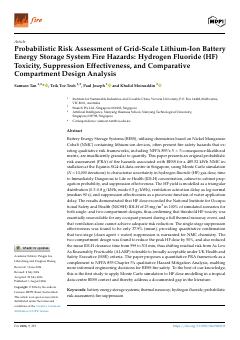
Probabilistic Risk Assessment of Grid-Scale Lithium-Ion Battery Energy Storage System Fire Hazards: Hydrogen Fluoride (HF) Toxicity, Suppression Effectiveness, and Comparative Compartment Design Analysis
Compare BESS compartmentation quantitatively: two compartments halve HF dose and IDLH clearance time, but IDLH is still exceeded for anyone in the room in full thermal runaway, so runaway prevention (BMS integrity, UL 9540A containment, emergency power off) must stay the primary control.
- Mean IDLH (25 mg/m³) clearance time with 9 ACH was 599 min for one compartment and 301 min for two; the probability of clearing within 5 min was 0% for both.
Fire (MDPI AG) 2026
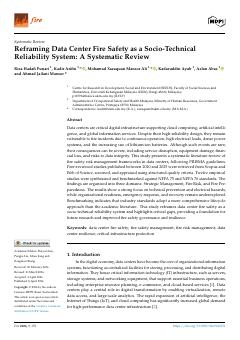
Reframing Data Center Fire Safety as a Socio-Technical Reliability System: A Systematic Review
Ask for a fire-safety design file that covers a lifecycle plan (aligned with NFPA 75 and NFPA 76) including emergency response, damage control and post-fire recovery, not only prevention and suppression.
- The search found 806 records (Scopus 330, Web of Science 476); twelve empirical studies were synthesised and benchmarked against NFPA 75 and NFPA 76.