
NFPA 76: Standard for the Fire Protection of Telecommunications Facilities
NFPA
The NFPA standard for fire protection and life safety in telecom facilities including service continuity, notable for its three detection levels and per-port coverage limits.
On this page
Overview
NFPA 76 is the NFPA standard covering fire protection and life safety in telecommunications facilities together with protection of service continuity. Read-only access after registration is free but the text has not been downloaded; the numbers here come from publicly available vendor summaries. Its distinctive feature is splitting detection into three levels: Very Early Warning Fire Detection (VEWFD), Early Warning Fire Detection (EWFD) and Standard Fire Detection (NFPA 72).
For VEWFD, the alert level is at most 0.2 %/ft obscuration and the alarm at most 1.0 %/ft, with at most 200 ft2 (18.6 m2) per port/sensor and a transport time under 60 s. For EWFD, alarm sensitivity is at most 1.5 %/ft, coverage at most 400 ft2 (37.2 m2) per port/sensor and transport time under 90 s. In two-level (high and low) port arrangements each level is limited to 400 ft2 per port.
These figures allow tighter spacing than NFPA 72 spot detectors, and aspirating smoke detection is the usual way to reach VEWFD. The practical consequence is that pipe length is not just a cost item but a transport-time criterion: a pipe network exceeding 60 s does not qualify as VEWFD. The record covers detection only; the standard's suppression and structural provisions are not on this page.
Key points
- Three detection levels: VEWFD, EWFD and standard (NFPA 72) detection.
- VEWFD: alert <= 0.2 %/ft, alarm <= 1.0 %/ft; max 200 ft2 (18.6 m2) per port; transport time < 60 s.
- EWFD: alarm sensitivity <= 1.5 %/ft; max 400 ft2 (37.2 m2) per port; transport time < 90 s.
- Two-level (high and low) port arrangements: each level limited to 400 ft2 per port.
- Aspirating smoke detection is the usual means of achieving VEWFD.
Using it in design
- When the user selects VEWFD, auto-place aspirating sampling ports at no more than 200 ft2 (18.6 m2) each and check from pipe length that transport time is under 60 s.
- For EWFD apply the 400 ft2 (37.2 m2) per port and 90 s limits.
- Offer VEWFD as the default for Tier III/IV-intent white space and telecom rooms.
Monthly newsletter · free
Keep your reading list current
Once a month: new library sources, changes to Turkish regulations and upcoming data centre events.
SoSo CAD
Bring standards pre-checks into your project
Review model-based TS EN 50600 and Tier pre-checks, missing inputs and items requiring engineering review in SoSo CAD.
Request a demo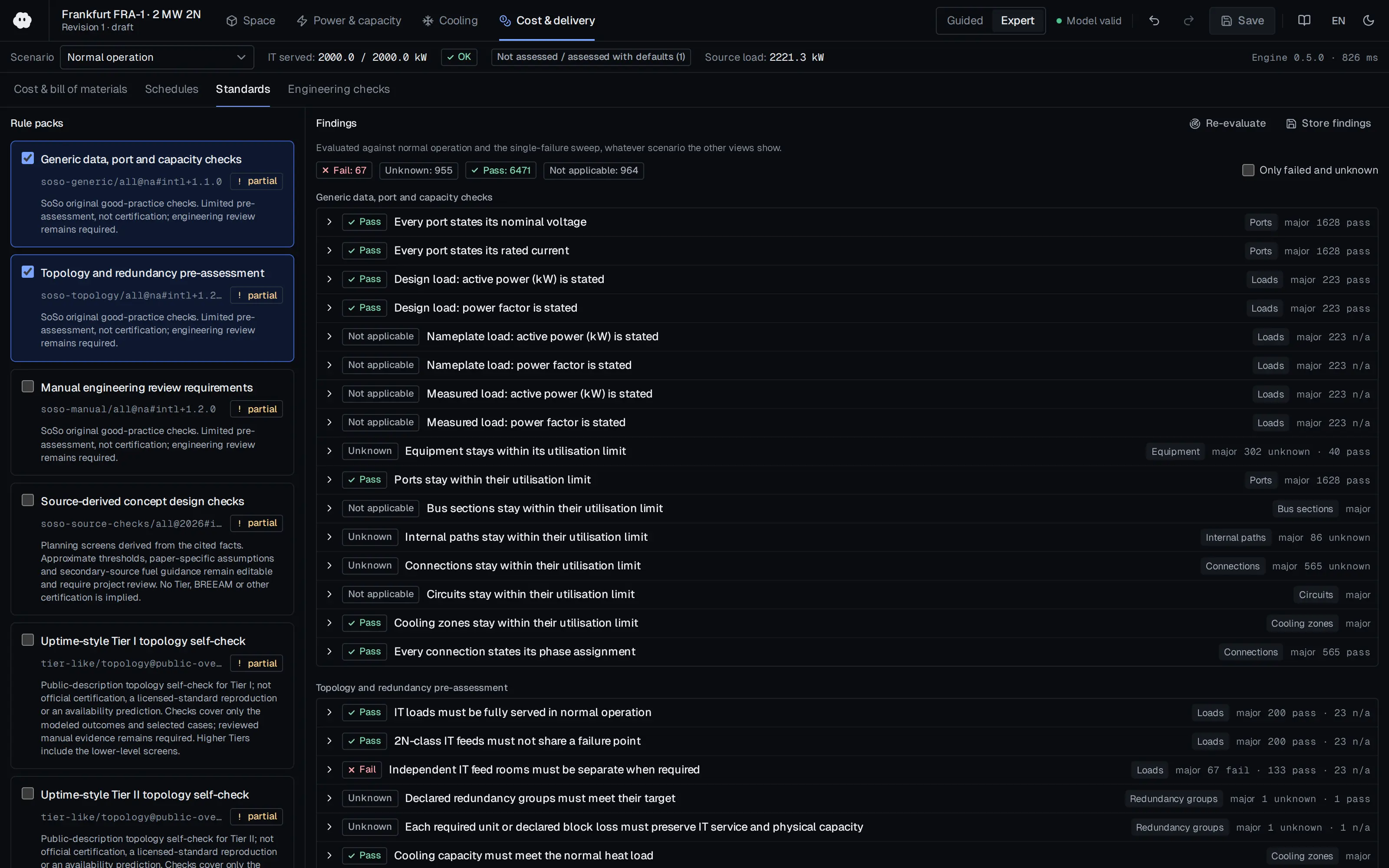
Who should read it
Engineers designing early-warning detection for telecom rooms and high-redundancy white space.
Related standards
- NFPA 76
- NFPA 72
- NFPA 75
Publication details
- Authors
- NFPA
- Publisher
- NFPA
- Year
- 2024
- Document number
- NFPA 76-2024
- Document language
- English
- Source type
- Standard
- Access
- Citation only
- Licence
- Copyright retained; citation only — the publisher’s terms apply to the original document
Citation
NFPA (2024). NFPA 76: Standard for the Fire Protection of Telecommunications Facilities. NFPA. NFPA 76-2024. https://www.nfpa.org/codes-and-standards/nfpa-76-standard-development/76
Events on this subject
Browse the events calendarAll content and rights belong to the respective authors and publishers. SoSo CAD provides only the citation, its own summary and a link to the source, and is not responsible for the sources' content.
Related sources
All sources on this topicNFPA 2024
NFPA 75: Standard for the Fire Protection of Information Technology Equipment
Defaults for white space in NFPA jurisdictions: 1-hour rated walls, 3/4-hour doors and rated fire/smoke dampers at penetrations.
- The Chapter 4 risk assessment can justify alternative protection.
U.S. DoD (UFC) 2021
UFC 3-600-01, Fire Protection Engineering for Facilities (8 August 2016, Change 6, 6 May 2021)
Build the data hall protection concept in this order: very early warning smoke detection, wet-pipe sprinklers throughout, clean agent only as an addition, and state in the specification that clean agent cannot replace the sprinklers.
- Stand-alone telecommunication facilities over 2,500 ft2 (232 m2) need clean agent or sprinklers; over 7,500 ft2 (696 m2) sprinklers are required and clean agent may only be added.
BICSI 2024
ANSI/BICSI 002-2024, Data Center Design and Implementation Best Practices (overview page)
Offer BICSI classes as an alternate standards profile alongside Uptime/TIA/EN, with an F1~Tier I/Rated-1/Class 1 ... F4~Tier IV/Rated-4/Class 4 table labelled 'conceptual equivalence only'
- A 2010 draft used F0-F5; current editions use F0-F4
ISO/IEC 2024
Information technology - Data centre facilities and infrastructures - Part 2: Building construction
In the site module, build a site-risk checklist keyed to the chosen protection class: flood, seismic, adjacent hazards and access routes.
- Conformance is covered in Clause 4.
Telecommunications Industry Association 2024
ANSI/TIA-942 Telecommunications Infrastructure Standard for Data Centers — TIA overview page
In a 'TIA-942' standards profile, let users pick a rating per discipline (for example electrical Rated-3, mechanical Rated-3, telecom Rated-2)
- 'Tier' terminology replaced by 'Rated 1-4' after an agreement with Uptime; the schemes are not interchangeable
Uptime Institute Journal (Uptime Institute) 2021
Learning from the OVHcloud data center fire
Separate UPS and battery rooms with fire-rated barriers.
- NFPA 75 and NFPA 76 are the related standards.