
ANSI/TIA-942 Telecommunications Infrastructure Standard for Data Centers — TIA overview page
Telecommunications Industry Association · Telecommunications Industry Association (TIA)
TIA's public page presenting the ANSI-accredited, vendor-neutral TIA-942 standard and its certification programme. Four 'Rated' levels apply to each discipline separately.
On this page
Overview
TIA-942 covers data centre telecommunications cabling, spaces, and the supporting architectural, electrical, mechanical, fire and security infrastructure. It applies to enterprise, colocation, hyperscale, edge and modular data centres. The current revision is ANSI/TIA-942-C (2024); this record rests on the public page and the full text was not read. The rating system has four levels: Rated-1 Basic, Rated-2 Redundant Component (N+1 on a single path), Rated-3 Concurrently Maintainable (multiple paths) and Rated-4 Fault Tolerant.
A level is awarded per discipline across telecom, architectural, electrical and mechanical, so a site can be Rated-3 for electrical and Rated-2 for telecom. The certification types are Design, Facility and Ready, unchanged in revision C. Conformity assessment and certification are carried out by TIA-licensed Certification Bodies, not exclusively by TIA itself. The 'Tier' wording was replaced by 'Rated' after an agreement with Uptime Institute; the two schemes are not interchangeable.
The limit is that the page is overview-level: the per-discipline requirement tables sit in the standard itself. What matters for design is that assessment is by discipline rather than a single overall number. The step from Rated-2 to Rated-3 is the move from component redundancy to multiple distribution paths, and that threshold drives architecture and cost. In the app's design logic the overall rating is taken from the weakest discipline, so a site stuck at Rated-2 in telecom should not be shown as Rated-3 overall.
Key points
- Rated-1 Basic, Rated-2 Redundant Component (N+1 on single path), Rated-3 Concurrently Maintainable (multiple paths), Rated-4 Fault Tolerant
- Levels apply per discipline: telecom, architectural, electrical, mechanical
- Certification types: Design, Facility, Ready (unchanged in revision C)
- Applies to enterprise, colocation, hyperscale, edge and modular data centres
- 'Tier' terminology replaced by 'Rated 1-4' after an agreement with Uptime; the schemes are not interchangeable
- Assessment and certification are done by TIA-licensed Certification Bodies
Using it in design
- In a 'TIA-942' standards profile, let users pick a rating per discipline (for example electrical Rated-3, mechanical Rated-3, telecom Rated-2)
- Compute the overall rating as the minimum across disciplines
- Show the weakest discipline in the UI as the limiting factor
- Do not present TIA 'Rated' results as equivalent to Uptime 'Tier' results
Monthly newsletter · free
Keep your reading list current
Once a month: new library sources, changes to Turkish regulations and upcoming data centre events.
SoSo CAD
Assess redundancy through scenarios
Compare normal operation and equipment failures in SoSo CAD, with supplied loads and capacity shortfalls in one view.
Request a demo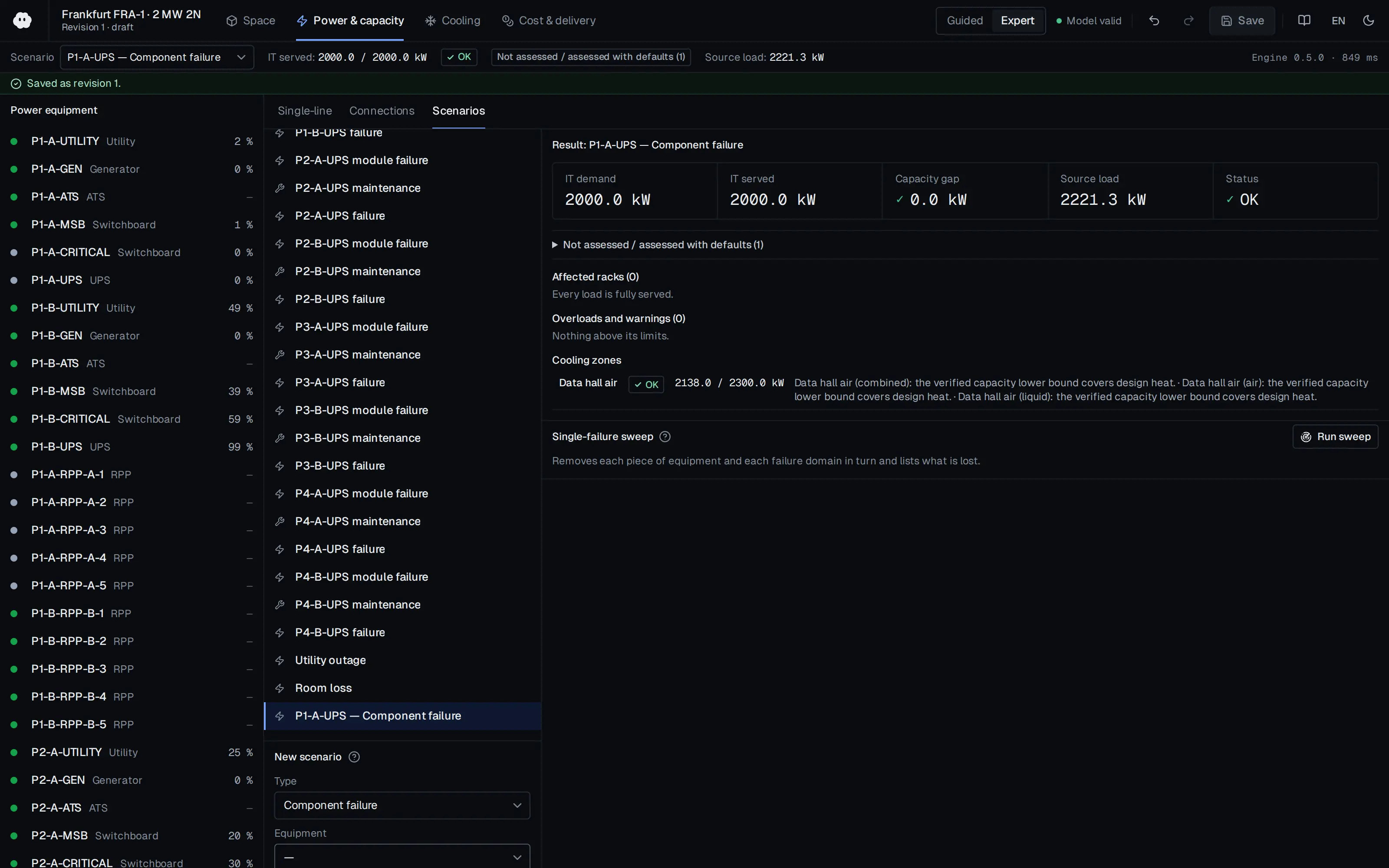
Who should read it
Owners considering TIA-942 certification, cabling and infrastructure designers, and consultants comparing rating schemes.
Related standards
- ANSI/TIA-942-C
- ANSI/TIA-568
- Uptime Tier Standard: Topology
- ANSI/BICSI 002
Publication details
- Authors
- Telecommunications Industry Association (TIA)
- Publisher
- Telecommunications Industry Association
- Year
- 2024
- Document number
- ANSI/TIA-942-C
- Document language
- English
- Source type
- Standard
- Access
- Free to read
- Licence
- Copyright retained; citation only — the publisher’s terms apply to the original document
Citation
Telecommunications Industry Association (TIA) (2024). ANSI/TIA-942 Telecommunications Infrastructure Standard for Data Centers — TIA overview page. Telecommunications Industry Association. ANSI/TIA-942-C. https://tiaonline.org/our-work/certifications/tia-942-certification/certifications-and-ratings/
Events on this subject
Browse the events calendarAll content and rights belong to the respective authors and publishers. SoSo CAD provides only the citation, its own summary and a link to the source, and is not responsible for the sources' content.
Related sources
All sources on this topicBICSI 2024
ANSI/BICSI 002-2024, Data Center Design and Implementation Best Practices (overview page)
Offer BICSI classes as an alternate standards profile alongside Uptime/TIA/EN, with an F1~Tier I/Rated-1/Class 1 ... F4~Tier IV/Rated-4/Class 4 table labelled 'conceptual equivalence only'
- A 2010 draft used F0-F5; current editions use F0-F4
Telecommunications Industry Association (TIA) 2024
ANSI/TIA-942-C, Telecommunications Infrastructure Standard for Data Centers (TIA standard page)
Offer a rating-level selector (Rated-1..4) that is separate from Uptime Tiers.
- Revision C was published in May 2024.

Open Compute Project Foundation 2023
Immersion Requirements Rev 2.0, First Amended (Revision 2.10, August 18, 2023)
Compare vendor offers on the same template: request W32 footprint density (kW/m2), full-solution static floor load, ceiling clearance and non-IT power per kW of IT in writing.
- Containment must hold at least 100% of the fluid volume of any single system without breach.
Open Compute Project Foundation 2020
Colocation Facility Guidelines for Deployment of Open Racks, Revision 4.0 (15 December 2020)
Check the delivery route against rack height plus 0.5 m, door and corridor widths, and the lift capacity, before agreeing to host or design for Open Racks.
- Maximum rack density is at least 8 kW (Acceptable) or 12 kW (Optimum); cold aisle width is at least 1,200 mm or 1,500 mm.
TÜV NORD 2026
EN 50600 — data centre facilities and infrastructures (overview and certification)
In an 'EN 50600' standards profile, offer separate availability-class selectors for power, cooling and cabling (instead of a single Tier), plus a protection-class selector per room or zone
- Protection classes 1-4 for unauthorised access and other hazards; physical-security zoning required
Huawei Digital Power 2025
Huawei AI Data Center Reference Design
Import RD 01-21 as parametric AI-hall templates (rack kW, racks per module, module kW, redundancy of fan walls/TMUs/towers, generator and transformer counts) and as golden test cases for capacity math.
- Power distribution supports 2N, DR and BR architectures.