Topic guide

Cooling

Explore technical publications on data centre cooling systems, thermal loads and operating conditions. Review air and liquid approaches, energy use and operational requirements within each source’s scope.

Sources
339
Downloadable PDFs
92
Years
2006–2026

Start here

Monthly newsletter · free

Keep your reading list current

Once a month: new library sources, changes to Turkish regulations and upcoming data centre events.

All sources

1–24 / 339

Technical guideFree to read

Upsite Technologies blog 2014

4 Steps to Reducing Bypass Airflow

Compute CCF for each room from running cooling capacity and IT load and show it as a KPI, with a warning when it is high (oversupply).

  • CCF = rated capacity of running cooling units (kW) / (1.10 x IT critical load kW); the 10% covers lights, people etc.
Research paperFree to read

arXiv preprint (National University of Singapore) 2025

A Bidirectional Gated Recurrent Unit Model for PUE Prediction in Data Centers

For an operations or digital-twin module, use the feature list as a practical minimum sensor set for PUE prediction: outdoor dry/wet-bulb, IT power, UPS power, CRAC power/capacity/SCOP, coil temperatures and airflow.

  • RFECV selected feature sets of {21, 28, 29, 32, 33, 43} features with the minimum MSE.
Research paperPDF

Energies (MDPI AG) 2020

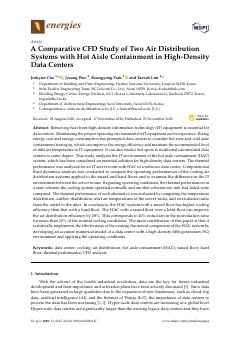
A Comparative CFD Study of Two Air Distribution Systems with Hot Aisle Containment in High-Density Data Centers

In high-density HAC halls, prefer a raised floor to hard-floor supply; on a hard floor high-velocity jets can starve the racks nearest the CRAHs and draw hot air back into them.

  • On the hard floor, supply velocities of 10 m/s or more persisted to the eighth rack position, versus the fourth with a raised floor.
Research paperPDF

Fluids (MDPI AG) 2026

A Review of Thermal Management in Modern Data Centres: Water Usage Effectiveness and Heat Transfer Coefficients

Set WUE targets from the heat-rejection topology (dry, free-cooling, hybrid, evaporative) and not only the server-side cooling technology; WUE depends on the share of heat rejected by evaporation.

  • Dry facilities with closed-loop liquid cooling need essentially no water, while evaporative systems typically report WUE up to 2.5 L/kWh.

All content and rights belong to the respective authors and publishers. SoSo CAD provides only the citation, its own summary and a link to the source, and is not responsible for the sources' content.