
Energy Storage Is a Core Power Strategy for Next-Generation Data Centers
Burns & McDonnell · Justin Gruetzner, Joshua Tucker
A Burns & McDonnell white paper on battery energy storage systems (BESS) as a campus-scale power asset for hyperscale and AI data centres.
On this page
Overview
This 2025 white paper by Justin Gruetzner and Joshua Tucker was published by Burns & McDonnell. It treats battery energy storage systems as a campus-scale power asset for hyperscale and AI data centres. It sets out use cases from interconnection support and load smoothing to spinning reserve, black start and campus-level UPS, and explains which are sized on MW and which on MWh.
On sizing, most commercial BESS offer 2-4 h duration, and data centres usually prioritise MW capacity over duration. Load smoothing is sized on MW, while spinning reserve and backup are sized on MWh from ramp rates, start times and required ride-through. Degradation is handled by initial overbuild plus augmentation, often in years 3-5, and 20-25 year performance guarantees are common.
On chemistry, LFP is preferred over NMC because thermal runaway starts at a higher temperature and propagation risk is lower. On electrical architecture, current data centre BESS connect AC at medium voltage, typically 34.5 kV, while 800 V DC buses are emerging. Alternatives such as sodium, flow batteries and flywheels are treated as complementary rather than near-term replacements. These architectural choices directly affect site layout and the connection point.
The primary codes are NFPA 855, UL 9540 and the UL 9540A large-scale fire tests, which drive layout spacing; NFPA 72 is used for detection. NFPA 75 is also among the related standards. The document is a consultancy white paper, so it needs vendor- and project-specific verification, and its figures are given under particular assumptions. Even so, the MW versus MWh distinction and the code requirements give teams bringing BESS into the design a practical framework.
Key points
- Most commercial BESS offer 2-4 h duration; data centres usually prioritise MW capacity over duration.
- Load smoothing is sized on MW; spinning reserve and backup on MWh, from ramp rates, start times and required ride-through.
- Degradation is handled by initial overbuild plus augmentation, often in years 3-5; 20-25 year performance guarantees are common.
- LFP is preferred over NMC because thermal runaway starts at a higher temperature and propagation risk is lower.
- Current data centre BESS connect AC at medium voltage, typically 34.5 kV; 800 V DC buses are emerging.
- Primary codes: NFPA 855, UL 9540 and UL 9540A large-scale fire tests (which drive layout spacing); NFPA 72 for detection.
- Sodium, flow batteries and flywheels are treated as complementary, not near-term replacements.
- Use cases include interconnection support, load smoothing, spinning reserve, black start and campus-level UPS.
Using it in design
- Add a BESS catalogue type with chemistry, MW, MWh, connection voltage and UL 9540A test reference.
- Define separate sizing rules for MW-driven and MWh-driven use cases.
- Apply NFPA 855 spacing and exposure checks in site layout.
- Warn when NMC is chosen near occupied buildings.
Monthly newsletter · free
Keep your reading list current
Once a month: new library sources, changes to Turkish regulations and upcoming data centre events.
SoSo CAD
Review your power design in SoSo CAD
Inspect supply paths, equipment loads and UPS failure scenarios in one model.
Request a demo
Who should read it
Electrical engineers, energy consultants and fire-safety specialists planning BESS for hyperscale and AI data centres.
Related standards
- NFPA 855
- UL 9540
- UL 9540A
- NFPA 72
- NFPA 75
Publication details
- Authors
- Justin Gruetzner; Joshua Tucker
- Publisher
- Burns & McDonnell
- Year
- 2025
- Document number
- 10791403663
- Document language
- English
- Source type
- Expert / community
- Access
- Free to read
- Licence
- Copyright retained; citation only — the publisher’s terms apply to the original document
Citation
Justin Gruetzner; Joshua Tucker (2025). Energy Storage Is a Core Power Strategy for Next-Generation Data Centers. Burns & McDonnell. 10791403663. https://info.burnsmcd.com/white-paper/energy-storage-is-a-core-power-strategy-for-next-generation-data-centers
Events on this subject
- Electricity Eurasia 2027
- ELECO 2026 Elektrik-Elektronik ve Biyomedikal Mühendisliği Konferansı
- 7x24 Exchange Spring Conference
All content and rights belong to the respective authors and publishers. SoSo CAD provides only the citation, its own summary and a link to the source, and is not responsible for the sources' content.
Related sources
All sources on this topic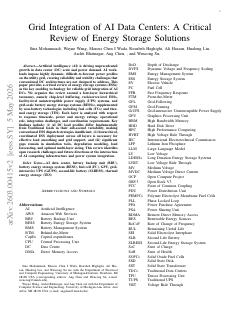
arXiv preprint (University of Michigan) 2026
Grid Integration of AI Data Centers: A Critical Review of Energy Storage Solutions (arXiv preprint)
Layer storage by timescale (chip/server sub-ms to ms, rack ms to seconds, UPS and GiUPS sub-second to 10 s, BESS minutes to hours) and show each layer's duty in the coordination scheme.
- Rapid AI load variations often induce 5-10% voltage swings within milliseconds.
WSEAS TRANSACTIONS ON POWER SYSTEMS (World Scientific and Engineering Academy and Society (WSEAS)) 2026
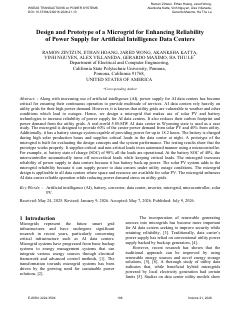
Design and Prototype of a Microgrid for Enhancing Reliability of Power Supply for Artificial Intelligence Data Centers
Follow the energy-balance chain in a PV/BESS sizing helper (daily load split, conversion losses, usable depth of discharge, power rating against night peak); report usable-energy duration rather than nameplate duration and make DoD an explicit input.
- Covering 60% of demand needs 81,857 kWh/day from PV after 5% DC-AC and 10% battery losses.
Open Compute Project Foundation 2026
White Paper: Requirements for Energy Storage Systems Used in Data Centers, Revision 1.0, Version 1.0 (OCP Ready Facilities, January 2026)
Fix the ESS architecture (DC or AC coupled, distributed or centralised, backup-only or grid-interactive), write the applicable NFPA 70, NFPA 855 and IEC 62933 parts into the design basis, and consult the authority having jurisdiction (AHJ) early.
- FM Global DS 5-33 (as cited) recommends battery installations in rooms with at least a 2-hour fire rating.
arXiv preprint (University of Texas at Austin; formatted for IEEE Transactions on Power Systems) 2025
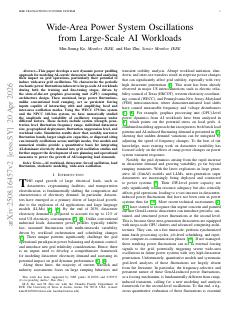
Wide-Area Power System Oscillations from Large-Scale AI Workloads
Model AI data-centre load as a persistent periodic forcing (0.3-1.5 Hz band, about 20% of peak fluctuating) rather than a ramp, and add oscillation analysis to the grid-interconnection study.
- The fine-tuning model uses a dominant frequency U(0.3, 0.7) Hz and compute fraction 0.7-0.9.
IEEE Access (Institute of Electrical and Electronics Engineers (IEEE)) 2021
A Novel Reliability Index to Assess the Computational Resource Adequacy in Data Centers
Set the number of spare PSUs/servers in a rack with a LOWP-style calculation from target service reliability and the load duration curve, avoiding unnecessary overprovisioning.
- The rack model assumes 10 blade servers rated 800 W each (400 W idle) with 40 local fans.
IEEE Access (Institute of Electrical and Electronics Engineers (IEEE)) 2021
A Review of Data Centers Energy Consumption and Reliability Modeling
Define the failure state (loss of PDU power, loss of a rack, loss of service) explicitly before starting a reliability study and state it in the report.
- Cooling-system operational availability is AO = 1/(λsys/µsys + 1) and functional availability is Af = AO(1 − pus) + (1 − AO)·pt.