
A Review of Data Centers Energy Consumption and Reliability Modeling
IEEE Access (Institute of Electrical and Electronics Engineers (IEEE)) · Kazi Main Uddin Ahmed, Math H. J. Bollen et al.
This review from Luleå University of Technology classifies the energy models of data-centre load sections (IT, cooling, power conversion) and the reliability assessment methods for the IT power conversion system, and shows where the gaps are.
CC BY 4.0 — share with attribution
On this page
Overview
The study tackles two linked questions: how data-centre load sections are modelled for energy consumption, and how the reliability of the IT power conversion system (IPCS) is assessed. The method is a systematic literature review: energy models for the IT, internal power conditioning and cooling load sections are classified and their advantages and disadvantages set out by application, and reliability modelling approaches are then reviewed.
For energy modelling, the main conclusion is that the availability of model parameters and variables matters more than accuracy. On reliability, the deterministic Uptime Tier approach is contrasted with probabilistic methods (RBD, fault tree, Markov, Monte Carlo, Petri nets). The deterministic Tier calculation ignores grid outage probability, differing component failure rates and random failure modes, and assumes constant failure and repair rates. IEEE Std 493-2007 (Gold Book) defines failure as loss of power to a PDU (or UPS distribution panel), so a single branch breaker trip that de-energises one rack is not a data-centre failure; the failure state must therefore be defined before any study.
Five IPCS reliability indices are compiled from the literature: MTBF, MTTR, availability, severity and risk (financial loss caused by the failure). Cooling-system operational availability is expressed as AO = 1/(λsys/µsys + 1) and functional availability as Af = AO(1 − pus) + (1 − AO)·pt. Because Tier IV availability must reach five to six nines, very few failure events appear in a million stochastic samples, and Monte Carlo results depend strongly on failure-mode modelling and the chosen distributions.
Limits: as a review it has no new measurements; failure and repair data for PDUs, PSUs and cooling devices are not public, largely because operators keep them confidential, and only server failure and repair times have a public data set. Models therefore lean on generic data and assumptions, and the research gaps are listed as recommendations in the conclusion.
Key points
- The deterministic Tier availability calculation ignores grid outage probability, differing component failure rates and random failure modes in the supply paths, and assumes constant failure and repair rates.
- IEEE Std 493-2007 (Gold Book) defines failure as loss of power to a PDU (or UPS distribution panel); a single branch breaker trip that de-energises one rack is not a data-centre failure under that definition, so the failure state must be defined first.
- Five IPCS reliability indices are compiled: MTBF, MTTR, availability, severity and risk (financial loss caused by the failure).
- Cooling-system operational availability is AO = 1/(λsys/µsys + 1) and functional availability is Af = AO(1 − pus) + (1 − AO)·pt.
- Tier IV availability must reach five to six nines, so very few failure events appear in a million stochastic samples; Monte Carlo results depend strongly on failure-mode modelling and chosen distributions.
- A public data set exists for server failure and repair times, but failure and repair data for PDUs, PSUs and cooling devices is not public, largely because operators keep it confidential.
- Conclusion: the availability of model parameters and variables matters more than accuracy for energy models.
Using it in design
- Define the failure state (loss of PDU power, loss of a rack, loss of service) explicitly before starting a reliability study and state it in the report.
- When showing Tier-level targets with a deterministic calculation, state that grid outages and failure-rate differences are not included; support it with a probabilistic method (Markov, Monte Carlo) and present failure-mode assumptions as inputs.
- Use the functional availability formula that combines cooling availability with room-temperature probabilities in cooling redundancy checks.
- Flag the source (manufacturer, operating record) and uncertainty for PDU, PSU and cooling failure data.
Monthly newsletter · free
Keep your reading list current
Once a month: new library sources, changes to Turkish regulations and upcoming data centre events.
SoSo CAD
Assess redundancy through scenarios
Compare normal operation and equipment failures in SoSo CAD, with supplied loads and capacity shortfalls in one view.
Request a demo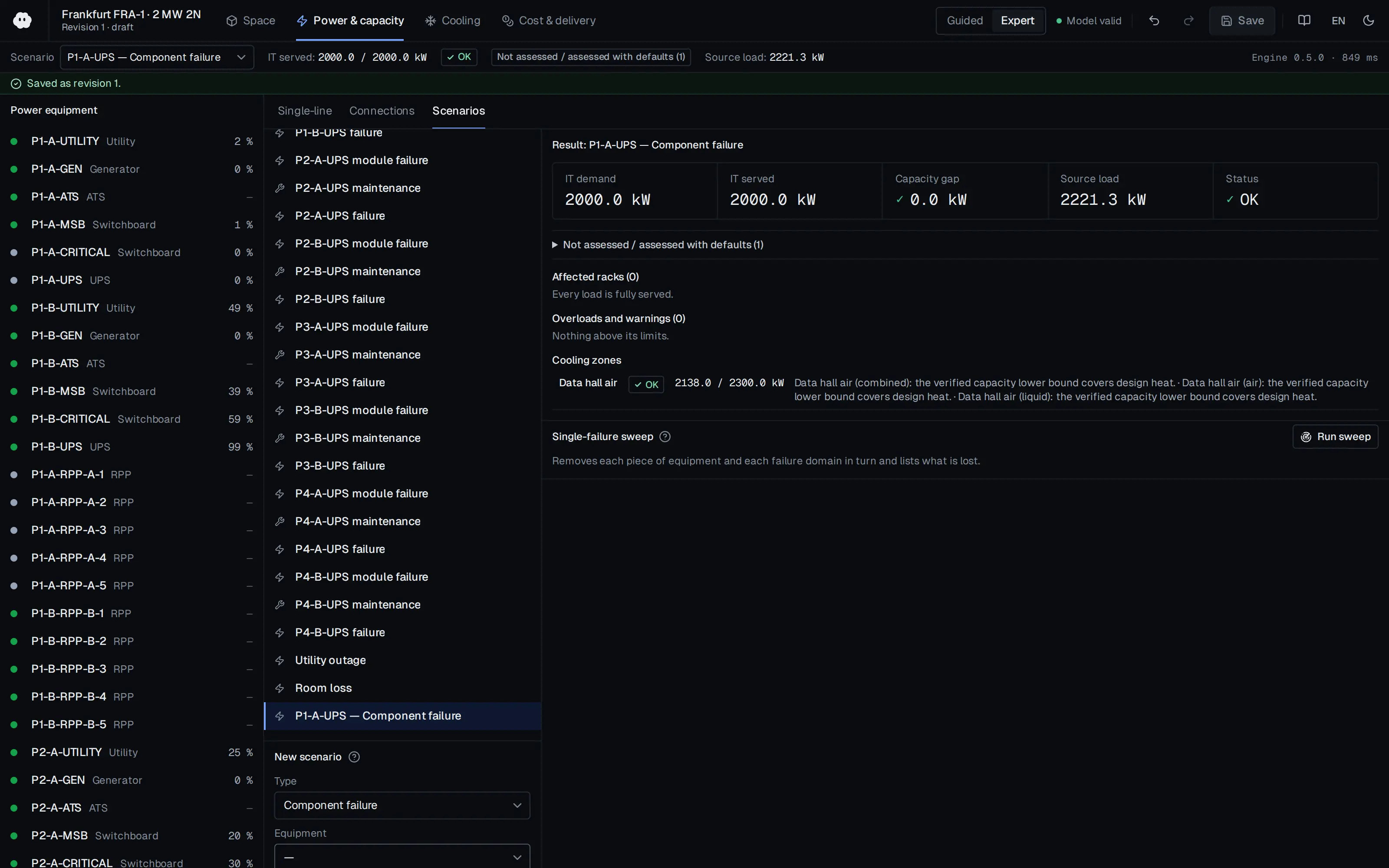
Who should read it
Researchers, design engineers and operations planners doing data-centre reliability and energy modelling.
Document contents
- I. Introduction (A. Background, B. Research gaps, C. Objective and approach, D. Contributions and recommendations, E. Organization)
- II. Related Review Articles
- III. Review of Data Center Load Modeling (A. IT load models, B. Internal power conditioning system model, C. Cooling section models)
- IV. Review of the Reliability Modeling of Data Centers (A. Tier classification, B. Factors to consider for the reliability, C. Reliability indices and metrics, D. Methodologies used for reliability modeling, E. Dependability of the data center load)
- V. Limitations and Future Works
- VI. Conclusion and Recommendations
Related standards
- IEEE 493-2007
- Uptime Institute Tier Standard: Topology
Read the document
dc-energy-reliability-modeling-review-2021.pdf
CC BY 4.0 — share with attribution
The document is provided unaltered because its licence permits redistribution.
Publication details
- Authors
- Kazi Main Uddin Ahmed; Math H. J. Bollen; Manuel Alvarez
- Publisher
- IEEE Access (Institute of Electrical and Electronics Engineers (IEEE))
- Year
- 2021
- Volume
- 9
- Pages
- 152536-152563
- Document language
- English
- Source type
- Scientific
- Access
- Open licence — downloadable
- Licence
- CC BY 4.0 — share with attribution
- Licence evidence
- ieeexplore.ieee.org
Original licence note
PDF footer states 'This work is licensed under a Creative Commons Attribution 4.0 License'.
Citation
Kazi Main Uddin Ahmed; Math H. J. Bollen; Manuel Alvarez (2021). A Review of Data Centers Energy Consumption and Reliability Modeling. IEEE Access (Institute of Electrical and Electronics Engineers (IEEE)). 9, 152536-152563. https://doi.org/10.1109/ACCESS.2021.3125092
Events on this subject
- Electricity Eurasia 2027
- ELECO 2026 Elektrik-Elektronik ve Biyomedikal Mühendisliği Konferansı
- 7x24 Exchange Spring Conference
All content and rights belong to the respective authors and publishers. SoSo CAD provides only the citation, its own summary and a link to the source, and is not responsible for the sources' content.
Related sources
All sources on this topic
IEEE Access (Institute of Electrical and Electronics Engineers (IEEE)) 2021
A Novel Reliability Index to Assess the Computational Resource Adequacy in Data Centers
Set the number of spare PSUs/servers in a rack with a LOWP-style calculation from target service reliability and the load duration curve, avoiding unnecessary overprovisioning.
- The rack model assumes 10 blade servers rated 800 W each (400 W idle) with 40 local fans.
arXiv preprint (University of Michigan) 2026
Grid Integration of AI Data Centers: A Critical Review of Energy Storage Solutions (arXiv preprint)
Layer storage by timescale (chip/server sub-ms to ms, rack ms to seconds, UPS and GiUPS sub-second to 10 s, BESS minutes to hours) and show each layer's duty in the coordination scheme.
- Rapid AI load variations often induce 5-10% voltage swings within milliseconds.
WSEAS TRANSACTIONS ON POWER SYSTEMS (World Scientific and Engineering Academy and Society (WSEAS)) 2026
Design and Prototype of a Microgrid for Enhancing Reliability of Power Supply for Artificial Intelligence Data Centers
Follow the energy-balance chain in a PV/BESS sizing helper (daily load split, conversion losses, usable depth of discharge, power rating against night peak); report usable-energy duration rather than nameplate duration and make DoD an explicit input.
- Covering 60% of demand needs 81,857 kWh/day from PV after 5% DC-AC and 10% battery losses.
arXiv preprint (University of Texas at Austin; formatted for IEEE Transactions on Power Systems) 2025
Wide-Area Power System Oscillations from Large-Scale AI Workloads
Model AI data-centre load as a persistent periodic forcing (0.3-1.5 Hz band, about 20% of peak fluctuating) rather than a ramp, and add oscillation analysis to the grid-interconnection study.
- The fine-tuning model uses a dominant frequency U(0.3, 0.7) Hz and compute fraction 0.7-0.9.
ABB 2026
Next-Generation Medium-Voltage Architecture for AI Data Centers
For loads above roughly 30-50 MW add a grid-code compliance checklist (LVRT duration, frequency band, RoCoF, PF) and let users choose LV-UPS versus MV-UPS architecture.
- BESS blocks 0.6-21.6 MW with 1, 2 or 4 h durations
TÜV NORD 2026
EN 50600 — data centre facilities and infrastructures (overview and certification)
In an 'EN 50600' standards profile, offer separate availability-class selectors for power, cooling and cabling (instead of a single Tier), plus a protection-class selector per room or zone
- Protection classes 1-4 for unauthorised access and other hazards; physical-security zoning required