
Next-Generation Medium-Voltage Architecture for AI Data Centers
ABB
An ABB paper arguing that conventional low-voltage UPS topologies scale poorly for 200-500 MW AI campuses, and proposing medium-voltage distribution with MV UPS and battery energy storage (BESS) working together.
On this page
Overview
The paper argues that low-voltage UPS architecture does not scale for 200-500 MW AI campuses and proposes moving to medium-voltage distribution, typically 6-35 kV. The target for an MV UPS is system efficiency above 98% and response in under 2 ms to grid disturbances. The UPS handles fast transients while BESS takes longer-duration support, peak shaving and microgrid functions.
The grid-code section summarises conditions large loads now face: ride-through of dips down to 0% for 200-300 ms and of repeated dips (for example 10 within 90 s); frequency tolerance typically 47.5-52 Hz in Europe and +/-2 Hz in Asia; RoCoF up to 3 Hz/s and phase jumps up to +/-30 degrees. After a fault, active power must recover to at least 90% within 0.5 s, with power factor >=0.99 and reactive support.
In the components section BESS blocks span 0.6-21.6 MW with 1, 2 or 4 hour durations. MV redundancy variants are shown as distributed redundant, 2N and N+1. The paper ties the architecture to 24/7 carbon-free operation through a microgrid approach, treating load, storage and generation under one control framework. It is a vendor article describing ABB's own approach and dates from 2026; the comparison figures are not independently verified. Grid-code examples vary by country, so a given project must use its own grid operator's requirements; the paper's value is in listing which topics need to be checked.
Key points
- MV distribution typically 6-35 kV for AI campuses of 200-500 MW
- MV UPS target >98% system efficiency and <2 ms response to grid disturbances
- Grid-code examples: ride through dips to 0% for 200-300 ms, repeated dips (e.g. 10 within 90 s)
- Frequency tolerance typically 47.5-52 Hz (Europe), +/-2 Hz (Asia); RoCoF up to 3 Hz/s; phase jump up to +/-30 deg
- Post-fault active power recovery >=90% within 0.5 s; PF >=0.99 / VAR support
- BESS blocks 0.6-21.6 MW with 1, 2 or 4 h durations
- Redundancy variants: distributed redundant, 2N, N+1
Using it in design
- For loads above roughly 30-50 MW add a grid-code compliance checklist (LVRT duration, frequency band, RoCoF, PF) and let users choose LV-UPS versus MV-UPS architecture.
- Add MV UPS (efficiency 98%+) and BESS (MW, MWh, duration 1/2/4 h) to the catalog.
- BESS energy calculation: energy = P x duration / DoD.
- Offer MV redundancy variants (distributed redundant, 2N, N+1) as templates and show the cost and availability difference.
Monthly newsletter · free
Keep your reading list current
Once a month: new library sources, changes to Turkish regulations and upcoming data centre events.
SoSo CAD
Review your power design in SoSo CAD
Inspect supply paths, equipment loads and UPS failure scenarios in one model.
Request a demo
Who should read it
Electrical designers and project decision makers choosing grid connection and UPS architecture for AI campuses of hundreds of MW.
Related standards
- IEC 62040-3
- IEC 62271
- EN 50549 / grid codes
- IEEE 2800
- EN 50600-2-2
Publication details
- Authors
- ABB
- Publisher
- ABB
- Year
- 2026
- Document number
- 9AKK108472A2558
- Document language
- English
- Source type
- Manufacturer
- Access
- Free to read
- Licence
- Copyright retained; citation only — the publisher’s terms apply to the original document
Citation
ABB (2026). Next-Generation Medium-Voltage Architecture for AI Data Centers. ABB. 9AKK108472A2558. https://library.e.abb.com/public/779d55d86bbd41a1b5913c9ac56c8013/9AKK108472A2558_en_B_Next-Generation%20Medium-Voltage%20Architecture%20for%20AI%20Data%20Centers.pdf
Events on this subject
Browse the events calendarAll content and rights belong to the respective authors and publishers. SoSo CAD provides only the citation, its own summary and a link to the source, and is not responsible for the sources' content.
Related sources
All sources on this topicSiemens 2013
Totally Integrated Power - Application Models for Power Distribution: Data Centres
Use the tier factors as defaults in the early-stage area estimator: grey space = white space x factor.
- Critical (ICT) to infrastructure power split is about 2:1 (PUE about 1.5).
arXiv preprint (University of Michigan) 2026
Grid Integration of AI Data Centers: A Critical Review of Energy Storage Solutions (arXiv preprint)
Layer storage by timescale (chip/server sub-ms to ms, rack ms to seconds, UPS and GiUPS sub-second to 10 s, BESS minutes to hours) and show each layer's duty in the coordination scheme.
- Rapid AI load variations often induce 5-10% voltage swings within milliseconds.
WSEAS TRANSACTIONS ON POWER SYSTEMS (World Scientific and Engineering Academy and Society (WSEAS)) 2026
Design and Prototype of a Microgrid for Enhancing Reliability of Power Supply for Artificial Intelligence Data Centers
Follow the energy-balance chain in a PV/BESS sizing helper (daily load split, conversion losses, usable depth of discharge, power rating against night peak); report usable-energy duration rather than nameplate duration and make DoD an explicit input.
- Covering 60% of demand needs 81,857 kWh/day from PV after 5% DC-AC and 10% battery losses.
Open Compute Project Foundation 2026
Interface Specification Between Hyperscalers and Utility Grid for Disturbance Performance (Version 1.0.0)
For a new site, write the POI LVRT/HVRT envelope and the PFAPR requirement (90% within 2 s) as design criteria, and settle which voltage measurement (line-to-neutral or line-to-line) governs during protection coordination with the utility.
- In ERCOT NOGRR 282, cooling load is subtracted from the pre-fault load used to judge PFAPR.
Open Compute Project Foundation 2026
White Paper: Requirements for Energy Storage Systems Used in Data Centers, Revision 1.0, Version 1.0 (OCP Ready Facilities, January 2026)
Fix the ESS architecture (DC or AC coupled, distributed or centralised, backup-only or grid-interactive), write the applicable NFPA 70, NFPA 855 and IEC 62933 parts into the design basis, and consult the authority having jurisdiction (AHJ) early.
- FM Global DS 5-33 (as cited) recommends battery installations in rooms with at least a 2-hour fire rating.
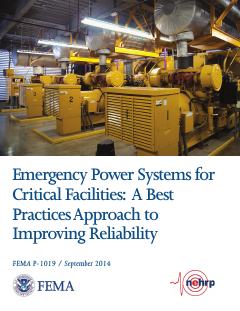
FEMA 2014
FEMA P-1019, Emergency Power Systems for Critical Facilities: A Best Practices Approach to Improving Reliability (September 2014)
At critical-facility data centers, place generators, ATS, fuel tanks and pumps above the greatest of BFE + 3 ft, DFE + 1 ft and 500-year elevation + 1 ft, and prefer elevation to dry floodproofing.
- Generators over 300 kW are almost exclusively diesel-fueled.