Topic guide

Sustainability

Browse publications on environmental impacts, carbon, resource use and life cycles. Compare assessment methods while reviewing their scope, data periods and reporting boundaries alongside the original sources.

Sources
201
Downloadable PDFs
66
Years
2007–2026

Start here

Research paperFree to readEditor’s pick

Journal of Science Policy & Governance (Journal of Science Policy and Governance, Inc.) 2026

Is Power Usage Effectiveness (PUE) Still Fit for Purpose? An Integrative Review of Data Center Metrics for Assessing the Environmental Impact of Modern AI Infrastructure

Give the sustainability panel at least four axes (PUE, CUE, WUE/WUEsource and a placeholder for IT productivity) and show them as a radar chart, so a low PUE never appears alone.

  • Water-energy tipping point: in a hot, dry climate a further 10% cut in water use can raise total energy use by 25%; in a cool, humid climate the cost is low.
Monthly newsletter · free

Keep your reading list current

Once a month: new library sources, changes to Turkish regulations and upcoming data centre events.

All sources

1–24 / 201

Research paperFree to readEditor’s pick

Journal of Science Policy & Governance (Journal of Science Policy and Governance, Inc.) 2026

Is Power Usage Effectiveness (PUE) Still Fit for Purpose? An Integrative Review of Data Center Metrics for Assessing the Environmental Impact of Modern AI Infrastructure

Give the sustainability panel at least four axes (PUE, CUE, WUE/WUEsource and a placeholder for IT productivity) and show them as a radar chart, so a low PUE never appears alone.

  • Water-energy tipping point: in a hot, dry climate a further 10% cut in water use can raise total energy use by 25%; in a cool, humid climate the cost is low.
Research paperPDF

arXiv preprint (Texas Tech University / PNNL; submitted to Renewable and Sustainable Energy Reviews) 2026

A Critical Review of Grid Integration Challenges and Flexibility Opportunities for Large-Scale Data Centers

Base interconnection studies on staged, updatable facility data rather than a single static MW value; requested peak MW and annual energy alone do not establish integration.

  • Under IEEE 519-2022, voltage-distortion limits at the PCC are the system owner's responsibility and current-distortion limits are the user's; a scalar THD cannot rule out narrow-band resonance.
Research paperPDF

Proceedings of the Twelfth ACM International Conference on Future Energy Systems (ACM) 2021

A Guide to Reducing Carbon Emissions through Data Center Geographical Load Shifting

For geographic load shifting, consider locational marginal carbon emissions (lambda-CO2) as the signal instead of LMP or regional average carbon intensity; it gave the largest reduction (-1.44%).

  • Lambda-CO2 shifting saved about 0.14 t CO2 per MW shifted and still reduced generation cost by 0.27%; LMP shifting cut cost by 1.07% but saved less carbon.
Research paperPDF

Applied Energy (Elsevier BV) 2025

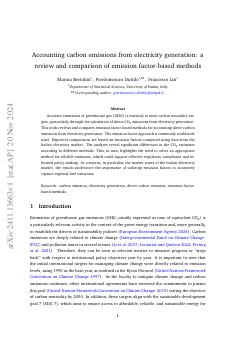
Accounting carbon emissions from electricity generation: a review and comparison of emission factor-based methods

In data-centre carbon accounting, state the method (Tier 1, 2, 3) and factor source (IPCC or national) when choosing a grid emission factor; simple methods can underestimate generation emissions by about 73%.

  • AEF for the North zone by Method 5 rose from 0.1627 tCO2/MWh in 2016 to 0.4709 in 2022, then fell to 0.3936 in 2023.
Research paperPDF

arXiv preprint (cs.AI), Harvard T.H. Chan School of Public Health 2026

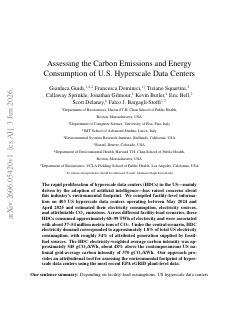
Assessing the Carbon Emissions and Energy Consumption of U.S. Hyperscale Data Centers

In fleet or facility energy estimation, use capacity × 8,760 × facility-load coefficient (0.48-0.70, central 0.58) and report the range (67.7-98.6 TWh) explicitly.

  • State-level intensities (central scenario): Virginia 535, Oregon 440, Iowa 645, Nebraska 740, Wyoming 1035 gCO2/kWh; Virginia had 142 HDCs, 21.0 TWh, 11.5 Mt.
Technical guidePDF

European Commission, DG ENER (AIT, Borderstep Institute, EY) 2025

Assessment of next steps to promote the energy performance and sustainability of data centres in EU, including the establishment of an EU-wide rating scheme - Second technical report

Align the PUE target of new designs with the proposed MPS: design PUE below 1.3 and operational PUE below 1.4 in the first three years; for existing sites plan the path to below 1.5 by 2030.

  • MPS feasibility was tested across 27 data centre archetypes with selected best available techniques (BAT).
Technical guideFree to read

iMasons Climate Accord (Infrastructure Masons) 2026

Best Practices for Data Center LCAs

Run an embodied-carbon estimate from the BOM at each design stage.

  • Related standards: EN 15978, ISO 14040, ISO 14044.
Research paperPDF

arXiv preprint (cs.CY; formatted for ACM e-Energy '26) 2026

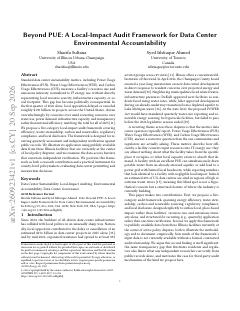
Beyond PUE: A Local-Impact Audit Framework for Data Center Environmental Accountability

In siting and community-acceptance files, present PUE, WUE and CUE together with regional water stress, grid headroom and verification maturity (L0-L4); back project commitments with contractual limits and independent metering (L2-L3).

  • Compliance gate: any unresolved major regulatory violation caps the composite score at a ceiling of 40 (suggested, subject to calibration).
Technical guideFree to read

European Commission, DG ENER 2026

Call for evidence for an initiative with an impact assessment - Data centres in the EU: minimum performance standards (Ares(2026)8908107)

Track this initiative as an upcoming rule pack; leave design headroom against likely MPS indicators (PUE, WUE, waste-heat reuse readiness, grid flexibility).

  • Legal basis is Article 194(2) TFEU; EU action is justified to avoid divergent national approaches.
Research paperPDF

arXiv preprint (cs.SE), Google 2024

Carbon accounting in the Cloud: a methodology for allocating emissions across data center users

In allocating carbon to data-centre users, give idle power to whoever holds the resource allocation and share dynamic power by actual usage; because an idle server draws about 45% of peak power, the idle share is large.

  • Resources with equivalent busy power used to weight idle-power allocation: 1 Intel Skylake N1 CPU core = 20 GiB RAM = 1 TiB SSD = 6 TiB HDD.
Research paperFree to read

Proceedings of the 28th ACM International Conference on Architectural Support for Programming Languages and Operating Systems, Volume 2 (ACM) 2023

Carbon Explorer: A Holistic Framework for Designing Carbon Aware Datacenters

Add an hourly 24/7 CFE coverage calculator to site and energy design that sizes wind, solar, BESS (in hours of IT load) and server headroom together; use hourly or sub-hourly supply profiles, never daily averages.

  • Grid lifecycle intensities (gCO2eq/kWh): wind 11, nuclear 12, hydro 24, solar 41, biofuels/other 230, natural gas 490, oil 650, coal 820.
Research paperPDF

IEEE Transactions on Power Systems (Institute of Electrical and Electronics Engineers (IEEE)) 2021

Carbon-Aware Computing for Datacenters

Consider shifting temporally flexible workloads (completable within 24 hours) to hours of lower carbon intensity and lower power peak as an option in data-centre grid-connection negotiation and power capacity planning.

  • A piecewise-linear model of power versus CPU usage achieves daily MAPE below 5% for more than 95% of power domains.

All content and rights belong to the respective authors and publishers. SoSo CAD provides only the citation, its own summary and a link to the source, and is not responsible for the sources' content.