
Options for exergy-rational use of heat generated by CHP systems
Original title Beraber Isı ve Güç Sistemlerinde Üretilen Isının Ekserji Akılcı Değerlendirilme Seçenekleri (Options for exergy-rational use of heat generated by CHP systems)
TMMOB Makina Mühendisleri Odası (MMO) · Birol Kılkış
A TESKON 2023 paper that develops an exergy-based optimisation model for using CHP heat and evaluates five configurations against ten exergy-based criteria.
On this page
Overview
Birol Kılkış's paper at the 15th National Building Services Engineering Congress of the Chamber of Mechanical Engineers (TESKON 2023, Izmir) appears on page 357 of the proceedings and is freely readable. It develops an exergy-based optimisation model for using the heat generated by combined heat and power (CHP) systems. Its subject is bringing a thermodynamic viewpoint, one that looks at the quality of energy sources as well as their quantity, into data centre design.
The study scores five configurations against ten exergy-based criteria. One scenario is a near-zero-carbon data centre whose power and cooling plant burns natural gas blended with hydrogen and biogas (Scenario 2, NCL = 6). Other scenarios combine heat pumps, ORC generators and absorption/adsorption chillers. The conclusion is that CHP heat is best used as heat when demand exists, but for cooling a data centre the proposed cascaded combinations are the most rational option.
The author's central argument is that PUE is blind to the thermodynamics of such plants. In the innovative data centre scenario, the PUE of the trigeneration plant is worked out as (100 kW IT + 100 kW / cooling COP of 3) / 100 kW = 1.33, against a quoted sector average of 1.6. Yet PUE cannot distinguish the quality of the energy sources. First-law primary energy indicators (PEI) are also judged insufficient, and an exergy-based RUEEX metric is proposed to find minimum-CO2 fuel-to-cooling paths.
The study's limits are that the scenarios are computational and conceptual and the record contains no detailed measurement data; the PUE example is also a simplified calculation. The related standard is ISO/IEC 30134-2. The message for designers is that where on-site CHP or trigeneration is present, PUE alone can mask the choice of fuel.
Key points
- Five CHP heat-use scenarios were scored with ten exergy-based criteria; Scenario 2 is a near-zero-carbon data centre (NCL = 6).
- Example PUE of the trigeneration DC: (100 kW IT + 100 kW / COPc of 3) / 100 kW = 1.33, versus a quoted sector average of 1.6.
- PUE is judged inadequate to describe the thermodynamics of on-site CHP/trigeneration DC plants.
- First-law primary energy indicators (PEI) are also insufficient; an exergy-based RUEEX metric is proposed to find minimum-CO2 fuel-to-cooling paths.
- Conclusion: CHP heat is best used as heat when demand exists, but for cooling a data centre the proposed cascaded combinations are the most rational option.
- Other scenarios combine heat pumps, ORC generators and absorption/adsorption chillers.
- Related standard: ISO/IEC 30134-2.
Using it in design
- In the energy module, when on-site CHP/trigeneration is modelled, report PUE together with source-aware metrics (primary energy, CO2 and optionally exergy-based figures).
- Warn that PUE alone can mask fuel choice.
- Catalogue absorption/adsorption chillers with thermal COP and driving-temperature fields.
- Check first whether there is demand for the CHP heat; where there is, prefer using it as heat over cooling.
Monthly newsletter · free
Keep your reading list current
Once a month: new library sources, changes to Turkish regulations and upcoming data centre events.
SoSo CAD
Compare the cost of design decisions
Evaluate equipment costs, energy expenses and total cost of ownership (TCO) using your inputs and assumptions in SoSo CAD.
Request a demo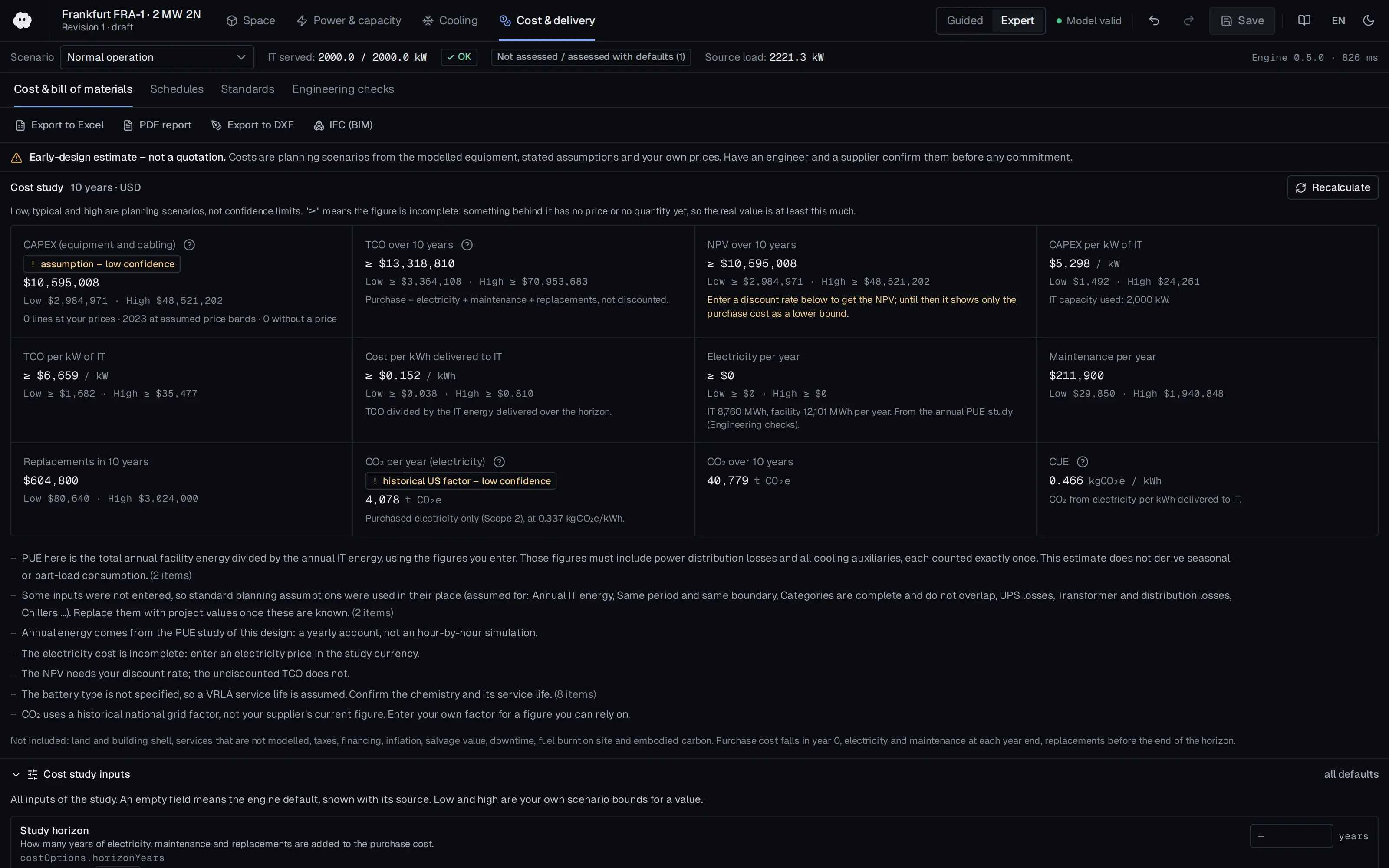
Who should read it
Mechanical and energy engineers and academics designing data centre energy plants with CHP or trigeneration systems.
Related standards
- ISO/IEC 30134-2
Publication details
- Authors
- Birol Kılkış
- Publisher
- TMMOB Makina Mühendisleri Odası (MMO)
- Year
- 2023
- Document number
- TESKON 2023 Bildiriler Kitabı, s. 357
- Event
- 15. Ulusal Tesisat Mühendisliği Kongresi (TESKON 2023), İzmir
- Document language
- English
- Source type
- Industry body
- Access
- Free to read
- Licence
- Copyright retained; citation only — the publisher’s terms apply to the original document
Citation
Birol Kılkış (2023). Beraber Isı ve Güç Sistemlerinde Üretilen Isının Ekserji Akılcı Değerlendirilme Seçenekleri (Options for exergy-rational use of heat generated by CHP systems). TMMOB Makina Mühendisleri Odası (MMO). TESKON 2023 Bildiriler Kitabı, s. 357. 15. Ulusal Tesisat Mühendisliği Kongresi (TESKON 2023), İzmir. https://mmoteskon.org/images/2025/05/teskon-2023-bildiriler-kitabi-1.pdf
Events on this subject
Browse the events calendarAll content and rights belong to the respective authors and publishers. SoSo CAD provides only the citation, its own summary and a link to the source, and is not responsible for the sources' content.
Related sources
All sources on this topic
European Commission JRC 2025
2025 Best Practice Guidelines for the EU Code of Conduct on Data Centre Energy Efficiency (JRC141521, EUR 40267)
Design the facility to operate within the ASHRAE Class A2 allowable range and require A2 operation within warranty in IT procurement; plan separate environmental zones (practice 5.3.4) for legacy equipment.
- IT equipment AC/DC power converters should be rated at 90% efficiency or better across expected load ranges.

Open Compute Project Foundation 2025
Reference Designs for Data Center Heat Reuse, Revision 1.0
Provide a heat-recovery-station block in the site layout with space sized from capacity (plate HX footprint, 10 m2 per MW for heat pumps, about 43 m3 per MW per 30 minutes of storage) and a demarcation boundary to the heat host.
- ORC heat-to-power converts less than 4% of the heat to electricity at these low temperatures.
European Commission, DG Communications Networks, Content and Technology (DG CONNECT) 2020
Energy-efficient Cloud Computing Technologies and Policies for an Eco-friendly Cloud Market: Final Study Report (SMART 2018/0028)
Use the regional and size-based values for first-pass PUE assumptions, but treat them as 2018-and-earlier averages and as historical context, not as a current target.
- German PUE in 2015: 2.1 for server rooms under 100 m2, 1.9 for 100-500 m2, 1.7 for 500-5,000 m2, 1.6 above 5,000 m2.
European Commission JRC 2020
Development of the EU Green Public Procurement (GPP) Criteria for Data Centres, Server Rooms and Cloud Services - Final Technical Report (JRC118558, EUR 30251 EN, 2020)
Ask in the specification for a designed PUE (dPUE) at a stated IT load (for example 50%) and conditions, under ISO/IEC 30134-2 or EN 50600-4-2, and write PUE demonstration at handover and the commissioning test into the contract.
- ASHRAE liquid cooling classes cited: W1 2-17 °C, W2 2-27 °C, W3 2-32 °C, W4 2-45 °C, W5 above 45 °C.
U.S. EPA / ENERGY STAR 2007
Report to Congress on Server and Data Center Energy Efficiency, Public Law 109-431 (August 2, 2007)
Use it for historical context on PUE: knowing that 2.0 was the 2007 average starting point, compare your current target PUE values against that reference.
- Data center peak grid load was about 7 GW (about 15 baseload power plants), expected to reach 12 GW by 2011.
Danfoss 2024
Data Centers and Energy: Reaching Sustainability
Report PUE, WUE and CUE together in the sustainability module.
- PUE, CUE and WUE are defined, with an example WUE of 1.8 L per kWh.