
A Critical Review of Grid Integration Challenges and Flexibility Opportunities for Large-Scale Data Centers
arXiv preprint (Texas Tech University / PNNL; submitted to Renewable and Sustainable Energy Reviews) · Bibek Dhakal, Manohar Chamana et al.
A review of data-centre grid integration from bulk planning down to distribution feeders, with emphasis on less-covered distribution issues: harmonic propagation and resonance, transformer derating and insulation ageing, cable ampacity, neutral heating, protection and measurement.
CC BY 4.0 — share with attribution
On this page
Overview
The proliferation of cloud computing and AI workloads is fundamentally reshaping the magnitude, spatial concentration and electrical characteristics of data-centre power demand. Data centres differ from conventional commercial loads because they combine high rack densities, converter-dominated interfaces, thermally coupled cooling, UPS, programmable workloads and increasingly complex behind-the-meter generation and storage within a single facility. The review covers resource planning, large-load interconnection, distribution feeders, market operation, real-time dynamics, power quality and asset management.
Static, composite, physics-based dynamic, calibrated, impedance, electromagnetic transient (EMT) and hybrid load models are compared by study purpose and data requirements, and flexibility options including UPS/BESS control, workload shifting, co-located renewables, CHP, fuel cells and thermal storage are assessed. Component shares are case-dependent: one dynamic model of a 10 MW facility cites a prior estimate of about 60% IT and 30% cooling energy, but at the simulated peak point server-room and HVAC components were about 85% and 15% of facility power. PUE is a useful efficiency metric but not a complete grid-impact metric.
A 2026 national assessment cited estimates roughly 9-10 GW of the U.S. project pipeline could interconnect at distribution voltages, needing on the order of 3000-4000 new feeders and several thousand 13-34.5 kV substation transformers. Ride-through is not a binary attribute: relevant parameters include voltage and frequency thresholds, delay, active/reactive response, recovery shape, internal segmentation, backup generation, UPS energy state and reconnection ramp. Under IEEE 519-2022, voltage-distortion limits at the PCC are the system owner's responsibility and current-distortion limits are the user's; a scalar THD cannot rule out narrow-band resonance, so screening should combine spectra with frequency-dependent impedance. Triplen harmonics from single-phase nonlinear loads may accumulate in the neutral, though diversity and phase-angle differences prevent a universal arithmetic sum.
The conclusion is that requested peak MW and annual energy matching cannot by themselves establish reliable or sustainable integration; studies need staged, updatable facility data and measured operating capability. Limits: distribution-level mechanisms are technically credible but less documented in hyperscale field settings than bulk-system impacts, and case-specific measurement, commissioning, spectrum and impedance analysis are more defensible than universal derating or protection assumptions. It is a preprint.
Key points
- Component shares are case-dependent: one dynamic model of a 10 MW facility cites a prior estimate of about 60% IT and 30% cooling energy, but at the simulated peak point server-room and HVAC components were about 85% and 15% of facility power.
- PUE is a useful efficiency metric but not a complete grid-impact metric.
- A 2026 national assessment cited estimates roughly 9-10 GW of the U.S. project pipeline could interconnect at distribution voltages, needing 3000-4000 new feeders and several thousand 13-34.5 kV substation transformers.
- Ride-through is not a binary attribute: voltage and frequency thresholds, delay, active/reactive response, recovery shape, internal segmentation, backup generation, UPS energy state and reconnection ramp.
- Under IEEE 519-2022, voltage-distortion limits at the PCC are the system owner's responsibility and current-distortion limits are the user's; a scalar THD cannot rule out narrow-band resonance.
- Triplen harmonics from single-phase nonlinear loads may accumulate in the neutral; diversity and phase-angle differences prevent a universal arithmetic sum.
Using it in design
- Base interconnection studies on staged, updatable facility data rather than a single static MW value; requested peak MW and annual energy alone do not establish integration.
- In harmonic assessment combine spectra with frequency-dependent impedance rather than scalar THD (resonance risk), and verify transformer and cable thermal duty and neutral heating by case-specific measurement.
- Define ride-through parametrically (thresholds, delay, response, recovery shape, UPS energy state, reconnection ramp), not as a binary.
- If large loads will connect at distribution voltage, assess the need for feeders and substation transformers early.
Monthly newsletter · free
Keep your reading list current
Once a month: new library sources, changes to Turkish regulations and upcoming data centre events.
SoSo CAD
Review your power design in SoSo CAD
Inspect supply paths, equipment loads and UPS failure scenarios in one model.
Request a demo
Who should read it
Grid engineers and designers evaluating integration, power quality and flexibility of large data centres on distribution and transmission grids.
Document contents
- 1. Introduction
- 2. Review methodology, scope, and positioning (2.1 Scope, source selection, and evidence grading, 2.2 Positioning relative to existing reviews)
- 3. Data center operations and load characteristics (3.1 Load mix and facility coupling, 3.2 Workload stages and electrical variability, 3.3 Power electronics, UPS systems, cooling, and internal architecture)
- 4. Grid impacts across layers and time scales (4.1 Transmission planning and large-load interconnection, 4.2 Distribution-system and point of interconnection impacts, 4.3 Markets, tariffs, and operational flexibility, 4.4 Real-time dynamics, ride-through, and stability)
- 5. Power quality and distribution asset degradation (5.1 Harmonics, resonance, and interpretation of power quality metrics, 5.2 Transformer heating, derating, and insulation aging, 5.3 Cable ampacity, underground thermal constraints, and neutral conductors, 5.4 Protection, metering, and monitoring implications, 5.5 Harmonic-constrained optimal power flow for converter-dominated loads)
- 6. Modeling requirements for data center loads (6.1 What static models can and cannot represent, 6.2 Dynamic, calibrated, impedance, EMT, and hybrid representations, 6.3 Calibration, data exchange, and model governance)
- 7. Regulatory, reliability, and interconnection developments
- 8. Integration strategies and implementation requirements (8.1 Interconnection reform and study data, 8.2 DERMS, ADMS, and utility coordination)
- 10. Conclusion
Related standards
- IEEE 519-2022
Read the document
large-dc-grid-integration-review-2026.pdf
CC BY 4.0 — share with attribution
The document is provided unaltered because its licence permits redistribution.
Publication details
- Authors
- Bibek Dhakal; Manohar Chamana; Biswambhar Gayen; Jatendar Kumar; S M Shams Rahman; Aaqib Peerzada; Ki Yeob Lee; Olatunji M. Adeyanju; Bhaskar Mitra; Stephen Bayne
- Publisher
- arXiv preprint (Texas Tech University / PNNL; submitted to Renewable and Sustainable Energy Reviews)
- Year
- 2026
- Document number
- arXiv:2610.19374
- Document language
- English
- Source type
- Scientific
- Access
- Open licence — downloadable
- Licence
- CC BY 4.0 — share with attribution
- Licence evidence
- arxiv.org
Original licence note
arXiv record licence is http://creativecommons.org/licenses/by/4.0/ (checked via arXiv OAI-PMH, v2)
Citation
Bibek Dhakal; Manohar Chamana; Biswambhar Gayen; Jatendar Kumar; S M Shams Rahman; Aaqib Peerzada; Ki Yeob Lee; Olatunji M. Adeyanju; Bhaskar Mitra; Stephen Bayne (2026). A Critical Review of Grid Integration Challenges and Flexibility Opportunities for Large-Scale Data Centers. arXiv preprint (Texas Tech University / PNNL; submitted to Renewable and Sustainable Energy Reviews). arXiv:2610.19374. https://doi.org/10.48550/arXiv.2610.19374
Events on this subject
Browse the events calendarAll content and rights belong to the respective authors and publishers. SoSo CAD provides only the citation, its own summary and a link to the source, and is not responsible for the sources' content.
Related sources
All sources on this topic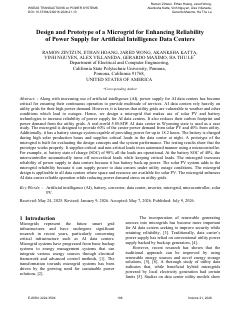
WSEAS TRANSACTIONS ON POWER SYSTEMS (World Scientific and Engineering Academy and Society (WSEAS)) 2026
Design and Prototype of a Microgrid for Enhancing Reliability of Power Supply for Artificial Intelligence Data Centers
Follow the energy-balance chain in a PV/BESS sizing helper (daily load split, conversion losses, usable depth of discharge, power rating against night peak); report usable-energy duration rather than nameplate duration and make DoD an explicit input.
- Covering 60% of demand needs 81,857 kWh/day from PV after 5% DC-AC and 10% battery losses.
Open Compute Project Foundation 2026
Clean Backup Power Technology Requirements, Base Specification Version 0.3 (effective Apr 22, 2026)
Extend the generator catalogue with technology type (diesel, HVO, gas, H2 ICE, PEM fuel cell), emissions factor relative to the 1742 lb/MWh baseline, start time, block-load capability and NFPA 110 level.
- Overload 110% for 60 s and 150% for 3 s; transient voltage response to ISO 8528-5 G3; steady-state frequency within +/-0.5%.
Open Compute Project Foundation 2026
White Paper: Requirements for Energy Storage Systems Used in Data Centers, Revision 1.0, Version 1.0 (OCP Ready Facilities, January 2026)
Fix the ESS architecture (DC or AC coupled, distributed or centralised, backup-only or grid-interactive), write the applicable NFPA 70, NFPA 855 and IEC 62933 parts into the design basis, and consult the authority having jurisdiction (AHJ) early.
- FM Global DS 5-33 (as cited) recommends battery installations in rooms with at least a 2-hour fire rating.
ABB 2026
Next-Generation Medium-Voltage Architecture for AI Data Centers
For loads above roughly 30-50 MW add a grid-code compliance checklist (LVRT duration, frequency band, RoCoF, PF) and let users choose LV-UPS versus MV-UPS architecture.
- BESS blocks 0.6-21.6 MW with 1, 2 or 4 h durations
arXiv preprint (University of Michigan) 2026
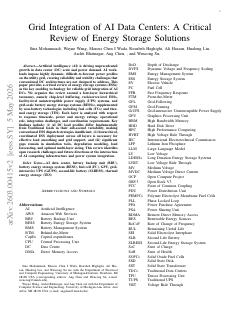
Grid Integration of AI Data Centers: A Critical Review of Energy Storage Solutions (arXiv preprint)
Layer storage by timescale (chip/server sub-ms to ms, rack ms to seconds, UPS and GiUPS sub-second to 10 s, BESS minutes to hours) and show each layer's duty in the coordination scheme.
- Rapid AI load variations often induce 5-10% voltage swings within milliseconds.
arXiv (Aalborg University) 2026
From Grid to Chip: Power Architecture, Stability, and Flexibility of AI Data Centers
For large sites, capture grid-code inputs per jurisdiction (FRT curve, MW/min ramp limit, power-quality limits) as project inputs and flag UPS settings that transfer to battery or generator on shallow sags.
- NVIDIA reports that 800 V DC instead of 415 V AC cuts copper requirements by 45%.