
Is Power Usage Effectiveness (PUE) Still Fit for Purpose? An Integrative Review of Data Center Metrics for Assessing the Environmental Impact of Modern AI Infrastructure
Journal of Science Policy & Governance (Journal of Science Policy and Governance, Inc.) · Waseq Billah, Jasmine Suarez et al.
A policy-oriented integrative review asking whether PUE still works for high-density AI facilities, identifying four blind spots and proposing a four-axis dashboard instead of a single metric.
On this page
Overview
This study by Waseq Billah, Jasmine Suarez and Erika Wolters, published in 2026 in the Journal of Science Policy & Governance (vol. 1, issue 28), is a policy-oriented integrative review. The search screened 206 hits to 54 peer-reviewed articles published between 2017 and 2025. The paper is free to read on the journal site, but no open licence is stated in the PDF, so it is not redistributed in this library. The central question is whether PUE still works for high-density AI facilities.
The study identifies four blind spots. First, PUE is carbon blind: it treats every kWh alike regardless of source. Grid intensity varies from a world average of 475 gCO2e/kWh to below 60 on clean grids and above 700 on coal-heavy grids, so a low-PUE site on a coal grid can have a worse impact than a high-PUE site on renewables. Second, PUE is purely operational and ignores embodied and end-of-life impacts. Third, it ignores local water and grid scarcity. Fourth, it treats IT energy as a single block, with no view of idle hardware or wasted computation.
Evaporative cooling can improve PUE at a high water cost, creating a perverse incentive in water-stressed regions; for example, a Microsoft data centre in North Holland used 84 million litres of drinking water in 2021, nearly five times its 12-20 million litre design estimate. WUE is annual on-site water use divided by IT energy, and WUEsource adds the water consumed in generating the electricity. Citing Lei and Masanet (2022), in a hot, dry climate a further 10% cut in water use can raise total energy use by 25%, whereas in a cool, humid climate cutting water use costs little energy.
The authors propose a four-axis dashboard instead of a single metric: infrastructure efficiency (PUE), climate impact (CUE), water footprint (WUE and WUEsource) and computational productivity (workload goodput per watt). Two sites with the same PUE can show very different shapes on the spider chart. Embodied carbon was left out because manufacturer disclosures are inconsistent. On policy, the revised EU EED requires public reporting that includes water use and waste-heat use; Singapore pairs PUE limits with Green Mark certification; the authors suggest a 100+ MW threshold for applying interconnection criteria to hyperscale sites.
Key points
- PUE is carbon blind: grid intensity runs from a 475 gCO2e/kWh world average to below 60 on clean grids and above 700 on coal-heavy grids, so a low-PUE site on coal can be worse than a high-PUE site on renewables.
- PUE derivatives such as aPUE, bPUE and cPUE add temporal or environmental sensitivity but do not fix the core limitation that PUE measures only power overhead.
- PUE treats IT energy as monolithic and cannot separate productive computation from idle hardware or wasted work, which motivates goodput metrics.
- Evaporative cooling can improve PUE at a high water cost; a Microsoft data centre in North Holland used 84 million litres of drinking water in 2021 against a 12-20 million litre design estimate.
- WUE is annual on-site water use divided by IT energy; WUEsource adds water consumed in generating the electricity, and both are needed for siting decisions.
- Water-energy tipping point: in a hot, dry climate a further 10% cut in water use can raise total energy use by 25%; in a cool, humid climate the cost is low.
- Proposed dashboard: PUE, CUE, WUE and WUEsource, and workload goodput per watt; embodied carbon left out because of inconsistent disclosures.
Using it in design
- Give the sustainability panel at least four axes (PUE, CUE, WUE/WUEsource and a placeholder for IT productivity) and show them as a radar chart, so a low PUE never appears alone.
- For CUE, use a site grid-intensity input, defaulting to 475 gCO2e/kWh with a source tag and a range of 60-700.
- When the user picks evaporative or adiabatic cooling, compute WUE, flag high WUE in water-stressed locations and warn that PUE gains are being bought with water.
- Optionally add a water-versus-energy trade-off curve by climate zone for cooling-system selection.
Monthly newsletter · free
Keep your reading list current
Once a month: new library sources, changes to Turkish regulations and upcoming data centre events.
SoSo CAD
Compare the cost of design decisions
Evaluate equipment costs, energy expenses and total cost of ownership (TCO) using your inputs and assumptions in SoSo CAD.
Request a demo
Who should read it
Engineers, policy makers and sustainability specialists who select, report or regulate data centre sustainability metrics.
Related standards
- ISO/IEC 30134-2
- ISO/IEC 30134-8
- ISO/IEC 30134-9
- EU Energy Efficiency Directive (EU) 2023/1791
Publication details
- Authors
- Waseq Billah; Jasmine Suarez; Erika Wolters
- Publisher
- Journal of Science Policy & Governance (Journal of Science Policy and Governance, Inc.)
- Year
- 2026
- Volume
- 1
- Issue
- 28
- Document language
- English
- Source type
- Scientific
- Access
- Free to read
- Licence
- Licence conditions not established — confirm the conditions with the publisher
Original licence note
Free to read on the journal site but no open licence stated in the PDF; not redistributed.
Citation
Waseq Billah; Jasmine Suarez; Erika Wolters (2026). Is Power Usage Effectiveness (PUE) Still Fit for Purpose? An Integrative Review of Data Center Metrics for Assessing the Environmental Impact of Modern AI Infrastructure. Journal of Science Policy & Governance (Journal of Science Policy and Governance, Inc.). 1(28). https://doi.org/10.38126/jspg280101
Events on this subject
Browse the events calendarAll content and rights belong to the respective authors and publishers. SoSo CAD provides only the citation, its own summary and a link to the source, and is not responsible for the sources' content.
Related sources
All sources on this topic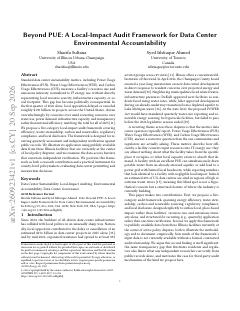
arXiv preprint (cs.CY; formatted for ACM e-Energy '26) 2026
Beyond PUE: A Local-Impact Audit Framework for Data Center Environmental Accountability
In siting and community-acceptance files, present PUE, WUE and CUE together with regional water stress, grid headroom and verification maturity (L0-L4); back project commitments with contractual limits and independent metering (L2-L3).
- Compliance gate: any unresolved major regulatory violation caps the composite score at a ceiling of 40 (suggested, subject to calibration).
European Commission, DG Energy 2025
Assessment of the energy performance and sustainability of data centres in EU - First technical report (July 2025)
Compare your design PUE target with the real EU spread: 1.21 on average above 10 MW, 1.55 at 1-2 MW; set a realistic bound for your facility size.
- Rule of thumb cited: PUE below 1.2 excellent, 1.2-1.5 good, above 1.5 room for improvement.
European Commission, DG ENER (AIT, Borderstep Institute, EY) 2025
Assessment of next steps to promote the energy performance and sustainability of data centres in EU, including the establishment of an EU-wide rating scheme - Second technical report
Align the PUE target of new designs with the proposed MPS: design PUE below 1.3 and operational PUE below 1.4 in the first three years; for existing sites plan the path to below 1.5 by 2030.
- MPS feasibility was tested across 27 data centre archetypes with selected best available techniques (BAT).
European Commission (Official Journal of the European Union) 2024
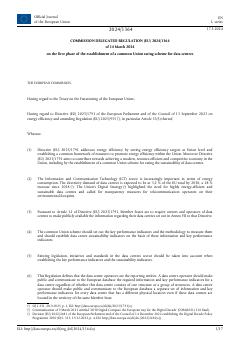
Commission Delegated Regulation (EU) 2024/1364 of 14 March 2024 on the first phase of the establishment of a common Union rating scheme for data centres
Build the metering architecture to the regulation: meters on every supply input for total energy (grid and back-up generator separately) and at every UPS output for IT energy, with a system that retains measurement point and device records for at least 10 years.
- Data centre electricity demand is projected to reach 3.2% of total EU demand by 2030, a 28% increase over 2018.
Open Compute Project Foundation 2024
Data Center Facility Sustainability Metrics (OCP Data Center Facility white paper, October 2, 2024)
Build the metering plan so that PUE can be reported at the highest category possible, with IT load measured at PDU or equipment input rather than the UPS output where feasible.
- External reporting is annual (required) and quarterly on a trailing 12 months (recommended); internal tracking should be continuous or monthly.
arXiv preprint 2026
The fallacy of sustainable Generative AI: limitations in EU environmental regulation of data centres and paths forward
For EU projects, add an EED compliance module that flags facilities of 500 kW and above as reportable.
- The second EU technical report suggests targets of PUE 1.3 for new data centres and WUE below 0.4 m3/MWh.