
Assessment of the energy performance and sustainability of data centres in EU - First technical report (July 2025)
European Commission, DG Energy · Dennis Heatubun, Ionut Dragan et al.
The first technical report of a study for European Commission DG ENER, analysing data from the first reporting period of the EU data centre reporting scheme under the Energy Efficiency Directive and Delegated Regulation (EU) 2024/1364. It supplies real European benchmark values for PUE, WUE, ERF and REF.
CC BY 4.0 — share with attribution
On this page
Overview
The report is the first deliverable of the study supporting Article 12(5) of Directive 2023/1791, prepared for the Commission by EY, AIT and Borderstep. It covers three tasks: the quality and completeness of reported data, the energy efficiency and sustainability of European data centres, and the user experience of the reporting scheme. The analysis uses first-period data as of June 20, 2025; results are preliminary and the document does not reflect the Commission's official position.
Reporting is mandatory for sites with installed IT capacity above 500 kW, and above 300 kW in Germany. In the first period about 36% of eligible EU data centres, 770 facilities, reported; six Member States have no data and five have fewer than three reporting sites. Around 80% of the reported data were judged accurate and reliable. Breakdowns by Member State, type and size are suppressed where fewer than three sites report, and aggregate metrics are weighted by total energy consumption.
In the PUE analysis of 681 sites, energy-weighted averages fall markedly with size: 1.63 for 100-500 kW, 1.64 for 500-1000 kW, 1.55 for 1-2 MW, 1.47 for 2-10 MW and 1.21 above 10 MW. The report attributes this to larger sites being younger, professionally managed and able to exploit economies of scale. Co-hosting and enterprise sites outperform colocation, where operators cannot control IT utilisation and size infrastructure for the most demanding customer. As a rule of thumb PUE below 1.2 is excellent, 1.2-1.5 good and above 1.5 shows room for improvement.
WUE is total water input divided by IT energy; only 458 sites supplied usable water data, with energy-weighted averages from 0.193 m3/MWh at 100-500 kW to 0.704 above 10 MW. Indirect water use is excluded (only EN 50600-4-9 categories 1 and 2). ERF data are very limited: in the reported data about 1.9% of heat is reused, or 23.5% when counting only sites that reuse heat. The EU weighted average REF is 0.87; about two thirds of renewable supply comes from guarantees of origin, under one third from green PPAs and below 1% from on-site generation.
The report recommends improving the scheme: review indicators not directly relevant, differentiate requirements for colocation, enterprise and co-hosting sites, harmonise rules across Member States, document each KPI clearly, add automated plausibility checks, ease navigation and allow import/export in formats such as Excel. For designers the most useful content is the real European PUE and WUE spread and the interplay among PUE, WUE, ERF and REF: improving PUE with water-intensive cooling can worsen WUE. The report openly acknowledges data quality problems.
Key points
- EU reporting is mandatory above 500 kW installed IT capacity (Germany: above 300 kW); 770 data centres, about 36% of the EU estimate, reported in the first period.
- Energy-weighted average PUE by size: 1.63 (100-500 kW), 1.64 (500-1000 kW), 1.55 (1-2 MW), 1.47 (2-10 MW), 1.21 (above 10 MW), n=681.
- Rule of thumb cited: PUE below 1.2 excellent, 1.2-1.5 good, above 1.5 room for improvement.
- Colocation sites show higher average PUE than co-hosting and enterprise sites.
- Climate Neutral Data Centre Pact targets: PUE 1.3 (1.4 in warm climates) for new sites by 2025 and existing sites by 2030, and WUE 0.4 l/kWh by 2040.
- Germany's 2023 Energy Efficiency Act: sites starting from July 2026 need PUE <= 1.3 and ERF 10%, with ERF 15% and 20% for July 2027 and 2028 starts; existing sites need PUE <= 1.5 by July 2027 and <= 1.3 by July 2030.
- WUE is total water input divided by IT energy; 458 sites reported usable data and size-class averages run from 0.193 to 0.704 m3/MWh.
- First-period EU27 averages per reporting site: installed IT power 17,075 kW (median 1,287 kW), computer room area 3,670 m2, waste heat temperature 24 °C.
- All reporting EU sites together have 3,738.86 MW installed IT power, 14,088 GWh energy use and 6,223,391 m3 water consumption.
- EU weighted average REF is 0.87; about two thirds of renewable supply comes from guarantees of origin and under 1% from on-site generation. ERF data are limited.
Using it in design
- Compare your design PUE target with the real EU spread: 1.21 on average above 10 MW, 1.55 at 1-2 MW; set a realistic bound for your facility size.
- Read targets together: Germany's EnEfG and the Climate Neutral Data Centre Pact set PUE 1.3 for new sites, while ERF targets depend on the presence of a heat offtaker.
- Assess PUE and WUE together when choosing cooling technology; the report stresses that water-intensive cooling can worsen WUE and that low PUE does not guarantee high REF.
- When planning heat reuse, confirm local heat demand and climate early; the report notes large sites struggle to find local offtakers able to take their heat continuously.
- In colocation design, remember that sizing infrastructure for the most demanding customer raises PUE; consider modular zones with different temperature and redundancy levels.
- For sites subject to reporting, design separate metering for IT and total energy, water input, renewable energy and waste heat from the start.
Monthly newsletter · free
Keep your reading list current
Once a month: new library sources, changes to Turkish regulations and upcoming data centre events.
SoSo CAD
Compare the cost of design decisions
Evaluate equipment costs, energy expenses and total cost of ownership (TCO) using your inputs and assumptions in SoSo CAD.
Request a demo
Who should read it
Engineers who design or operate data centres in the EU, sustainability and compliance teams, and policy specialists assessing the reporting scheme.
Document contents
- Introduction
- Methodologies
- Study Developments and Results
- Task 1.1 - Data quality and completeness assessment
- Data completeness assessment
- Data quality assessment
- Task 1.2 - Energy efficiency and sustainability of European data centres
- Power Usage Effectiveness (PUE)
- Water Usage Effectiveness (WUE)
- Energy Reuse Factor (ERF)
- Renewable Energy Factor (REF)
- Task 1.3 - Reporting scheme user experience and data management assessment
- Conclusion
- Recommendations to improve the reporting scheme
- Annex 1 - Data quality assessment and valid data points per KPI
- Annex 2 - Surveys and interviews
- Annexes 3 and 4 - Union and Member State level results according to Annex IV of Delegated Regulation (EU) 2024/1364
Read the document
eu-dc-energy-performance-assessment-2025.pdf
CC BY 4.0 — share with attribution
The document is provided unaltered because its licence permits redistribution.
Publication details
- Authors
- Dennis Heatubun; Ionut Dragan; Marco Bolchi; Patricia Lopes Bautista; Simon Hinterholzer; Ralph Hintemann; Nicolas Marx; Patrik Furda
- Publisher
- European Commission, DG Energy
- Year
- 2025
- Document language
- English
- Source type
- Government / public
- Access
- Open licence — downloadable
- Licence
- CC BY 4.0 — share with attribution
- Licence evidence
- doi.org
Original licence note
Document reuse notice: Commission reuse policy (Decision 2011/833/EU), licensed CC BY 4.0; attribution required; third-party elements excluded.
Citation
Dennis Heatubun; Ionut Dragan; Marco Bolchi; Patricia Lopes Bautista; Simon Hinterholzer; Ralph Hintemann; Nicolas Marx; Patrik Furda (2025). Assessment of the energy performance and sustainability of data centres in EU - First technical report (July 2025). European Commission, DG Energy. https://doi.org/10.2833/3168794
Events on this subject
Browse the events calendarAll content and rights belong to the respective authors and publishers. SoSo CAD provides only the citation, its own summary and a link to the source, and is not responsible for the sources' content.
Related sources
All sources on this topic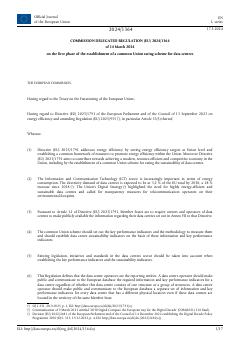
European Commission (Official Journal of the European Union) 2024
Commission Delegated Regulation (EU) 2024/1364 of 14 March 2024 on the first phase of the establishment of a common Union rating scheme for data centres
Build the metering architecture to the regulation: meters on every supply input for total energy (grid and back-up generator separately) and at every UPS output for IT energy, with a system that retains measurement point and device records for at least 10 years.
- Data centre electricity demand is projected to reach 3.2% of total EU demand by 2030, a 28% increase over 2018.
European Commission / Official Journal of the European Union 2024
Commission Delegated Regulation (EU) 2024/1364
In preliminary sustainability calculations, compute PUE, WUE, ERF and REF using the Annex III definitions.
- WUE = W_IN (m3) / E_IT (MWh).
Open Compute Project Foundation 2024
Data Center Facility Sustainability Metrics (OCP Data Center Facility white paper, October 2, 2024)
Build the metering plan so that PUE can be reported at the highest category possible, with IT load measured at PDU or equipment input rather than the UPS output where feasible.
- External reporting is annual (required) and quarterly on a trailing 12 months (recommended); internal tracking should be continuous or monthly.
arXiv preprint 2026
The fallacy of sustainable Generative AI: limitations in EU environmental regulation of data centres and paths forward
For EU projects, add an EED compliance module that flags facilities of 500 kW and above as reportable.
- The second EU technical report suggests targets of PUE 1.3 for new data centres and WUE below 0.4 m3/MWh.
Digital Realty 2025
Digital Realty: Sustainability (portfolio PUE and renewable coverage)
Use portfolio PUE of about 1.38-1.4 as the benchmark for multi-tenant colocation (against hyperscale about 1.1 and industry about 1.54).
- Portfolio PUE 1.38.
Meta 2025
Meta 2025 Environmental Data Index (data center PUE and WUE)
Take hyperscale best-in-class WUE of about 0.2 L/kWh (withdrawal basis) and PUE of about 1.08 as benchmarks.
- Total water withdrawal 3,726 ML (2020) -> 5,637 ML (2024).