
Assessment of next steps to promote the energy performance and sustainability of data centres in EU, including the establishment of an EU-wide rating scheme - Second technical report
European Commission, DG ENER (AIT, Borderstep Institute, EY) · Simon Hinterholzer, Ralph Hintemann et al.
The second technical report of the DG ENER study: it analyses data reported under Article 12, designs a multi-criteria EU data centre label and proposes minimum performance standards (MPS) for PUE, WUE and REF. It is the technical basis of the 2026 Commission data centre package.
CC BY 4.0 — share with attribution
On this page
Overview
The report is the second deliverable of the technical assistance study supporting implementation of Article 12(5) of Directive (EU) 2023/1791, produced by EY, AIT and Borderstep for the European Commission (manuscript completed August 2025, dated October 2025). It covers three tasks: Task 2.1 the need for and implementation of a common EU rating scheme, Task 2.2 ways to improve energy efficiency including minimum performance standards, and Task 2.3 the feasibility of a transition to a net-zero emission data centre sector. The analysis uses data from 748 data centres reported under EED Article 12 and received by 24 April 2025; about 600 valid entries remained per indicator.
The rating work reviews existing certification and labelling schemes (for example the Blue Angel) and, through surveys, interviews and workshops, produces a four-section multi-criteria label draft: general information on top, upstream impacts on the left (origin of electricity and water), efficiency of the building, infrastructure and IT hardware in the centre, and downstream aspects (waste heat, hardware circularity) on the right. Because it relies on existing indicators it adds little burden; annual updates and machine-readable publication are suggested. Whether the label should be public is presented as a debated topic because of trade-secret concerns.
The MPS proposal focuses on three core indicators. For PUE: operational PUE below 1.5 by 2030 for centres commissioned before 2027, and design PUE below 1.3 with operational PUE below 1.4 within three years for centres commissioned from 2027. For WUE: below 0.4 m3/MWh by 2030 for existing and from 2027 for new centres, based on net water input (Category 2). For REF: 100% on an annual balance by 2030, with a future field for hourly matching. For ERF no uniform EU standard is proposed; a location-specific 'maximum possible ERF' (MaxERF) set by local authorities is used and the actual ERF is expressed against it.
The report states its limits clearly: the data belong to the first reporting cycle and are incomplete and inconsistent; stakeholders said at least two full reporting cycles are needed for MPS, that without climate normalisation operators in warm or water-stressed regions could be penalised, and that small and legacy sites are vulnerable. The report also proposes corrections to the reporting scheme: reported IT power should be rated power, water should be standardised to WUE Category 2 (EN 50600-4-9) and cooling degree days should be retrieved automatically from Eurostat.
Key points
- Data from 748 data centres reported under EED Art. 12(5) (received by 24 April 2025) were analysed; about 600 valid entries remained per KPI.
- Proposed PUE MPS: operational PUE < 1.5 by 2030 for DCs commissioned before 2027; design PUE < 1.3 and operational PUE < 1.4 within three years for DCs commissioned from 2027.
- 56% of 600 entries already achieve PUE <= 1.5, including 49% of sites older than ten years and 46% of sites with CDD > 165.
- Proposed WUE MPS: < 0.4 m3/MWh for existing DCs by 2030 and for new DCs from 2027, using Category 2 (net water input) reporting only; 72% of 421 entries already meet it.
- A 25% local water-depletion threshold (WRI Aqueduct at NUTS3) is suggested to decide where the stricter WUE requirement should apply.
- Weighted average REF across reported data is 86.8%; a target of REF = 100% (annual balance) by 2030 is proposed, with a future field for hourly-matched renewables.
- Only 50 of 617 DCs reported any heat reuse (average outlet 25 C), so no EU-wide ERF MPS is recommended; instead ERF/MaxERF is set by local authorities.
- The proposed label has four sections: general information on top, upstream impacts on the left, efficiency in the centre, downstream aspects and circularity on the right; it relies on existing indicators.
- Reviewed schemes include rules where all cooling systems must use refrigerants with GWP < 150, and the Blue Angel sets PUE benchmarks down to 1.25.
- MPS feasibility was tested across 27 data centre archetypes with selected best available techniques (BAT).
Using it in design
- Align the PUE target of new designs with the proposed MPS: design PUE below 1.3 and operational PUE below 1.4 in the first three years; for existing sites plan the path to below 1.5 by 2030.
- When choosing cooling technology calculate WUE on a net water input (Category 2) basis and treat the below-0.4 m3/MWh target as a stricter condition in water-scarce regions.
- Report rated power (UPS, fuse protection) as IT power; the report found installed power often wrongly stated (energy consumption exactly 8,760 times the connected load).
- Track renewable supply on an hourly-matching basis in addition to the annual balance; a reporting field will be added.
- Discuss waste heat reuse with the local authority in the MaxERF framework in advance, and know that without an off-taker it will be reported as not applicable (N/A).
- Check that cooling degree days (CDD) are consistent with the location-based value retrieved from Eurostat instead of entering them yourself; the report says CDD were often reported incorrectly.
Monthly newsletter · free
Keep your reading list current
Once a month: new library sources, changes to Turkish regulations and upcoming data centre events.
SoSo CAD
Bring standards pre-checks into your project
Review model-based TS EN 50600 and Tier pre-checks, missing inputs and items requiring engineering review in SoSo CAD.
Request a demo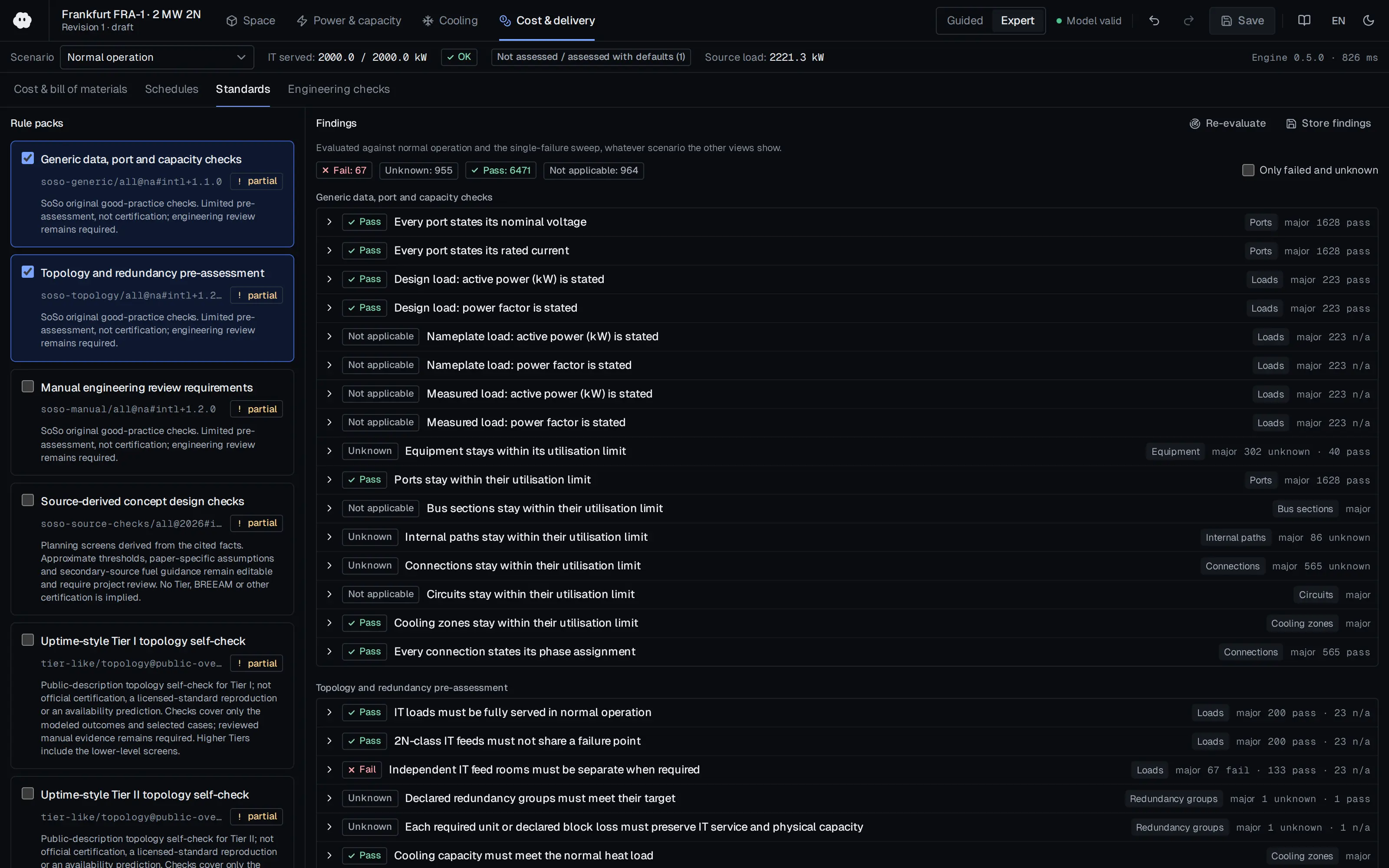
Who should read it
Engineers, compliance and policy teams designing and operating data centres in the EU and preparing for rating and minimum performance standards.
Document contents
- 1. Introduction: purpose, structure of the report, version control, acronyms, reference documents
- 2. Methodologies: Task 2 - Next steps towards a sustainable data centre sector
- 3. Study developments and results
- Task 2.1 - Assess the need and propose ways to implement a possible common EU rating scheme
- Task 2.2 - Assess the need and propose ways to improve energy efficiency, including minimum performance standards
- Task 2.3 - Assess the feasibility of a transition towards a net-zero emission data centre sector
- 4. Conclusions: the results in brief, summary of stakeholder feedback, recommendations for the data reporting scheme
- Annex 1 - Surveys/interviews
- Annex 2 - Detailed BAT rating
- Annex 3 - Archetypes
- Annex 4 - External standards, policies and initiatives
Related standards
- Directive (EU) 2023/1791
- Delegated Regulation (EU) 2024/1364
- EN 50600-4-2
- EN 50600-4-9
- ISO/IEC 30134
Read the document
eu-dc-rating-scheme-second-technical-report-2025.pdf
CC BY 4.0 — share with attribution
The document is provided unaltered because its licence permits redistribution.
Publication details
- Authors
- Simon Hinterholzer; Ralph Hintemann; Severin Beucker; Nicolas Marx; Patrik Furda; Dennis Heatubun; Ionut Dragan; Marco Bolchi; Patricia Lopes Bautista
- Publisher
- European Commission, DG ENER (AIT, Borderstep Institute, EY)
- Year
- 2025
- Document number
- MJ-01-25-123-EN-N
- Document language
- English
- Source type
- Government / public
- Access
- Open licence — downloadable
- Licence
- CC BY 4.0 — share with attribution
- Licence evidence
- op.europa.eu
Original licence note
Copyright page (PDF p.4): Decision 2011/833/EU; reuse authorised under CC BY 4.0 unless otherwise noted.
Citation
Simon Hinterholzer; Ralph Hintemann; Severin Beucker; Nicolas Marx; Patrik Furda; Dennis Heatubun; Ionut Dragan; Marco Bolchi; Patricia Lopes Bautista (2025). Assessment of next steps to promote the energy performance and sustainability of data centres in EU, including the establishment of an EU-wide rating scheme - Second technical report. European Commission, DG ENER (AIT, Borderstep Institute, EY). MJ-01-25-123-EN-N. https://doi.org/10.2833/0828045
Events on this subject
Browse the events calendarAll content and rights belong to the respective authors and publishers. SoSo CAD provides only the citation, its own summary and a link to the source, and is not responsible for the sources' content.
Related sources
All sources on this topic
European Commission 2026
Report from the Commission to the European Parliament and the Council on the energy efficiency of data centres in the EU - COM(2026) 500 final
Set the PUE target for new designs against the bands in the report (below 1.2 excellent, above 1.5 needs improvement) and possible future minimum-standard thresholds, noting that the 500-1000 kW class averaged 1.64.
- EU data centres consumed 68 TWh of electricity in 2024, expected to reach 114 TWh by 2030 (3.2% of EU electricity).
European Commission 2026
Annexes 1 to 3 to Commission Delegated Regulation C(2026) 3472 - EU data centre energy (PUE) and water (WUE) efficiency classes, data centre label, and amendments to Delegated Regulation (EU) 2024/1364
Translate PUE and WUE targets into A-G classes: class A needs a design PUE of 1.15 or below and WUE of 0.1 or below; the class D boundary is 1.5 and 0.6. Write the class target into the design specification.
- WUE classes: A <= 0.1; B 0.1-0.2; C 0.2-0.4; D 0.4-0.6; E 0.6-0.8; F 0.8-1.0; G > 1.0.
European Commission 2026
Commission Delegated Regulation C(2026) 3472 of 21.9.2026 supplementing Directive (EU) 2023/1791 and amending Delegated Regulation (EU) 2024/1364 as regards the establishment of a common Union rating scheme for data centres (main act)
As labels will be issued every year from 15 August 2027, set PUE and WUE class targets (Annex I) at design stage for new and existing sites and build the metering infrastructure to the reporting requirements.
- Labels are generated automatically by the European database every year from 15 August 2027 and are publicly available electronically in all official Union languages.
European Commission, DG Energy 2025
Assessment of the energy performance and sustainability of data centres in EU - First technical report (July 2025)
Compare your design PUE target with the real EU spread: 1.21 on average above 10 MW, 1.55 at 1-2 MW; set a realistic bound for your facility size.
- Rule of thumb cited: PUE below 1.2 excellent, 1.2-1.5 good, above 1.5 room for improvement.
European Commission (Official Journal of the European Union) 2024
Commission Delegated Regulation (EU) 2024/1364 of 14 March 2024 on the first phase of the establishment of a common Union rating scheme for data centres
Build the metering architecture to the regulation: meters on every supply input for total energy (grid and back-up generator separately) and at every UPS output for IT energy, with a system that retains measurement point and device records for at least 10 years.
- Data centre electricity demand is projected to reach 3.2% of total EU demand by 2030, a 28% increase over 2018.
European Commission, DG ENER (Viegand Maagoe and COWI) 2023
Reporting requirements on the energy performance and sustainability of data centres for the Energy Efficiency Directive - Task B report: Labelling and minimum performance standards
Add local design limits (Noord-Holland design PUE of at most 1.16, German 27 degree inlet temperature) as configurable warnings rather than hard rules, since some are drafts or local.
- The example roll-out is metrics in year 1, voluntary pass-or-fail in year 3, rating in year 5 and mandatory requirements in year 6.