
Reporting requirements on the energy performance and sustainability of data centres for the Energy Efficiency Directive - Task B report: Labelling and minimum performance standards
European Commission, DG ENER (Viegand Maagoe and COWI) · Viegand Maagoe, COWI
The study compiles data centre labelling and minimum performance rules from around the world and ranks how the EU could use EED reporting data for a rating or minimum standard. It shows where local design limits originate and which of them are only drafts.
CC BY 4.0 — share with attribution
On this page
Overview
Task B looks at what could follow the Task A reporting scheme: Article 12(5) of the EED points to a possible EU-wide sustainability label and/or minimum performance standards, especially for new and significantly refurbished data centres. The report first gathers evidence on existing instruments: national and regional legislation, voluntary initiatives, certification schemes, building-focused schemes, self-regulation and the CLC/TS 50600-5-1 maturity model. It then makes a first evaluation of options, singles out the most promising ones and describes the groundwork needed to design policy.
The compilation contains concrete numbers. French Decree 2019-771 covers tertiary buildings over 1,000 m2 and foresees reference values for data centres by IT power density (W/m2), utilisation and PUE. The German Energy Efficiency Act draft asks for PUE 1.3 and at least 30% utilisation for centres starting operation from 1 January 2025 and a minimum 27 degree air intake for new air-cooled centres from 2028. Noord-Holland requires new centres over 2,000 m2 and 5 MVA to have a design PUE of at most 1.16, EU Code of Conduct participation and an energy monitoring system accessible to the authority.
Further examples include China's 2019 guidance (PUE of 1.4 or less for new large and ultra-large centres), GB 40879-2021 (three grades, maximum allowable value 1.50, design PUE calculated from local climate), the New South Wales requirement of at least 4.5 stars NABERS for government data centres, and the US DCOI 2019 revision, which dropped PUE as not always appropriate for comparison. Voluntary schemes covered include Blauer Engel (DE-UZ 228, independent auditor), CEEDA, DCA, Singapore SS 564, the Swiss label (bronze, silver, gold, plus tag for low carbon; valid three years) and the ENERGY STAR score, which normalises PUE against a peer building group by weighted least-squares regression.
Section 7 ranks options by effectiveness: minimum performance on metrics such as PUE, REF and ERF is high impact, rating-based and voluntary pass-or-fail labels are medium or uncertain, and plain metric reporting is medium/low. An example timetable runs metric reporting in year 1, voluntary pass-or-fail in year 3, rating in year 5 and mandatory requirements in year 6 after the scheme enters into force. One stakeholder proposed design PUE below 1.3, operational PUE below 1.5 and REF above 30% for new centres; the report presents these only as a stakeholder proposal.
The study recommends no final policy; it provides a method framework. For rating, each metric must be normalised for factors outside operator control: size, type, EN 50600-1 redundancy class (1-4), cooling degree days, water availability and proximity to heat users. Base cases quantify improvement potential, and scenarios are compared with a business-as-usual projection. The report warns that mandatory requirements may have very limited impact on existing data centres and need complementing with other options.
Key points
- Noord-Holland conditions for new centres over 2,000 m2 and 5 MVA include EU Code of Conduct participation, an energy monitoring system accessible to the authority and design PUE of at most 1.16, plus a groundwater ban and annual WUE registration per ISO/IEC 30134-9.
- The German draft requires PUE 1.3 and 30% utilisation for centres operating from 1 January 2025 and a minimum 27 degree cooling air intake for new air-cooled centres from 1 January 2028; media reports add 50% unsubsidised renewable electricity from 2024 and 100% from 2025.
- French Decree 2019-771 covers tertiary buildings over 1,000 m2, with data centre reference values by IT density, utilisation and PUE.
- China's 2019 guidance targets PUE of 1.4 or less for new large and ultra-large centres; GB 40879-2021 has three grades and a maximum allowable value of 1.50, with design PUE derived from local climate.
- The Swiss Data Center Efficiency Label (2020) has bronze, silver and gold grades, a plus tag for low carbon, and three-year validity.
- New South Wales requires government-owned or leased data centres to reach at least 4.5 stars on the NABERS Infrastructure and IT Equipment rating.
- The US DCOI dropped PUE in its 2019 revision as not always appropriate for comparison across facilities, while still asking for PUE improvement over time.
- Ranking of options: minimum performance on PUE, REF and ERF has high impact; labelling options are medium or uncertain; metric reporting alone is medium/low.
- The example roll-out is metrics in year 1, voluntary pass-or-fail in year 3, rating in year 5 and mandatory requirements in year 6.
- Normalising a rating requires at least size, type, EN 50600-1 redundancy class, cooling degree days, water availability, location and year of construction or renovation.
Using it in design
- Add local design limits (Noord-Holland design PUE of at most 1.16, German 27 degree inlet temperature) as configurable warnings rather than hard rules, since some are drafts or local.
- For new air-cooled designs, compare the planned supply air temperature with 27 degrees to judge early whether a possible future requirement would be met.
- Define target PUE separately as design PUE and operating PUE; the stakeholder proposal quoted in the report also keeps them apart.
- Design energy and water (WUE) monitoring so that it can be opened to the competent authority.
- Keep the rating inputs (IT energy, rack count, redundancy class, cooling degree days, location) in the data model so the tool can later show a projected EU class.
Monthly newsletter · free
Keep your reading list current
Once a month: new library sources, changes to Turkish regulations and upcoming data centre events.
SoSo CAD
Bring standards pre-checks into your project
Review model-based TS EN 50600 and Tier pre-checks, missing inputs and items requiring engineering review in SoSo CAD.
Request a demo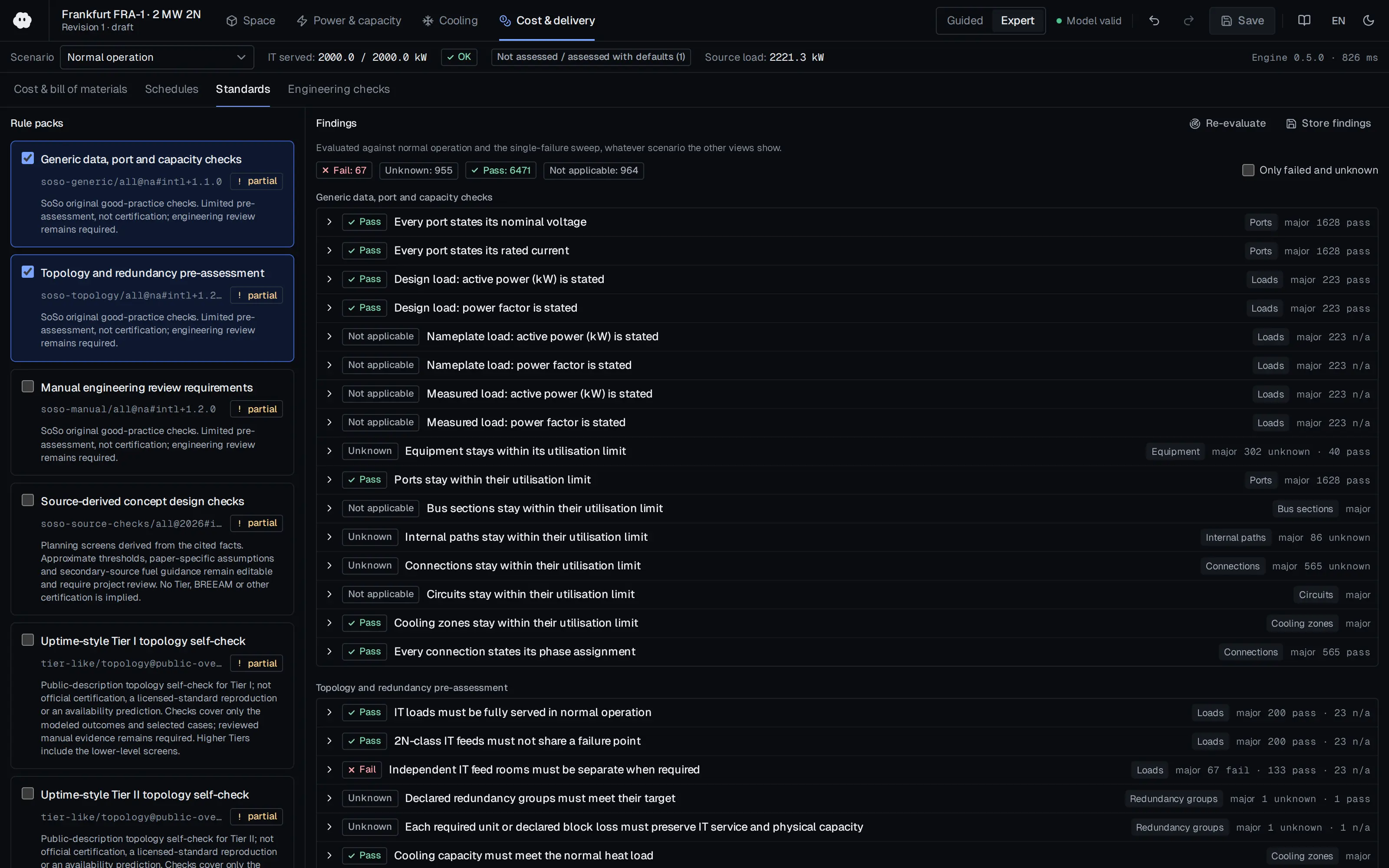
Who should read it
Design engineers, regulatory advisers and policy analysts tracking local or EU data centre efficiency requirements.
Document contents
- Introduction
- Objectives
- Structure and objectives of this document
- Evidence of existing policy instruments and potential instruments
- National and regional legislation
- Voluntary initiatives
- Voluntary certification schemes
- Building focused data centre certification schemes
- Self-regulation
- CLC/TS 50600-5-1 Maturity model for Energy management and Environmental sustainability
- Identification of policy options based on existing policies
- First evaluation of different options
- Identify a small number of most promising options
- Groundwork to design the policy options
- Voluntary labelling based on pass-or-fail criteria
- Labelling scheme based on rating or classes
- Mandatory requirements on energy metrics or on the labelling scheme
- Scenarios
Related standards
- Directive (EU) 2023/1791
- EN 50600-4-2
- ISO/IEC 30134
Read the document
eu-eed-dc-reporting-task-b-2023.pdf
CC BY 4.0 — share with attribution
The document is provided unaltered because its licence permits redistribution.
Publication details
- Authors
- Viegand Maagoe; COWI
- Publisher
- European Commission, DG ENER (Viegand Maagoe and COWI)
- Year
- 2023
- Document language
- English
- Source type
- Government / public
- Access
- Open licence — downloadable
- Licence
- CC BY 4.0 — share with attribution
- Licence evidence
- op.europa.eu
Original licence note
Copyright page: Commission reuse policy, Decision 2011/833/EU; reuse authorised under CC BY 4.0 unless otherwise noted.
Citation
Viegand Maagoe; COWI (2023). Reporting requirements on the energy performance and sustainability of data centres for the Energy Efficiency Directive - Task B report: Labelling and minimum performance standards. European Commission, DG ENER (Viegand Maagoe and COWI). https://doi.org/10.2833/74040
Events on this subject
Browse the events calendarAll content and rights belong to the respective authors and publishers. SoSo CAD provides only the citation, its own summary and a link to the source, and is not responsible for the sources' content.
Related sources
All sources on this topic
European Commission, DG ENER (AIT, Borderstep Institute, EY) 2025
Assessment of next steps to promote the energy performance and sustainability of data centres in EU, including the establishment of an EU-wide rating scheme - Second technical report
Align the PUE target of new designs with the proposed MPS: design PUE below 1.3 and operational PUE below 1.4 in the first three years; for existing sites plan the path to below 1.5 by 2030.
- MPS feasibility was tested across 27 data centre archetypes with selected best available techniques (BAT).
European Commission JRC 2019
Development of European Green Public Procurement Criteria for Data Centres - Preliminary report (JRC118550, EUR 29945 EN)
Seed the embodied-versus-operational carbon module with the roughly one third procured assets and two thirds use-stage split as a default sanity check for LCA outputs.
- IT energy share is assumed at 52% in 2010, 57% in 2015 and 67% in 2030, with a PUE of 1.5 for 2030.
European Commission, DG ENER 2026
Call for evidence for an initiative with an impact assessment - Data centres in the EU: minimum performance standards (Ares(2026)8908107)
Track this initiative as an upcoming rule pack; leave design headroom against likely MPS indicators (PUE, WUE, waste-heat reuse readiness, grid flexibility).
- Legal basis is Article 194(2) TFEU; EU action is justified to avoid divergent national approaches.

Open Compute Project Foundation 2025
Embodied Carbon Disclosure Base Specification v1 (OCP/iCA Carbon Disclosure Workstream), effective July 2025
Give catalogue items (UPS, generators, switchgear, cable, CDUs, racks, concrete) an embodied-carbon block: A1-A3 kg CO2e, functional unit, method (EPD/LCA/TM65/EEIO), verification status and emission factor source, matching this disclosure template.
- The value is normalised to a functional unit; examples are 5.1 kg CO2e per metre of cable and 700 kg CO2e per 500 kW UPS.
European Parliament and Council of the European Union 2023
Directive (EU) 2023/1791 of the European Parliament and of the Council of 13 September 2023 on energy efficiency and amending Regulation (EU) 2023/955 (recast) - Energy Efficiency Directive
If the site's installed IT power is 500 kW or more, provide in the design for the annual Annex VII reporting and the monitoring infrastructure (energy, power utilisation, temperature set points, waste heat, water, renewables); measurement is based on the EN 50600-4 family.
- Art. 12(2): data centres serving exclusively defence and civil protection are excluded.
European Commission 2026
Report from the Commission to the European Parliament and the Council on the energy efficiency of data centres in the EU - COM(2026) 500 final
Set the PUE target for new designs against the bands in the report (below 1.2 excellent, above 1.5 needs improvement) and possible future minimum-standard thresholds, noting that the 500-1000 kW class averaged 1.64.
- EU data centres consumed 68 TWh of electricity in 2024, expected to reach 114 TWh by 2030 (3.2% of EU electricity).