
Directive (EU) 2023/1791 of the European Parliament and of the Council of 13 September 2023 on energy efficiency and amending Regulation (EU) 2023/955 (recast) - Energy Efficiency Directive
European Parliament and Council of the European Union · European Parliament, Council of the European Union
The recast EU Energy Efficiency Directive (OJ L 231, 20.9.2023). For data centres the key provisions are Article 12 (annual public reporting for sites of at least 500 kW), Annex VII, Article 26(6)-(7) (waste heat use and cost-benefit analysis) and Article 33(3) (rating scheme).
EU reuse (2011/833/EU) — reuse permitted with acknowledgement of the source
On this page
Overview
The Directive establishes a common framework of measures that makes energy efficiency a priority across all sectors, removes barriers in the energy market and overcomes market failures that impede efficiency in the supply, transmission, storage and use of energy. It sets a binding 2030 target: Member States collectively ensure a reduction of energy consumption of at least 11.7% in 2030 against the projections of the 2020 EU Reference Scenario so that final energy consumption is no more than 763 Mtoe, with an indicative primary energy target of 992.5 Mtoe. The requirements are minimum requirements and Member States may keep more stringent measures.
For data centres the core is Article 12. By 15 May 2024 and every year thereafter, Member States must require owners and operators of data centres with an installed IT power demand of at least 500 kW to make the Annex VII information publicly available (except information protected by trade secret and confidentiality law). Data centres serving exclusively defence and civil protection are excluded. The Commission establishes a European database on data centres, publicly available at aggregated level.
For sites with 1 MW or more installed IT power Member States encourage consideration of the best practices of the European Code of Conduct (CoC). By 15 May 2025 the Commission assesses the data and, where appropriate, submits legislative proposals including minimum performance standards and a feasibility assessment of a transition to a net-zero emission data centre sector; such proposals may set a timeframe for existing data centres.
Annex VII defines minimum monitoring and publication content: name, owner and operators, start date and municipality; floor area, installed power, annual incoming and outgoing data traffic and amount of data stored and processed; and performance in the last full calendar year on indicators covering energy consumption, power utilisation, temperature set points, waste heat utilisation, water usage and renewable energy. These are based, where applicable, on CEN/CENELEC EN 50600-4 until the delegated act under Article 33(3) enters into force. Article 33(3) empowers the Commission to establish a common Union scheme for rating the sustainability of data centres, setting indicator definitions, key performance indicators and the measurement methodology.
Other provisions concerning data centres directly: Article 26(6) requires data centres with total rated energy input above 1 MW to use waste heat or other recovery applications unless they show this is not technically or economically feasible. Article 26(7)(d) requires an installation-level cost-benefit analysis under Annex XI for newly planned or substantially refurbished data centres above 1 MW, including seasonal heat demand and district heating/cooling connection. Article 11 requires enterprises averaging more than 85 TJ a year to have a certified energy management system (by 11 October 2027), and those above 10 TJ without one to undergo energy audits (first by 11 October 2026, then at least every four years). The Directive is a general legal text; implementation detail sits in Delegated Regulation (EU) 2024/1364 and the 2026 rating regulation.
Key points
- Art. 12(1): from 15 May 2024 and every year after, owners/operators of data centres with installed IT power demand of at least 500 kW must make the Annex VII information public (except information protected by trade secret and confidentiality law).
- Art. 12(2): data centres serving exclusively defence and civil protection are excluded.
- Art. 12(3): the Commission establishes a European database on data centres, publicly available at aggregated level.
- Art. 12(4): data centres with installed IT power of 1 MW or more are encouraged to take into account the latest EU Code of Conduct best practices.
- Art. 12(5): by 15 May 2025 the Commission assesses the data and may propose measures including minimum performance standards and a net-zero transition feasibility assessment; proposals may set a compliance timeframe for existing data centres.
- Annex VII covers name, owner, operator, start date and municipality; floor area, installed power, data traffic and data processed; and last-year indicators on energy, power utilisation, temperature set points, waste heat, water and renewables, based on EN 50600-4 until the delegated act applies.
- Art. 26(6): data centres with total rated energy input above 1 MW must use waste heat or other recovery applications unless shown technically or economically infeasible.
- Art. 26(7)(d): new or substantially refurbished data centres above 1 MW must carry out a cost-benefit analysis of waste heat use, including seasonal heat demand and district heating/cooling connection.
- Art. 11: enterprises averaging more than 85 TJ/year must implement a certified energy management system (by 11 October 2027); those above 10 TJ without one must undergo energy audits.
- Recitals cite EU data centre consumption of 76.8 TWh in 2018, expected to rise to 98.5 TWh by 2030 (+28%); in 2018 data centres accounted for 2.7% of Union electricity demand.
Using it in design
- If the site's installed IT power is 500 kW or more, provide in the design for the annual Annex VII reporting and the monitoring infrastructure (energy, power utilisation, temperature set points, waste heat, water, renewables); measurement is based on the EN 50600-4 family.
- For a site with total rated energy input above 1 MW prepare the Annex XI cost-benefit analysis (including seasonal demand and district heating/cooling connection) at design stage to show whether waste heat use is technically or economically infeasible.
- At 1 MW or more of installed IT power use the latest EU Code of Conduct best practices as a design checklist.
- For operators whose company-level annual energy consumption exceeds 85 TJ add a certified energy management system (by 11 October 2027), and above 10 TJ an energy audit, to project requirements.
- Follow later steps such as minimum performance standards and rating through Delegated Regulation (EU) 2024/1364 and the 2026 rating regulation; the Directive is the legal basis for those instruments.
Monthly newsletter · free
Keep your reading list current
Once a month: new library sources, changes to Turkish regulations and upcoming data centre events.
SoSo CAD
Bring standards pre-checks into your project
Review model-based TS EN 50600 and Tier pre-checks, missing inputs and items requiring engineering review in SoSo CAD.
Request a demo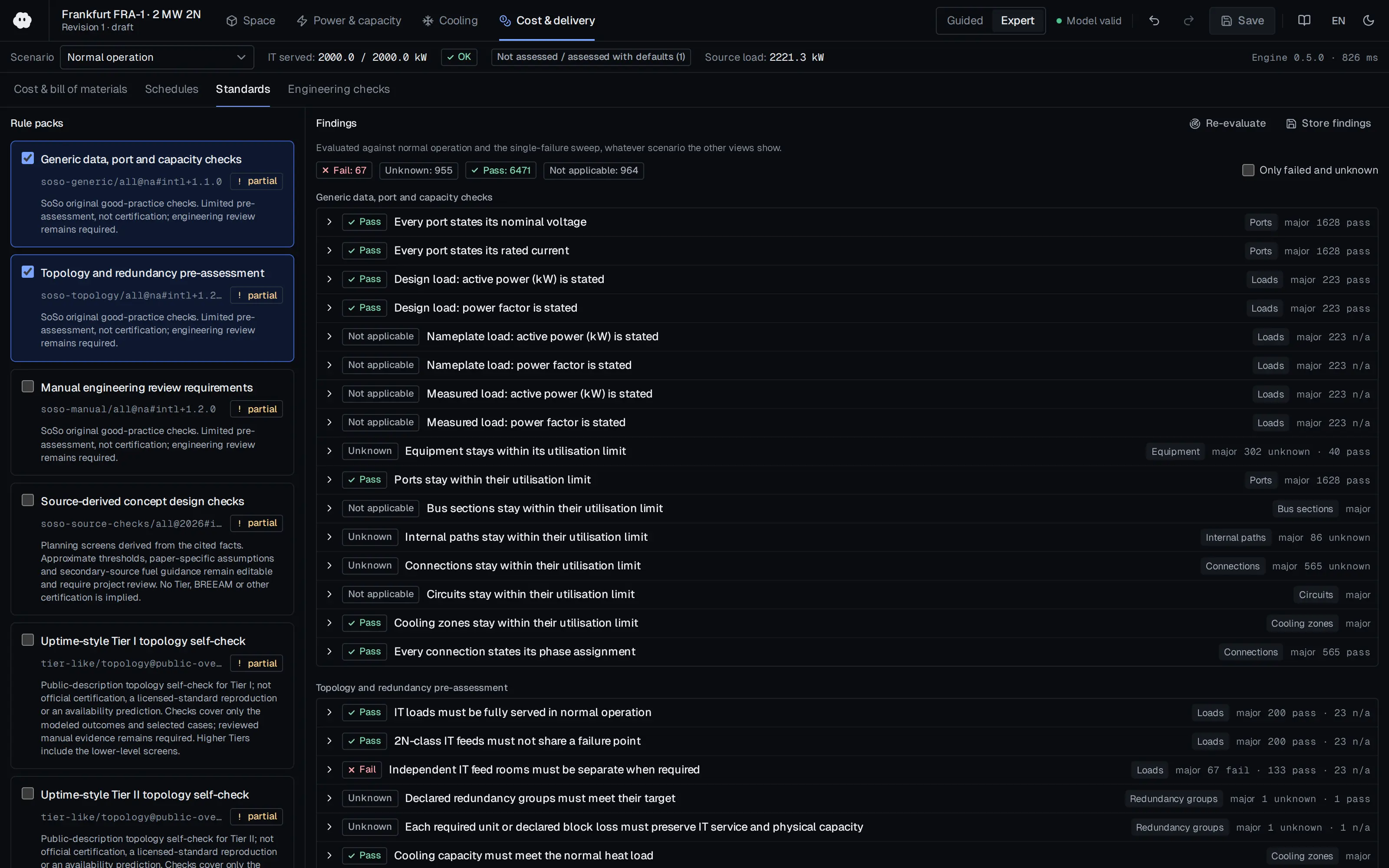
Who should read it
Engineers, compliance and legal teams designing, operating or reporting on data centres in the EU.
Document contents
- Chapter I Subject matter, scope, definitions and energy efficiency targets (Articles 1-4)
- Chapter II Exemplary role of public sector (Articles 5-7)
- Chapter III Efficiency in energy use (Articles 8-20)
- Article 11 Energy management systems and energy audits
- Article 12 Data centres
- Chapter IV Consumer information and empowerment (Articles 21-24)
- Chapter V Efficiency in energy supply (Articles 25-27)
- Article 26 Heating and cooling supply
- Chapter VI Horizontal provisions (Articles 28-31)
- Chapter VII Final provisions (Articles 32-40)
- Article 33 Delegated acts
- Annex I National contributions to the Union's energy efficiency targets in 2030
- Annex VII Minimum requirements for monitoring and publishing the energy performance of data centres
- Annex XI Cost-benefit analyses
- Annex XVII Correlation table
Related standards
- Delegated Regulation (EU) 2024/1364
- C(2026) 3472
- EN 50600-4
- Commission Recommendation (EU) 2024/2395
- Commission Recommendation (EU) 2024/2002
Read the document
eu-dir-2023-1791-energy-efficiency-directive.pdf
EU reuse (2011/833/EU) — reuse permitted with acknowledgement of the source
The document is provided unaltered because its licence permits redistribution.
Publication details
- Authors
- European Parliament; Council of the European Union
- Publisher
- European Parliament and Council of the European Union
- Year
- 2023
- Document number
- Directive (EU) 2023/1791 (CELEX 32023L1791)
- Document language
- English
- Source type
- Expert / community
- Access
- Open licence — downloadable
- Licence
- EU reuse (2011/833/EU) — reuse permitted with acknowledgement of the source
- Licence evidence
- eur-lex.europa.eu
Original licence note
Official Journal text downloaded from EUR-Lex; the EUR-Lex legal notice authorises reuse under Commission Decision 2011/833/EU (only the OJ authentic version is legally binding).
Citation
European Parliament; Council of the European Union (2023). Directive (EU) 2023/1791 of the European Parliament and of the Council of 13 September 2023 on energy efficiency and amending Regulation (EU) 2023/955 (recast) - Energy Efficiency Directive. European Parliament and Council of the European Union. Directive (EU) 2023/1791 (CELEX 32023L1791). https://eur-lex.europa.eu/legal-content/EN/TXT/PDF/?uri=CELEX:32023L1791
Events on this subject
Browse the events calendarAll content and rights belong to the respective authors and publishers. SoSo CAD provides only the citation, its own summary and a link to the source, and is not responsible for the sources' content.
Related sources
All sources on this topic
European Commission JRC 2019
Development of European Green Public Procurement Criteria for Data Centres - Preliminary report (JRC118550, EUR 29945 EN)
Seed the embodied-versus-operational carbon module with the roughly one third procured assets and two thirds use-stage split as a default sanity check for LCA outputs.
- IT energy share is assumed at 52% in 2010, 57% in 2015 and 67% in 2030, with a PUE of 1.5 for 2030.
European Commission 2026
Report from the Commission to the European Parliament and the Council on the energy efficiency of data centres in the EU - COM(2026) 500 final
Set the PUE target for new designs against the bands in the report (below 1.2 excellent, above 1.5 needs improvement) and possible future minimum-standard thresholds, noting that the 500-1000 kW class averaged 1.64.
- EU data centres consumed 68 TWh of electricity in 2024, expected to reach 114 TWh by 2030 (3.2% of EU electricity).
European Commission 2026
Annexes 1 to 3 to Commission Delegated Regulation C(2026) 3472 - EU data centre energy (PUE) and water (WUE) efficiency classes, data centre label, and amendments to Delegated Regulation (EU) 2024/1364
Translate PUE and WUE targets into A-G classes: class A needs a design PUE of 1.15 or below and WUE of 0.1 or below; the class D boundary is 1.5 and 0.6. Write the class target into the design specification.
- WUE classes: A <= 0.1; B 0.1-0.2; C 0.2-0.4; D 0.4-0.6; E 0.6-0.8; F 0.8-1.0; G > 1.0.
European Commission 2026
Commission Delegated Regulation C(2026) 3472 of 21.9.2026 supplementing Directive (EU) 2023/1791 and amending Delegated Regulation (EU) 2024/1364 as regards the establishment of a common Union rating scheme for data centres (main act)
As labels will be issued every year from 15 August 2027, set PUE and WUE class targets (Annex I) at design stage for new and existing sites and build the metering infrastructure to the reporting requirements.
- Labels are generated automatically by the European database every year from 15 August 2027 and are publicly available electronically in all official Union languages.
arXiv preprint (cs.AI), Harvard T.H. Chan School of Public Health 2026
Assessing the Carbon Emissions and Energy Consumption of U.S. Hyperscale Data Centers
In fleet or facility energy estimation, use capacity × 8,760 × facility-load coefficient (0.48-0.70, central 0.58) and report the range (67.7-98.6 TWh) explicitly.
- State-level intensities (central scenario): Virginia 535, Oregon 440, Iowa 645, Nebraska 740, Wyoming 1035 gCO2/kWh; Virginia had 142 HDCs, 21.0 TWh, 11.5 Mt.
Applied Energy (Elsevier BV) 2025
Accounting carbon emissions from electricity generation: a review and comparison of emission factor-based methods
In data-centre carbon accounting, state the method (Tier 1, 2, 3) and factor source (IPCC or national) when choosing a grid emission factor; simple methods can underestimate generation emissions by about 73%.
- AEF for the North zone by Method 5 rose from 0.1627 tCO2/MWh in 2016 to 0.4709 in 2022, then fell to 0.3936 in 2023.