Topic guide

Sustainability

Browse publications on environmental impacts, carbon, resource use and life cycles. Compare assessment methods while reviewing their scope, data periods and reporting boundaries alongside the original sources.

Sources
201
Downloadable PDFs
66
Years
2007–2026

All sources

25–48 / 201

Technical guidePDF

Open Compute Project Foundation 2026

Clean Backup Power Technology Requirements, Base Specification Version 0.3 (effective Apr 22, 2026)

Extend the generator catalogue with technology type (diesel, HVO, gas, H2 ICE, PEM fuel cell), emissions factor relative to the 1742 lb/MWh baseline, start time, block-load capability and NFPA 110 level.

  • Overload 110% for 60 s and 150% for 3 s; transient voltage response to ISO 8528-5 G3; steady-state frequency within +/-0.5%.
RegulationPDF

European Commission 2024

Commission Recommendation (EU) 2024/2395 of 2 September 2024 setting out guidelines for the interpretation of Article 26 of Directive (EU) 2023/1791 as regards heating and cooling supply requirements

When testing the 1 MW waste heat threshold, compute "total rated energy input" from rated capacity (for example utility connection or rated IT plus infrastructure), not modelled annual energy, and take the measurement point at the handover of electricity supply.

  • CBA thresholds: thermal electricity generation 10 MW, industrial installation 8 MW, service facility 7 MW, data centre 1 MW.
RegulationPDF

European Commission 2019

Commission Staff Working Document SWD(2019) 106 - Impact Assessment accompanying Commission Regulation laying down ecodesign requirements for servers and data storage products

In the what-if module show direct and infrastructure savings separately for IT refresh scenarios: the document finds infrastructure savings exceed direct IT savings, which supports showing that every watt saved in IT also saves cooling and power infrastructure energy.

  • The preferred option 3.2 saves 6.5 TWh per year in 2020 and 8.9 TWh in 2030.
White paperPDF

Open Compute Project Foundation 2023

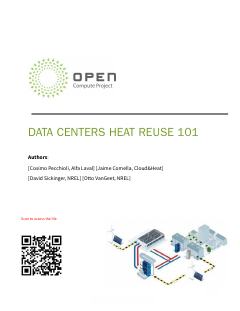
Data Centers Heat Reuse 101

A heat-reuse module should report recoverable heat (kW) and its temperature band by cooling technology (air, RDHx, DLC/immersion) and suggest compatible heat-host categories.

  • Containerised/modular data centres can exceed 0.5 MW, a significant heat quantity for many local applications.
Research paperPDF

Energy Efficiency (Springer Science and Business Media LLC) 2019

Data centres in future European energy systems—energy efficiency, integration and policy

In waste-heat sales, set outlet temperature by cooling technology (air 25-35 °C, liquid up to 60 °C, two-phase up to 90 °C) and check heat-pump requirement against the district-heating generation (45-55 °C for 4G).

  • Fourth-generation district heating can run with supply temperatures of 45 to 55 °C.
Research paperPDF

WSEAS TRANSACTIONS ON POWER SYSTEMS (World Scientific and Engineering Academy and Society (WSEAS)) 2026

Design and Prototype of a Microgrid for Enhancing Reliability of Power Supply for Artificial Intelligence Data Centers

Follow the energy-balance chain in a PV/BESS sizing helper (daily load split, conversion losses, usable depth of discharge, power rating against night peak); report usable-energy duration rather than nameplate duration and make DoD an explicit input.

  • Covering 60% of demand needs 81,857 kWh/day from PV after 5% DC-AC and 10% battery losses.
RegulationPDF

European Parliament and Council of the European Union 2023

Directive (EU) 2023/1791 of the European Parliament and of the Council of 13 September 2023 on energy efficiency and amending Regulation (EU) 2023/955 (recast) - Energy Efficiency Directive

If the site's installed IT power is 500 kW or more, provide in the design for the annual Annex VII reporting and the monitoring infrastructure (energy, power utilisation, temperature set points, waste heat, water, renewables); measurement is based on the EN 50600-4 family.

  • Art. 12(2): data centres serving exclusively defence and civil protection are excluded.
Technical guidePDF

Open Compute Project Foundation 2025

Embodied Carbon Disclosure Base Specification v1 (OCP/iCA Carbon Disclosure Workstream), effective July 2025

Give catalogue items (UPS, generators, switchgear, cable, CDUs, racks, concrete) an embodied-carbon block: A1-A3 kg CO2e, functional unit, method (EPD/LCA/TM65/EEIO), verification status and emission factor source, matching this disclosure template.

  • The value is normalised to a functional unit; examples are 5.1 kg CO2e per metre of cable and 700 kg CO2e per 500 kW UPS.
Research paperPDF

Applied Sciences (MDPI AG) 2025

Energy Efficiency Through Waste-Heat Recovery: Hybrid Data-Centre Cooling in District Heating Applications

When connecting waste heat to DH, fix the DH generation early: for 5G and 4G direct heat-exchanger connection suffices (PUE below 1.6, ERF above 0.85), while 3G needs a high-temperature heat pump (PUE about 2.1, payback about 14 years).

  • The hybrid cooling system has a DLC loop at 25-30 °C and a CRCC (chilled-water rack cooler) loop at 10-15 °C.

All content and rights belong to the respective authors and publishers. SoSo CAD provides only the citation, its own summary and a link to the source, and is not responsible for the sources' content.

Monthly newsletter · free

Keep your reading list current

Once a month: new library sources, changes to Turkish regulations and upcoming data centre events.