
Commission Staff Working Document SWD(2019) 106 - Impact Assessment accompanying Commission Regulation laying down ecodesign requirements for servers and data storage products
European Commission
The impact assessment behind Regulation (EU) 2019/424. It sizes EU data centre and server/storage electricity use, compares policy options and quantifies energy, CO2 and economic impacts of the preferred option.
EU reuse (2011/833/EU) — reuse permitted with acknowledgement of the source
On this page
Overview
The document applies the significance and proportionality tests of the ecodesign framework to show why servers and data storage products should be regulated. On scale, EU-28 data centre electricity use (servers, storage and network equipment) was estimated at 78 TWh in 2015, 2.5% of final electricity consumption. Servers and storage alone used about 53 TWh (2%) in 2015 and are projected at 55 TWh in 2020 and 78 TWh in 2030; including infrastructure such as cooling, the figure is 96 TWh in 2015 (3.2%) and 121 TWh in 2030. Industry revenue in 2015 was estimated at about EUR 55 billion.
For the energy split inside data centres, a table assumes IT at 52% in 2010, 57% in 2015 and 65% from 2020, with 2020-2030 values interpolated assuming a business-as-usual PUE of 1.55 in 2030. The document also cites the EURECA project's analysis of more than 350 public administration data centres, which found average annual server utilisation of around 20%; this supports the focus on idle power. Underlying drivers include lack of functional information on energy and resources, and split incentives.
The options are business as usual (1), self-regulation (2, discarded because industry proposed none), ecodesign requirements (3), energy labelling (4, discarded because B2B products lack a suitable metric and data) and a complementary approach such as ENERGY STAR (5). Option 3 is assessed in six components: PSU minimum efficiency (for example in scenario 3.2 Gold in 2019, Platinum in 2023, Titanium in 2026), operating temperature information or ASHRAE-based minimum requirements, idle power, SERT-based performance, information requirements and material efficiency. Scenarios 3.1, 3.2 and 3.3 differ in stringency.
The preferred option is 3.2. For servers, 2030 savings are about 2.4 TWh direct and 3.7 TWh indirect (infrastructure), 6.1 TWh in total (2.1 Mt CO2e); for storage 0.8 TWh direct and 2 TWh indirect, 2.8 TWh (0.9 Mt CO2e); in total 6.5 TWh in 2020 and 8.9 TWh in 2030. In the scenario comparison, 2030 server savings including infrastructure are 2.7 TWh for 3.1, 6.1 TWh for 3.2 and 15.3 TWh for 3.3. The most ambitious 3.3 assumes 100% adoption and is treated as overly optimistic, since actually raising operating temperature depends on operator behaviour.
Long-term projections are treated as uncertain because of rapid technological change. Scenario 3.2 assumes 30% of data centres adopt higher operating conditions; at 15% adoption savings including infrastructure fall by about a third or more (5.6 TWh for servers and storage), and at 45% they rise to 12.1 TWh (a 36% increase). The document proposes a review within four years and lists monitoring indicators such as PSU efficiency compliance, idle power, presence of temperature information and material efficiency items such as ease of disassembly.
Key points
- EU-28 data centre electricity (servers, storage, network) was estimated at 78 TWh in 2015, about 2.5% of final electricity consumption.
- Servers and storage alone used about 53 TWh in 2015, projected 55 TWh in 2020 and 78 TWh in 2030; including infrastructure 96 TWh in 2015 and 121 TWh in 2030.
- The preferred option 3.2 saves 6.5 TWh per year in 2020 and 8.9 TWh in 2030.
- In 2030 servers save about 2.4 TWh direct plus 3.7 TWh infrastructure (6.1 TWh, 2.1 Mt CO2e); storage 0.8 TWh direct plus 2 TWh indirect (2.8 TWh, 0.9 Mt CO2e).
- Server and storage industry revenue was estimated at about EUR 55 billion in 2015.
- IT energy share is assumed at 52% in 2010, 57% in 2015 and 65% after 2020; a PUE of 1.55 is used for the 2030 business-as-usual case.
- The EURECA project found average annual server utilisation of around 20% across more than 350 public data centres.
- Energy labelling was discarded for lack of a suitable metric and data for B2B products, and self-regulation because industry proposed none.
- Scenario 3.2 assumes 30% of data centres adopt higher operating temperatures through the information requirement; at 15% savings fall to 5.6 TWh, at 45% they rise to 12.1 TWh.
- A review within four years is proposed; monitoring covers PSU efficiency, idle power, operating temperature information and disassemblability.
Using it in design
- In the what-if module show direct and infrastructure savings separately for IT refresh scenarios: the document finds infrastructure savings exceed direct IT savings, which supports showing that every watt saved in IT also saves cooling and power infrastructure energy.
- Use the declared operating condition class (A1-A4) when choosing inlet temperature targets for a new hall; the document's purpose for this information requirement is to let operators raise operating temperature safely.
- For low-utilisation server room retrofits, treat roughly 20% average server utilisation as a starting assumption and show the savings potential of consolidation and virtualisation.
- Idle power matters, but industry experts argue it is not a sufficient efficiency proxy by itself; compare servers on idle power together with SERT-based active state efficiency.
- Whether operators actually raise operating temperature depends on behaviour; model the adoption rate (for example 15%, 30%, 45%) as a sensitivity parameter in temperature-increase savings.
Monthly newsletter · free
Keep your reading list current
Once a month: new library sources, changes to Turkish regulations and upcoming data centre events.
SoSo CAD
Bring standards pre-checks into your project
Review model-based TS EN 50600 and Tier pre-checks, missing inputs and items requiring engineering review in SoSo CAD.
Request a demo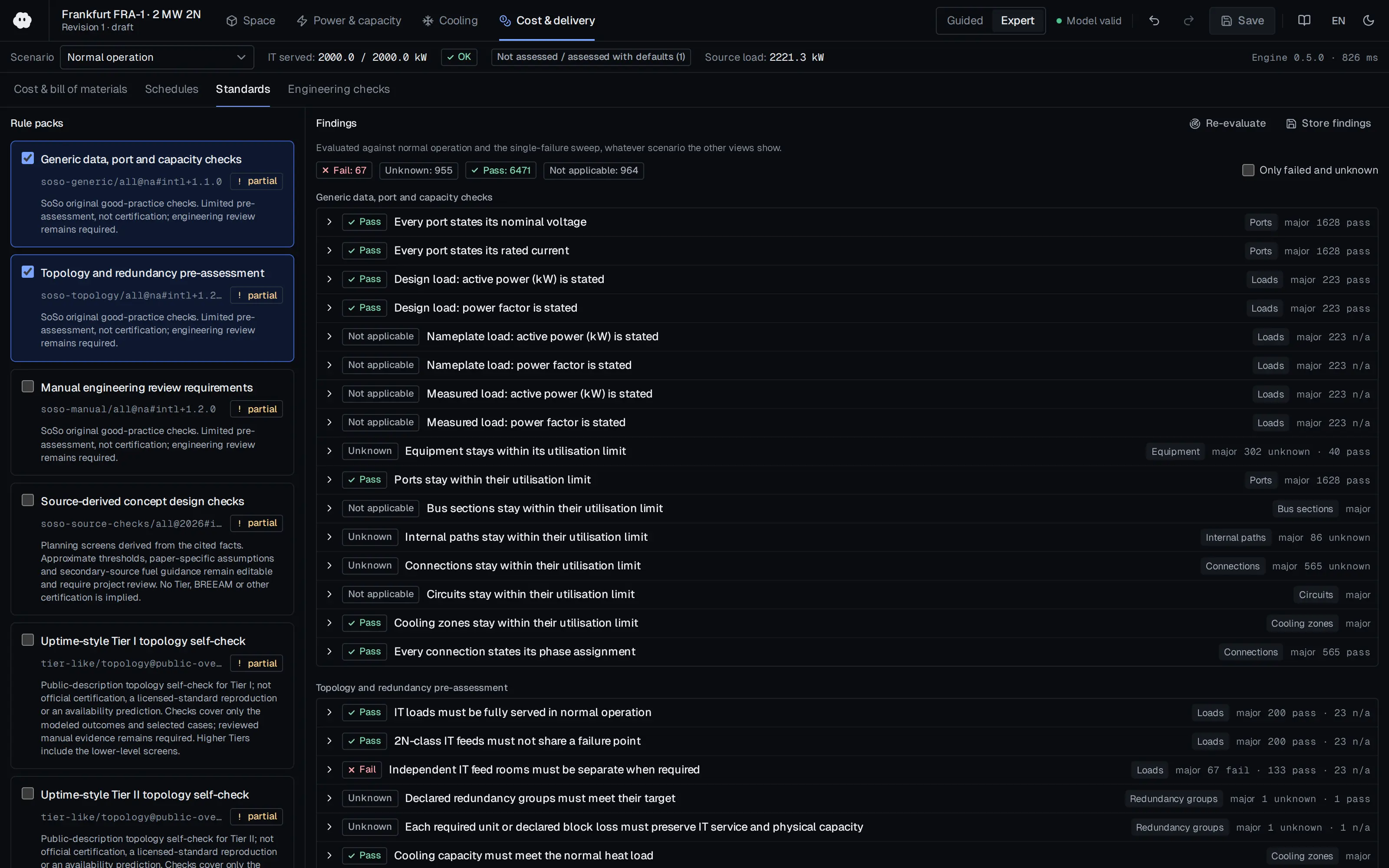
Who should read it
Engineers, policy analysts and researchers who want the reasoning, energy figures and economic impacts behind the server and storage ecodesign regulation.
Document contents
- Introduction
- Problem definition
- What is the scale of the problem?
- What are the underlying drivers of the problem?
- Who is affected, in what ways and to what extent?
- How are existing policies and legislation affecting the issue?
- Baseline scenario: How will the issue evolve in absence of intervention?
- Should the EU act?
- Policy objectives
- Policy options
- Minimum efficiency requirements for power supply units
- Operating temperature information requirements
- Requirement on the idle mode energy consumption
- Information or MEPS requirement on servers' performance (e.g. SERT-based)
- Material efficiency requirements
- Option 5: Complementary regulatory approaches - compulsory Energy Star
- Analysis of impacts
- Comparison of options
- Evaluation and monitoring
- Annexes
Related standards
- Regulation (EU) 2019/424
Read the document
eu-swd-2019-106-ecodesign-servers-impact-assessment.pdf
EU reuse (2011/833/EU) — reuse permitted with acknowledgement of the source
The document is provided unaltered because its licence permits redistribution.
Publication details
- Authors
- European Commission
- Publisher
- European Commission
- Year
- 2019
- Document number
- SWD(2019) 106 final (CELEX 52019SC0106)
- Document language
- English
- Source type
- Government / public
- Access
- Open licence — downloadable
- Licence
- EU reuse (2011/833/EU) — reuse permitted with acknowledgement of the source
- Licence evidence
- eur-lex.europa.eu
Original licence note
Downloaded from EUR-Lex / Publications Office; EUR-Lex legal notice authorises reuse of EU legal texts and Commission documents under Decision 2011/833/EU. Consolidated texts are documentation only; OJ versions are authentic.
Citation
European Commission (2019). Commission Staff Working Document SWD(2019) 106 - Impact Assessment accompanying Commission Regulation laying down ecodesign requirements for servers and data storage products. European Commission. SWD(2019) 106 final (CELEX 52019SC0106). https://op.europa.eu/o/opportal-service/download-handler?identifier=11bb88df-471c-11e9-a8ed-01aa75ed71a1&format=pdf&language=en&productionSystem=cellar
Events on this subject
- iMasons Climate Accord Summit
- ICCI 2027 – Uluslararası Enerji ve Çevre Fuarı ve Konferansı
- The smarter E Europe (Intersolar Europe, ees Europe, Power2Drive, EM-Power)
All content and rights belong to the respective authors and publishers. SoSo CAD provides only the citation, its own summary and a link to the source, and is not responsible for the sources' content.
Related sources
All sources on this topic
European Commission 2024
Commission Recommendation (EU) 2024/2395 of 2 September 2024 setting out guidelines for the interpretation of Article 26 of Directive (EU) 2023/1791 as regards heating and cooling supply requirements
When testing the 1 MW waste heat threshold, compute "total rated energy input" from rated capacity (for example utility connection or rated IT plus infrastructure), not modelled annual energy, and take the measurement point at the handover of electricity supply.
- CBA thresholds: thermal electricity generation 10 MW, industrial installation 8 MW, service facility 7 MW, data centre 1 MW.
European Commission 2020
EU green public procurement criteria for data centres, server rooms and cloud services - SWD(2020) 55 final
Create an "EU GPP 2020 (core/comprehensive)" compliance profile: check refrigerant GWP <= 10 in the cooling catalogue, REF = 1 for third-party facilities, ICT class A2/A3 and the W class of liquid loops.
- AC11 points: x for GWP 0-10, 0.6x for 11-150, 0.2x for 151-750.
European Commission JRC 2019
Development of European Green Public Procurement Criteria for Data Centres - Preliminary report (JRC118550, EUR 29945 EN)
Seed the embodied-versus-operational carbon module with the roughly one third procured assets and two thirds use-stage split as a default sanity check for LCA outputs.
- IT energy share is assumed at 52% in 2010, 57% in 2015 and 67% in 2030, with a PUE of 1.5 for 2030.
Open Compute Project Foundation 2024
Policies to Accelerate Data Center Heat Reuse: Achieving Economic and Climate Change Goals, Revision 1.0
Add a jurisdiction-aware compliance check: for German sites flag PUE 1.3 and the 10/15/20% energy-reuse targets by commissioning date.
- Since 2021 Norway recommends heat reuse assessment for data centres above 2 MW.
European Parliament and Council of the European Union 2023
Directive (EU) 2023/1791 of the European Parliament and of the Council of 13 September 2023 on energy efficiency and amending Regulation (EU) 2023/955 (recast) - Energy Efficiency Directive
If the site's installed IT power is 500 kW or more, provide in the design for the annual Annex VII reporting and the monitoring infrastructure (energy, power utilisation, temperature set points, waste heat, water, renewables); measurement is based on the EN 50600-4 family.
- Art. 12(2): data centres serving exclusively defence and civil protection are excluded.
T.C. Çevre, Şehircilik ve İklim Değişikliği Bakanlığı 2008
Binalarda Enerji Performansı Yönetmeliği (Regulation on Energy Performance of Buildings)
In the building/sustainability module (TR profile), add an NSEB check for buildings of 2,000 m2 and above: target class B and at least 10 percent of primary energy from on-site renewables.
- The text is consolidated with the 2025-2026 amendments.