
Policies to Accelerate Data Center Heat Reuse: Achieving Economic and Climate Change Goals, Revision 1.0
Open Compute Project Foundation
The second white paper of the OCP Heat Reuse sub-project surveys government policies that require, recommend or incentivise reuse of data centre waste heat (EU, Germany, the Netherlands, Norway, the US, Singapore and others). It works as a call to action for policy makers, the industry and heat users.
CC BY-SA 4.0 — share with attribution under the same licence
On this page
Overview
The document starts from the observation that data centres run year-round like large heat pumps and turn practically all the electricity they use into heat. The heat can be sold to end users with a zero carbon footprint, and its price depends on the end user's infrastructure savings and on the data centre's avoided cooling operating costs. Candidate users are space and district heating, pharmaceuticals, food and beverage, commercial cooling (hospital campuses, laboratories and large buildings, described as most compatible with data centres of 1 to 10 MW), bio-ethanol, water treatment and general hot-water preheating; in the hotel industry water heating makes up almost a third of energy use.
Barriers fall under four headings: lack of knowledge of the technology and opportunity, lack of proximity and connections between data centres and heat users (planning and zoning usually run separately), project development risks and costs (energy companies often want commitments of 10 years or more, longer than some data centre owners' financial horizon) and a lack of national and sub-national policy. Local climate means heat demand is not constant year-round, so using 100% of recaptured heat at all times is hard. Germany requires proximity of off-takers to be considered in data centre site selection.
Policy examples fall into three groups. Requirements and recommendations: the EU Energy Efficiency Directive (EED; the revision in force from October 2023 requires exportable excess heat to be reported from 2024 and has Member States encourage centres with 1 MW or more installed IT demand to apply the European Code of Conduct best practices), the EU Taxonomy, Germany's EnEfG (2023), Greater Amsterdam, Norway recommending assessment above 2 MW since 2021, the US and Singapore's SS 564. Information and matching: the EU Heat and Cold Matching Platform, Bytes2Heat, Ireland's Heat Atlas and the Norwegian heat map. Incentives: Washington State industrial symbiosis grants, Germany's three-billion-euro district heating fund, France's fonds chaleur, Quebec grants, Denmark's tax repeal and the UK's 65 million pound funding.
The appendix details selected policies. For EnEfG the draft provisions are PUE of 1.3 within 2 years for data centres operating on or after 1 July 2026, and a reused-energy share of at least 10%, 15% for starts from 1 July 2027 and a planned 20% from 1 July 2028. Washington grants require one-to-one non-state matching and are capped at USD 500,000 each. The document is a compilation rather than a legal source, states that policies may change and does not claim to be comprehensive.
Key points
- Heat users with year-round cooling demand such as hospital campuses, laboratories and large buildings are described as most compatible with data centres of roughly 1 to 10 MW.
- Main barriers: lack of knowledge, lack of proximity and connections, project risk and cost (energy companies want commitments of 10 years or more), and a policy gap.
- The revised EU EED took effect in October 2023; exportable excess heat must be reported from 2024; centres with 1 MW or more installed IT demand are encouraged to apply European Code of Conduct best practices.
- The EU Taxonomy requires data centres to follow Code of Conduct expected practices with third-party verification for a substantial contribution to climate change mitigation.
- Germany's EnEfG (2023) places heat-reuse and efficiency duties on data centres and on businesses using more than 15 GWh per year.
- EnEfG as summarised: PUE 1.3 within 2 years for centres operating from 1 July 2026; reused-energy share at least 10% (1 July 2026), 15% (1 July 2027) and a planned 20% (1 July 2028).
- Since 2021 Norway recommends heat reuse assessment for data centres above 2 MW.
- Washington State industrial symbiosis grants require one-to-one non-state matching and are capped at USD 500,000 each.
- Incentive examples: Germany's three-billion-euro district heating fund through 2026, the UK's 65 million pounds for five projects, US DOE COOLERCHIPS with 40 million dollars for 15 projects.
Using it in design
- Add a jurisdiction-aware compliance check: for German sites flag PUE 1.3 and the 10/15/20% energy-reuse targets by commissioning date.
- For EU sites of 1 MW IT or more, require EED reporting fields including exportable waste heat.
- Expose ERF and ERE as first-class metrics in the energy model so heat-reuse designs can be scored against these thresholds.
- Treat proximity to a heat host as a site-selection criterion for heat-reuse sites; in Germany it is expected to be considered in siting.
- Treat the policy summary as secondary and link users to primary legal texts for final verification.
- Show the mismatch between heat-host contracts of 10 years or more and the shorter financial horizon of data centre owners as a project risk.
Monthly newsletter · free
Keep your reading list current
Once a month: new library sources, changes to Turkish regulations and upcoming data centre events.
SoSo CAD
Compare the cost of design decisions
Evaluate equipment costs, energy expenses and total cost of ownership (TCO) using your inputs and assumptions in SoSo CAD.
Request a demo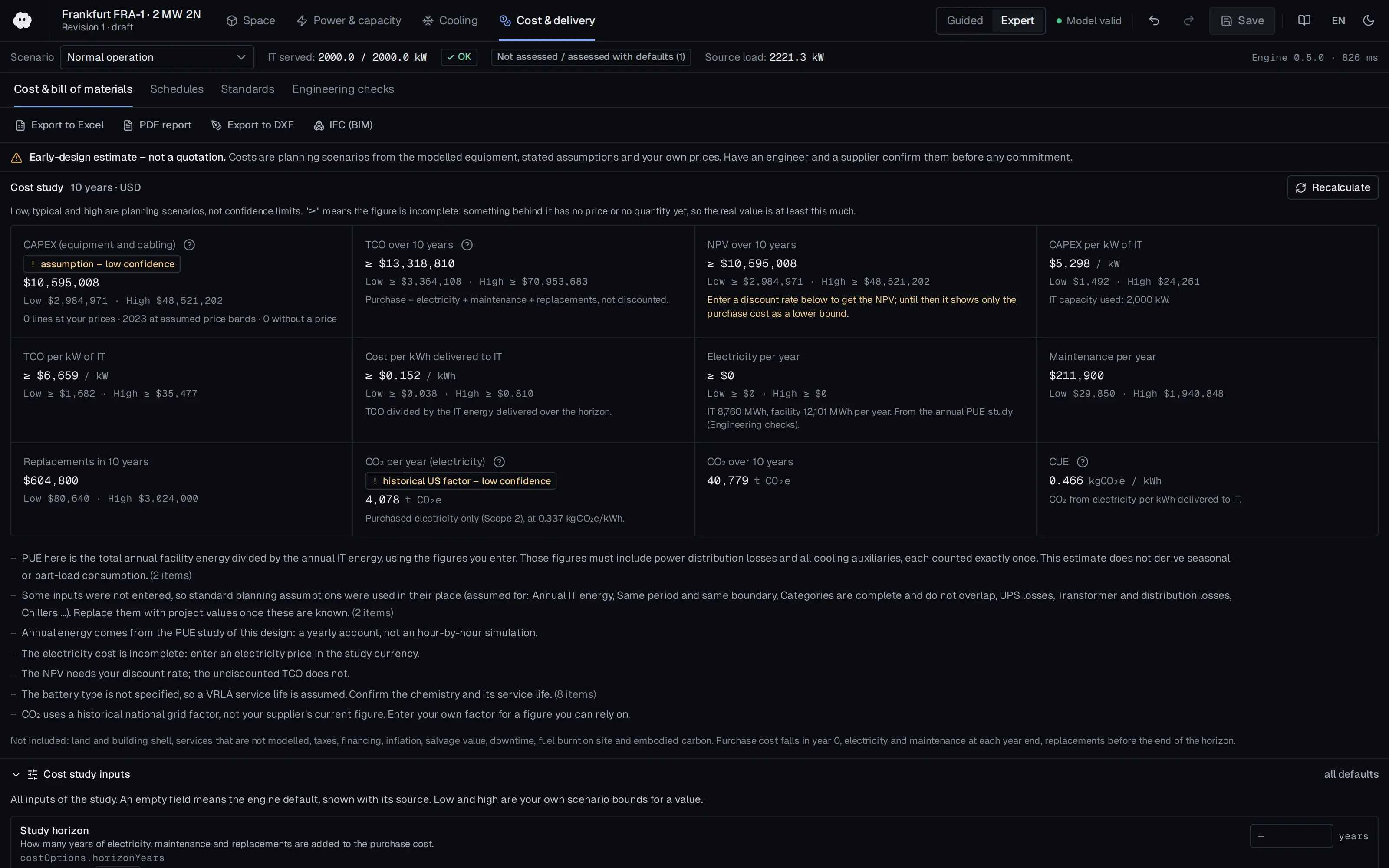
Who should read it
Data centre owners and operators, sustainability and public affairs managers, prospective heat users and policy makers.
Document contents
- Executive Summary
- Introduction
- The Opportunity
- Key Challenges
- Governments Can Adopt Helpful Policies
- Data Center Heat Reuse Requirements and Recommendations
- Analyzing Data Center Heat, Gathering/Sharing Information, and Promoting Collaboration
- Incentives for Data Center Heat Reuse
- Engagement
- Conclusion
- Appendix - Detailed Information on Policies
- EU's Energy Efficiency Directive (EED)
- Washington State Industrial Symbiosis Grant Program
- German Energy Efficiency Act (EnEfG-E)
- Greater Amsterdam Region Policies (The Netherlands)
- Appendix: References
Related standards
- EU Energy Efficiency Directive (EU) 2023/1791
- German Energy Efficiency Act (EnEfG) 2023
- EU Code of Conduct on Data Centre Energy Efficiency
- Singapore SS 564
Read the document
ocp-heat-reuse-policies.pdf
CC BY-SA 4.0 — share with attribution under the same licence
The document is provided unaltered because its licence permits redistribution.
Publication details
- Authors
- Open Compute Project Foundation
- Publisher
- Open Compute Project Foundation
- Year
- 2024
- Document number
- Rev 1.0
- Document language
- English
- Source type
- Industry body
- Access
- Open licence — downloadable
- Licence
- CC BY-SA 4.0 — share with attribution under the same licence
- Licence evidence
- www.opencompute.org
Original licence note
Title page (page 1) and License section (page 3) state the work is licensed under a Creative Commons Attribution-ShareAlike 4.0 International License.
Citation
Open Compute Project Foundation (2024). Policies to Accelerate Data Center Heat Reuse: Achieving Economic and Climate Change Goals, Revision 1.0. Open Compute Project Foundation. Rev 1.0. https://www.opencompute.org/documents/2024-02-22-ocp-heatreuse-wp-policies-vfinal-docx-2-pdf/
Events on this subject
- iMasons Climate Accord Summit
- ICCI 2027 – Uluslararası Enerji ve Çevre Fuarı ve Konferansı
- The smarter E Europe (Intersolar Europe, ees Europe, Power2Drive, EM-Power)
All content and rights belong to the respective authors and publishers. SoSo CAD provides only the citation, its own summary and a link to the source, and is not responsible for the sources' content.
Related sources
All sources on this topic
European Commission 2024
Commission Recommendation (EU) 2024/2395 of 2 September 2024 setting out guidelines for the interpretation of Article 26 of Directive (EU) 2023/1791 as regards heating and cooling supply requirements
When testing the 1 MW waste heat threshold, compute "total rated energy input" from rated capacity (for example utility connection or rated IT plus infrastructure), not modelled annual energy, and take the measurement point at the handover of electricity supply.
- CBA thresholds: thermal electricity generation 10 MW, industrial installation 8 MW, service facility 7 MW, data centre 1 MW.
European Parliament and Council of the European Union 2023
Directive (EU) 2023/1791 of the European Parliament and of the Council of 13 September 2023 on energy efficiency and amending Regulation (EU) 2023/955 (recast) - Energy Efficiency Directive
If the site's installed IT power is 500 kW or more, provide in the design for the annual Annex VII reporting and the monitoring infrastructure (energy, power utilisation, temperature set points, waste heat, water, renewables); measurement is based on the EN 50600-4 family.
- Art. 12(2): data centres serving exclusively defence and civil protection are excluded.
European Commission 2020
EU green public procurement criteria for data centres, server rooms and cloud services - SWD(2020) 55 final
Create an "EU GPP 2020 (core/comprehensive)" compliance profile: check refrigerant GWP <= 10 in the cooling catalogue, REF = 1 for third-party facilities, ICT class A2/A3 and the W class of liquid loops.
- AC11 points: x for GWP 0-10, 0.6x for 11-150, 0.2x for 151-750.
European Commission 2019
Commission Staff Working Document SWD(2019) 106 - Impact Assessment accompanying Commission Regulation laying down ecodesign requirements for servers and data storage products
In the what-if module show direct and infrastructure savings separately for IT refresh scenarios: the document finds infrastructure savings exceed direct IT savings, which supports showing that every watt saved in IT also saves cooling and power infrastructure energy.
- The preferred option 3.2 saves 6.5 TWh per year in 2020 and 8.9 TWh in 2030.
European Commission JRC 2019
Development of European Green Public Procurement Criteria for Data Centres - Preliminary report (JRC118550, EUR 29945 EN)
Seed the embodied-versus-operational carbon module with the roughly one third procured assets and two thirds use-stage split as a default sanity check for LCA outputs.
- IT energy share is assumed at 52% in 2010, 57% in 2015 and 67% in 2030, with a PUE of 1.5 for 2030.
T.C. Çevre, Şehircilik ve İklim Değişikliği Bakanlığı 2008
Binalarda Enerji Performansı Yönetmeliği (Regulation on Energy Performance of Buildings)
In the building/sustainability module (TR profile), add an NSEB check for buildings of 2,000 m2 and above: target class B and at least 10 percent of primary energy from on-site renewables.
- The text is consolidated with the 2025-2026 amendments.