
Commission Recommendation (EU) 2024/2395 of 2 September 2024 setting out guidelines for the interpretation of Article 26 of Directive (EU) 2023/1791 as regards heating and cooling supply requirements
European Commission
The Commission explains the efficient district heating and cooling criteria of EED Article 26 and the installation-level cost-benefit analysis for new or substantially refurbished installations. Section 3.4 deals with the waste heat obligation of data centres above 1 MW and how the threshold is determined.
EU reuse (2011/833/EU) — reuse permitted with acknowledgement of the source
On this page
Overview
The Recommendation gives interpretative guidelines for Member States transposing Article 26 of Directive (EU) 2023/1791, which replaces Article 14 of Directive 2012/27/EU and addresses heating and cooling (H&C) supply and the efficiency of district heating and cooling (DHC). It is intended purely for transposing and implementing this directive, not for other legal acts, and binding interpretation belongs to the Court of Justice. For context it notes that in 2022 only 24.9% of energy used for H&C came from renewable sources, and explains links to the RED and the EPBD.
Sections 3.1-3.3 cover the definition of efficient DHC (EDHC). The default approach rests on the shares of renewable energy, waste heat and (high-efficiency) cogeneration in the thermal energy entering the network, tightened in five steps: 2028, 2035, 2040, 2045 and 2050. Until 2035 EDHC status can be met by high-efficiency cogeneration alone or a 5% renewable share plus 45% combined; from 1 January 2035 fossil-only systems cannot qualify; from 2045 at least 75% renewable and waste heat is needed; from 2050 all input must be renewable or waste heat. Heat pump output counts fully as renewable if it meets RED Annex VII minimum efficiency.
The key data centre provision is Article 26(6): data centres with total rated energy input above 1 MW must utilise waste heat or other waste heat recovery applications unless it is shown, through the paragraph 7 assessment, not to be technically or economically feasible. In the Commission's view the obligation applies to all operating data centres above 1 MW where waste heat is not currently used, and those sites must assess potential use under 26(7). Technical feasibility depends on site characteristics and available solutions without compromising the data centre's primary activity; economic feasibility means the project can cover its costs and give a reasonable return for risk.
The installation-level cost-benefit analysis (CBA) applies to new or substantially refurbished thermal power plants (10 MW), industrial installations (8 MW), service facilities (7 MW) and data centres (1 MW). For data centres the CBA assesses technical feasibility, cost-efficiency, impact on energy efficiency and local heat demand including seasonal variation, and connection to district heating, with cooling solutions that capture waste heat at a useful temperature with minimal ancillary energy. "Total energy input" is read as capacity in MW, not energy volume in MWh, and for data centres the measurement point is the handover point(s) of electricity supply.
The financial analysis must reflect actual cash flows of investing in and operating the individual installation. Appendix G gives a five-step CBA approach: define scope (heat link and system boundary), available and potential waste heat, data collection, reference scenario and assumptions, and conducting the CBA (costs, benefits, techno-economic parameters). Member States may grant exemptions, which they must notify to the Commission, and CBA results feed into authorisation or permit criteria. The text is interpretative and national implementation remains with Member States.
Key points
- Article 26(6): data centres with total rated energy input above 1 MW must utilise waste heat or other recovery applications unless shown not technically or economically feasible.
- In the Commission's view the obligation covers all operating data centres above 1 MW that do not currently use waste heat; they must assess potential use under 26(7).
- Total rated energy input is the maximum energy that can flow through an installation (a theoretical maximum), not the energy actually consumed, and is compared with the threshold as a capacity in MW.
- For data centres the capacity measurement point is the handover point(s) of electricity supply.
- CBA thresholds: thermal electricity generation 10 MW, industrial installation 8 MW, service facility 7 MW, data centre 1 MW.
- The data centre CBA considers cooling solutions that capture waste heat at a useful temperature with minimal ancillary energy, heat demand including seasonal variation, and district heating connection.
- The financial analysis must reflect actual cash flows of the individual installation; common assumptions on payback, required return, fuel and electricity prices are recommended.
- The default EDHC approach tightens in 2028, 2035, 2040, 2045 and 2050; fossil-only systems cannot qualify from 1 January 2035 and at least 75% renewable and waste heat is required from 2045.
- Heat pump output counts fully as renewable if it meets RED Annex VII minimum efficiency at installation.
- Appendix G sets out a five-step CBA: scope, waste heat, data, reference scenario, analysis.
Using it in design
- When testing the 1 MW waste heat threshold, compute "total rated energy input" from rated capacity (for example utility connection or rated IT plus infrastructure), not modelled annual energy, and take the measurement point at the handover of electricity supply.
- When the threshold is exceeded, let the heat reuse module open a CBA workspace: heat available at capture temperature, heat pump uplift, seasonal demand match and cash flow analysis.
- When comparing cooling options, prefer those that capture waste heat at a useful temperature with minimal ancillary energy, that is, those delivering higher return temperatures.
- Add distance and existing or potential heat demand points to the siting analysis as inputs to the CBA scope.
- Keep the CBA output in a form suitable for the permit file, since results are taken into account in authorisation criteria.
Monthly newsletter · free
Keep your reading list current
Once a month: new library sources, changes to Turkish regulations and upcoming data centre events.
SoSo CAD
Bring standards pre-checks into your project
Review model-based TS EN 50600 and Tier pre-checks, missing inputs and items requiring engineering review in SoSo CAD.
Request a demo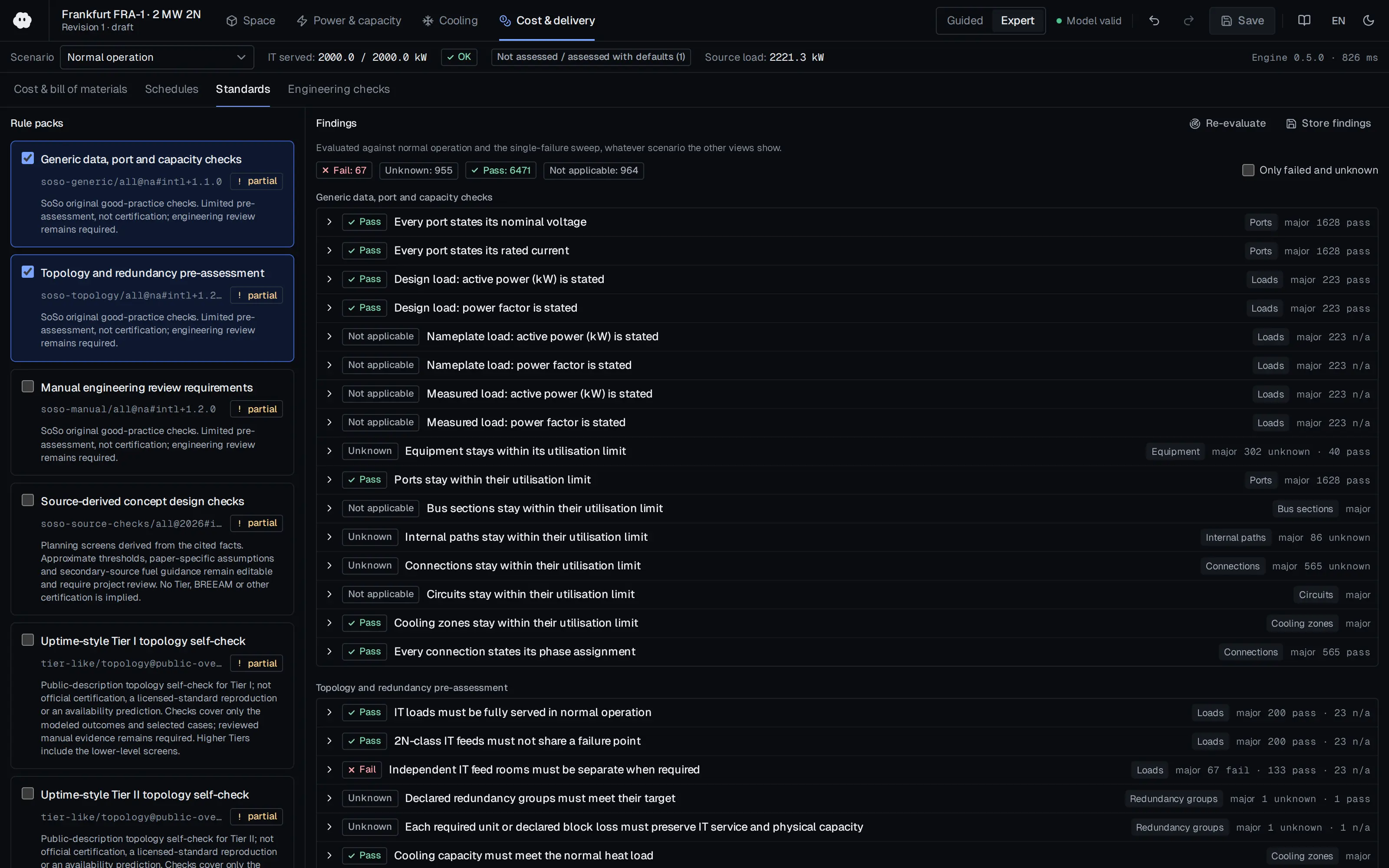
Who should read it
Engineers and energy consultants who design or operate data centres above 1 MW in the EU and plan for waste heat and cost-benefit analysis obligations.
Document contents
- Introduction
- Legal and policy context
- Obligations related to energy efficiency in heating and cooling in Article 26
- Criteria of EDHC (default and alternative approach): Article 26(1) and (2)
- Applying the definition of EDHC to newly built and refurbished DHC systems: Article 26(4)
- Mandatory planning to increase efficient use of primary energy and renewable energy use: Article 26(5)
- Ensuring efficient use of waste heat from data centres: Article 26(6)
- Installation level cost-benefit analysis for new or substantially refurbished facilities: Article 26(7) and (8)
- Methodology for the CBA
- Exemptions from the Cost-Benefit Analysis and notification
- Authorisation and equivalent permit procedures for installations
- Data collection on the Cost-Benefit Analyses
- Reporting requirements
- Appendix G: Five-step approach to conduct an installation-level CBA
Related standards
- Directive (EU) 2023/1791
- EN 50600-4-6
Read the document
eu-rec-2024-2395-eed-article-26.pdf
EU reuse (2011/833/EU) — reuse permitted with acknowledgement of the source
The document is provided unaltered because its licence permits redistribution.
Publication details
- Authors
- European Commission
- Publisher
- European Commission
- Year
- 2024
- Document number
- Recommendation (EU) 2024/2395 (CELEX 32024H2395)
- Document language
- English
- Source type
- Government / public
- Access
- Open licence — downloadable
- Licence
- EU reuse (2011/833/EU) — reuse permitted with acknowledgement of the source
- Licence evidence
- eur-lex.europa.eu
Original licence note
Official Journal text downloaded from EUR-Lex; the EUR-Lex legal notice authorises reuse under Commission Decision 2011/833/EU (only the OJ authentic version is legally binding).
Citation
European Commission (2024). Commission Recommendation (EU) 2024/2395 of 2 September 2024 setting out guidelines for the interpretation of Article 26 of Directive (EU) 2023/1791 as regards heating and cooling supply requirements. European Commission. Recommendation (EU) 2024/2395 (CELEX 32024H2395). https://eur-lex.europa.eu/legal-content/EN/TXT/PDF/?uri=CELEX:32024H2395
Events on this subject
Browse the events calendarAll content and rights belong to the respective authors and publishers. SoSo CAD provides only the citation, its own summary and a link to the source, and is not responsible for the sources' content.
Related sources
All sources on this topic
European Commission 2020
EU green public procurement criteria for data centres, server rooms and cloud services - SWD(2020) 55 final
Create an "EU GPP 2020 (core/comprehensive)" compliance profile: check refrigerant GWP <= 10 in the cooling catalogue, REF = 1 for third-party facilities, ICT class A2/A3 and the W class of liquid loops.
- AC11 points: x for GWP 0-10, 0.6x for 11-150, 0.2x for 151-750.
European Commission JRC 2025
2025 Best Practice Guidelines for the EU Code of Conduct on Data Centre Energy Efficiency (JRC141521, EUR 40267)
Design the facility to operate within the ASHRAE Class A2 allowable range and require A2 operation within warranty in IT procurement; plan separate environmental zones (practice 5.3.4) for legacy equipment.
- IT equipment AC/DC power converters should be rated at 90% efficiency or better across expected load ranges.
European Commission 2021
Commission Delegated Regulation (EU) 2021/2139 of 4 June 2021 supplementing Regulation (EU) 2020/852 by establishing the technical screening criteria for determining the conditions under which an economic activity qualifies as contributing substantially to climate change mitigation or climate change adaptation and for determining whether that economic activity causes no significant harm to any of the other environmental objectives (EU Taxonomy Climate Delegated Act)
Add an "EU Taxonomy 8.1" compliance profile: a Code of Conduct expected-practice checklist with justification fields for non-applicable items, and a refrigerant GWP <= 675 check in the cooling catalogue.
- 8.1 is a transitional activity under Article 10(2) of the Taxonomy Regulation.
European Commission, DG Communications Networks, Content and Technology (DG CONNECT) 2020
Energy-efficient Cloud Computing Technologies and Policies for an Eco-friendly Cloud Market: Final Study Report (SMART 2018/0028)
Use the regional and size-based values for first-pass PUE assumptions, but treat them as 2018-and-earlier averages and as historical context, not as a current target.
- German PUE in 2015: 2.1 for server rooms under 100 m2, 1.9 for 100-500 m2, 1.7 for 500-5,000 m2, 1.6 above 5,000 m2.
European Commission JRC 2020
Development of the EU Green Public Procurement (GPP) Criteria for Data Centres, Server Rooms and Cloud Services - Final Technical Report (JRC118558, EUR 30251 EN, 2020)
Ask in the specification for a designed PUE (dPUE) at a stated IT load (for example 50%) and conditions, under ISO/IEC 30134-2 or EN 50600-4-2, and write PUE demonstration at handover and the commissioning test into the contract.
- ASHRAE liquid cooling classes cited: W1 2-17 °C, W2 2-27 °C, W3 2-32 °C, W4 2-45 °C, W5 above 45 °C.
European Commission 2019
Commission Regulation (EU) 2019/424 of 15 March 2019 laying down ecodesign requirements for servers and data storage products - consolidated text 01.03.2021 (incl. Regulation (EU) 2021/341)
In the IT equipment catalogue store PSU efficiency at 10/20/50/100% load, power factor, active state efficiency (SERT/EN 303470) and declared operating class A1-A4, and validate new models against the 2023 tier.
- Secure data deletion applies from 1 March 2020; latest firmware and security updates must be made available from 1 March 2021.