
Driving sustainability in data centers
Jacobs
This Jacobs white paper surveys measures to reduce data centre energy, water and embodied carbon. It offers a broad framework from cooling strategies and water reuse to low-carbon concrete and alternative backup power.
On this page
Overview
The white paper is dated 2023 and compiles measures to reduce energy, water and embodied carbon in data centres. On cooling it covers immersion, adiabatic, free air, economisers and natural draft tested with CFD.
According to the water section, a typical 1 MW data centre with traditional cooling uses about 6.75 million gallons of water per year. Water-saving options include recycling cooling tower blowdown, using treated municipal effluent and seawater cooling. The adiabatic approach uses outdoor air below about 29.4 C (85 F), and free-air controls switch off evaporative systems when conditions allow.
On embodied carbon, supplementary cementitious materials and recycled content could cut concrete-related carbon by more than 50% in modelled scenarios. For backup power, it evaluates green hydrogen fuel cells or hydrogen reciprocating engines, plus battery energy storage (BESS) for renewable firming. One concept co-locates a data centre with a wastewater plant and a hydrogen electrolyser.
The paper closes with lessons on site selection, supply chain leverage, circularity and community engagement. As a consultancy white paper it offers no detailed calculation method; figures should be used as principle-level benchmarks.
Key points
- A typical 1 MW data centre with traditional cooling uses about 6.75 million gallons of water per year.
- Water-saving options: recycling cooling tower blowdown, treated municipal effluent and seawater cooling.
- Supplementary cementitious materials and recycled content could cut concrete-related carbon by more than 50% in modelled scenarios.
- Adiabatic approach uses outdoor air below about 29.4 C (85 F); free-air controls switch off evaporative systems when conditions allow.
- Backup alternatives: green hydrogen fuel cells or hydrogen reciprocating engines, plus BESS for renewable firming.
- A concept co-locates a data centre with a wastewater plant and a hydrogen electrolyser.
- Lessons: site selection, supply chain leverage, circularity and community engagement.
Using it in design
- Use the 6.75 Mgal/MW-yr figure as a sanity-check benchmark for evaporative designs.
- Include low-carbon concrete options in the embodied-carbon estimate.
- Add hydrogen fuel cells as a backup power type in the catalog.
- Treat water options (blowdown recycling, treated effluent, seawater) separately in site assessment.
Monthly newsletter · free
Keep your reading list current
Once a month: new library sources, changes to Turkish regulations and upcoming data centre events.
SoSo CAD
Compare the cost of design decisions
Evaluate equipment costs, energy expenses and total cost of ownership (TCO) using your inputs and assumptions in SoSo CAD.
Request a demo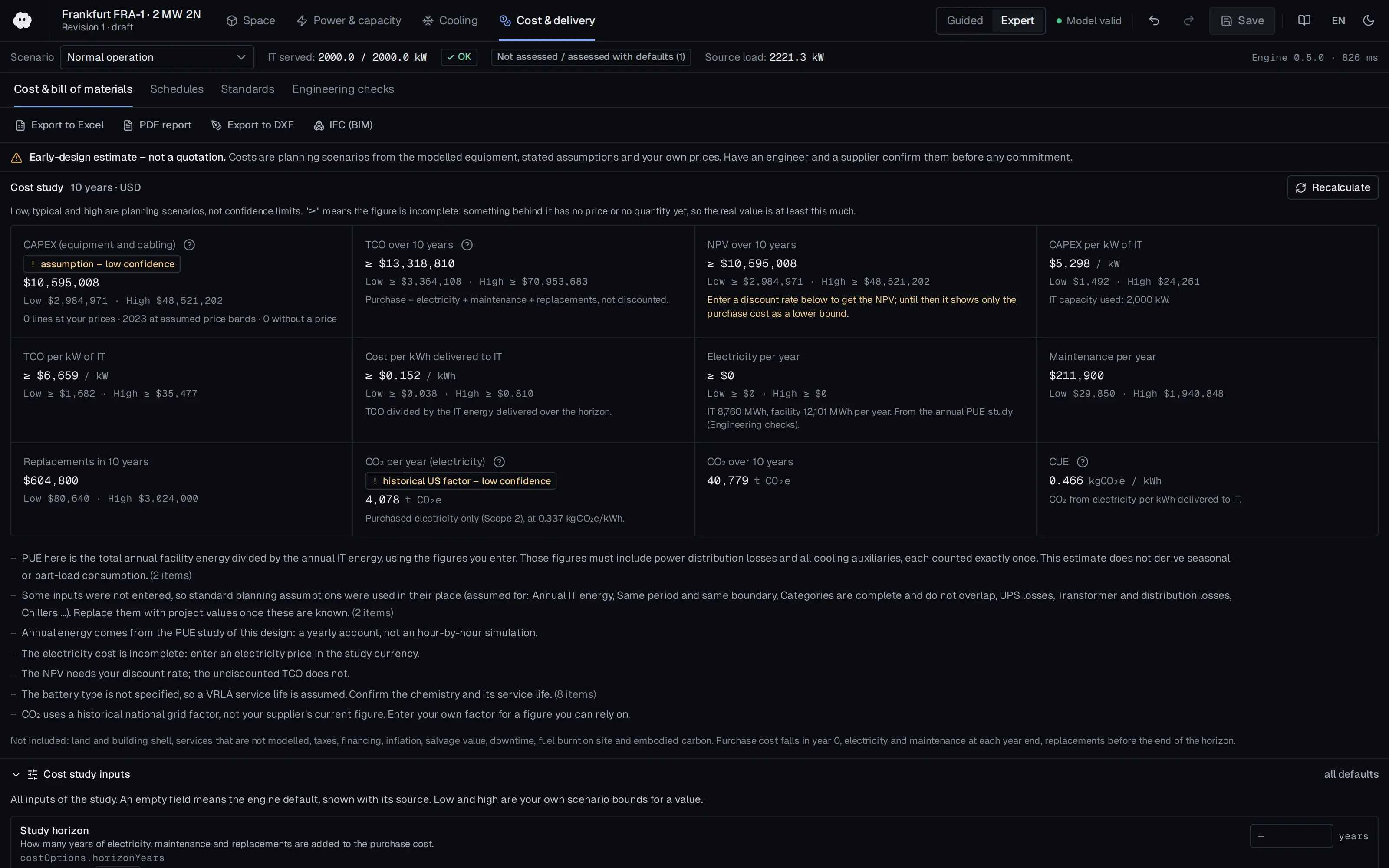
Who should read it
Data center designers with sustainability targets, developers, and corporate sustainability officers.
Related standards
- LEED v4.1 BD+C: Data Centers
Publication details
- Authors
- Jacobs
- Publisher
- Jacobs
- Year
- 2023
- Document language
- English
- Source type
- Expert / community
- Access
- Free to read
- Licence
- Copyright retained; citation only — the publisher’s terms apply to the original document
Citation
Jacobs (2023). Driving sustainability in data centers. Jacobs. https://jacobs.com/reports/advanced-manufacturing/driving-sustainability-data-centers
Events on this subject
Browse the events calendarAll content and rights belong to the respective authors and publishers. SoSo CAD provides only the citation, its own summary and a link to the source, and is not responsible for the sources' content.
Related sources
All sources on this topic
Frontiers in Environmental Science (Frontiers Media SA) 2026
Net sustainability assessment of AI-driven data centers in the GCC: an MCDA approach framework
In AI data-centre investment assessment in hot, arid regions, weigh carbon, water, social and governance criteria together with explicit weights (0.40/0.25/0.20/0.15); indirect water (desalination energy) was about 0.68 times direct cooling water.
- In the extended boundary, embodied carbon adds 15-25% to the operational footprint.
Open Compute Project Foundation 2026
Guidelines: Impact of Strategies on Data Center Energy Consumption, Carbon Footprint, and Water Consumption (March 2026)
Evaluate cooling and siting options on energy, carbon, site water and water scarcity together, not on PUE or WUE alone.
- Same example: emissions fall from 3,500 to 2,700 t CO2/yr with the carbon factor of 0.26 kg CO2/kWh.
European Commission, DG CNECT (EY, Borderstep Institute, AIT, RP legalitax) 2025
Synergies between Data Centres and Energy Systems - Final Report (European Commission, DG CNECT)
When choosing cooling architecture assess waste heat temperature early: liquid cooling gives higher temperatures, even air cooling can give about 30-35 C as a heat-pump source; position the heat pump for the receiving network temperature (60-80 C or 4th/5th generation).
- In the stakeholder survey, over 60% rated heat reuse technically viable today but only about 20% economically viable.
Nortek Air Solutions 2021
Solutions to Water and Power Availability that Challenge the Future of Data Centers
In a site/sustainability module, estimate annual water (m3), WUE and cooling energy for alternative plant types at a chosen SAT, using local water and power tariffs.
- Case prices: water ~USD 2/m3, power ~USD 0.10/kWh.
Geothermal Energy (Springer Science and Business Media LLC) 2026
Potential of aquifer thermal energy storage (ATES) for data centres in Germany
Before linking data-centre waste heat to nearby building heating, check that site subsurface geology suits ATES and that the site is outside water-protection zones; only 13 of 19 sites did.
- Annual waste heat available for storage was Eth = Qth × F_load × (1 − F_free) × (1 − F_down), with a conservative mean annual load factor of 0.6.
arXiv preprint (cs.CY; formatted for ACM e-Energy '26) 2026
Beyond PUE: A Local-Impact Audit Framework for Data Center Environmental Accountability
In siting and community-acceptance files, present PUE, WUE and CUE together with regional water stress, grid headroom and verification maturity (L0-L4); back project commitments with contractual limits and independent metering (L2-L3).
- Compliance gate: any unresolved major regulatory violation caps the composite score at a ceiling of 40 (suggested, subject to calibration).