
Potential of aquifer thermal energy storage (ATES) for data centres in Germany
Geothermal Energy (Springer Science and Business Media LLC) · Florian Barth, Georg Schefel et al.
KIT researchers estimate the waste heat of 19 German data centres by detecting air-cooled chiller condensers on aerial images and converting fan counts to cooling capacity with regression equations, then match sites on suitable aquifers to nearby building heating demand.
CC BY 4.0 — share with attribution
On this page
Overview
Data centres produce large quantities of waste heat and require excessive amounts of cooling, which offers potential for an environmentally friendly space-heating supply for nearby areas. This coupled supply suffers from a seasonal mismatch, with most space heating needed in winter while data centres produce heat all year. Aquifer thermal energy storage (ATES) is a cost-efficient way to overcome it. Germany has passed a law making examination of waste-heat utilisation mandatory for future data centres, and from 2026 newly installed heating systems in buildings must use at least 65% renewable heat.
Method: nominal capacity of air-cooled chillers with small (< 1 m) condenser fans was estimated as Qth = 53.3 × n kW (n = number of fans), a regression on 527 chillers. Annual waste heat available for storage was computed as Eth = Qth × F_load × (1 − F_free) × (1 − F_down), with a conservative mean annual load factor of 0.6 (60% of peak). The 19 data centres examined produce 1740 GWh_th of waste heat, but only 13 are on very well or well-suited subsurface for ATES outside regulated water-protection zones.
Assuming a 60% ATES thermal recovery rate, the 13 sites could supply 707 GWh_th, covering about 20,000 nearby buildings in Berlin, Düsseldorf, Frankfurt, Hamburg and Karlsruhe. In Frankfurt, six data centres on suitable ground could supply 541 GWh_th (13% of residential and commercial heating demand), and placing ATES for all ten Frankfurt sites in the most suitable areas could reach 819 GWh_th (20%).
Limits: the waste-heat estimate rests on chillers detected on aerial images and generic load factors, not measured data; not all of the 19 data centres suit ATES, and the thermal recovery is a 60% assumption.
Key points
- Germany has passed a law making examination of waste-heat utilisation mandatory for future data centres, and from 2026 newly installed heating systems in buildings must use at least 65% renewable heat.
- Nominal capacity of air-cooled chillers with small (< 1 m) condenser fans was estimated as Qth = 53.3 × n kW (n = number of fans), a regression on 527 chillers.
- Annual waste heat available for storage was Eth = Qth × F_load × (1 − F_free) × (1 − F_down), with a conservative mean annual load factor of 0.6.
- The 19 data centres examined produce 1740 GWh_th of waste heat, but only 13 are on very well or well-suited subsurface for ATES outside regulated water-protection zones.
- Assuming a 60% ATES thermal recovery rate, the 13 sites could supply 707 GWh_th, covering about 20,000 nearby buildings in Berlin, Düsseldorf, Frankfurt, Hamburg and Karlsruhe.
- In Frankfurt, six data centres on suitable ground could supply 541 GWh_th (13% of residential and commercial heating demand); ATES for all ten sites in the most suitable areas could reach 819 GWh_th (20%).
Using it in design
- Before linking data-centre waste heat to nearby building heating, check that site subsurface geology suits ATES and that the site is outside water-protection zones; only 13 of 19 sites did.
- Calculate waste-heat potential from installed chiller capacity, load factor (0.6), free cooling and downtime, and make the ATES thermal recovery rate (60%) an explicit input.
- Bridge the seasonal mismatch (year-round heat, winter-peaking demand) with ATES and match it to nearby building heating demand.
Monthly newsletter · free
Keep your reading list current
Once a month: new library sources, changes to Turkish regulations and upcoming data centre events.
SoSo CAD
Compare the cost of design decisions
Evaluate equipment costs, energy expenses and total cost of ownership (TCO) using your inputs and assumptions in SoSo CAD.
Request a demo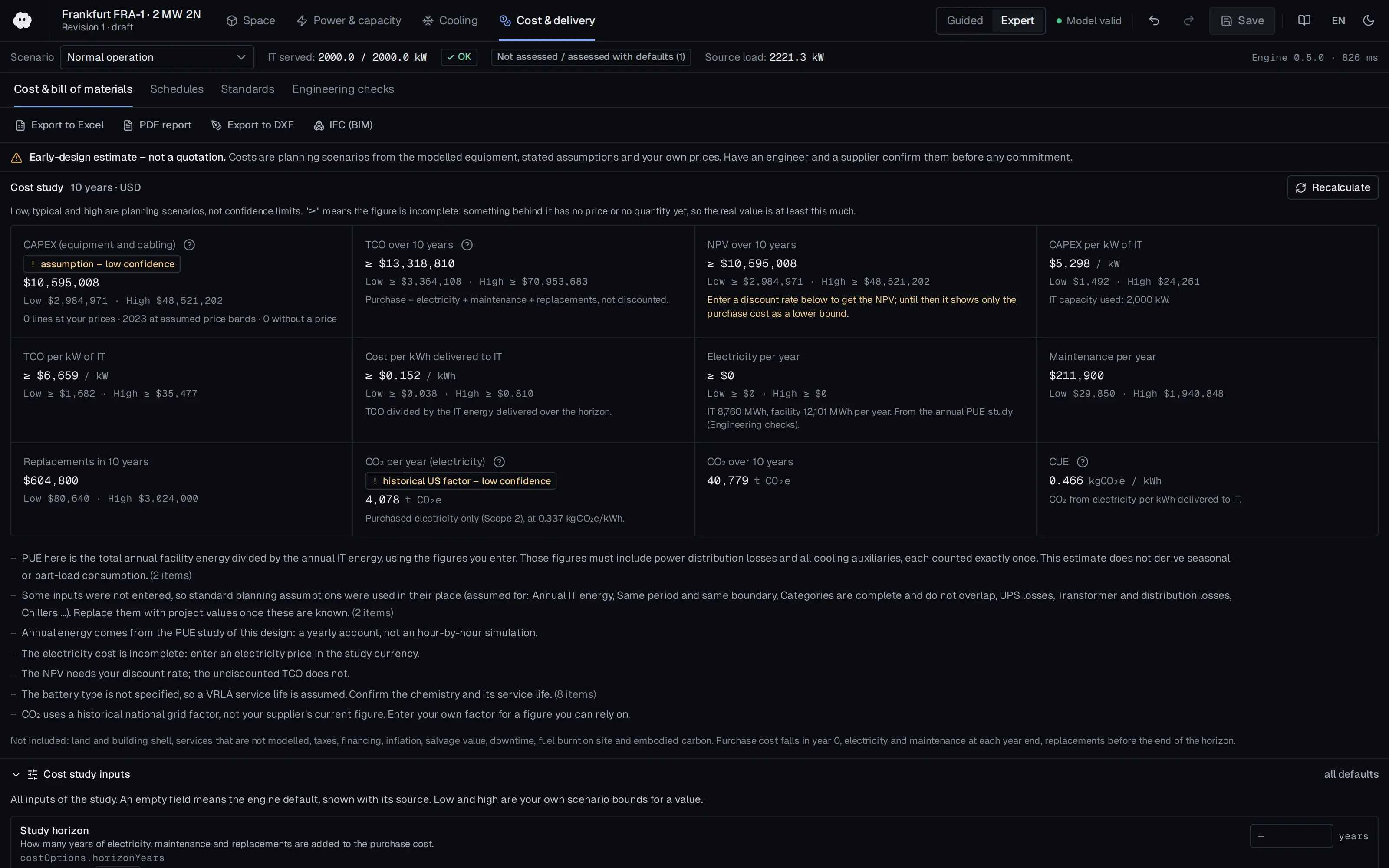
Who should read it
Planners, and geothermal and energy engineers planning to link data-centre waste heat to nearby building heating through seasonal storage.
Document contents
- Introduction
- Methods (chiller detection on aerial images, cooling-capacity regression, waste-heat calculation, ATES suitability analysis, matching to heat demand)
- Results (waste heat of 19 data centres, sites suited for ATES, Frankfurt case)
- Discussion and conclusions
Related standards
- German Energy Efficiency Act (EnEfG)
- GEG (65% renewable heat rule)
Read the document
ates-data-centres-germany-2026.pdf
CC BY 4.0 — share with attribution
The document is provided unaltered because its licence permits redistribution.
Publication details
- Authors
- Florian Barth; Georg Schefel; Philipp Blum; Kathrin Menberg
- Publisher
- Geothermal Energy (Springer Science and Business Media LLC)
- Year
- 2026
- Volume
- 14
- Issue
- 1
- Pages
- 11
- Document language
- English
- Source type
- Scientific
- Access
- Open licence — downloadable
- Licence
- CC BY 4.0 — share with attribution
- Licence evidence
- doi.org
Original licence note
KIT repository copy of the published article; article states it is licensed under a Creative Commons Attribution 4.0 International License.
Citation
Florian Barth; Georg Schefel; Philipp Blum; Kathrin Menberg (2026). Potential of aquifer thermal energy storage (ATES) for data centres in Germany. Geothermal Energy (Springer Science and Business Media LLC). 14(1), 11. https://doi.org/10.1186/s40517-026-00383-8
Events on this subject
Browse the events calendarAll content and rights belong to the respective authors and publishers. SoSo CAD provides only the citation, its own summary and a link to the source, and is not responsible for the sources' content.
Related sources
All sources on this topic
Frontiers in Environmental Science (Frontiers Media SA) 2026
Net sustainability assessment of AI-driven data centers in the GCC: an MCDA approach framework
In AI data-centre investment assessment in hot, arid regions, weigh carbon, water, social and governance criteria together with explicit weights (0.40/0.25/0.20/0.15); indirect water (desalination energy) was about 0.68 times direct cooling water.
- In the extended boundary, embodied carbon adds 15-25% to the operational footprint.
Open Compute Project Foundation 2026
Guidelines: Impact of Strategies on Data Center Energy Consumption, Carbon Footprint, and Water Consumption (March 2026)
Evaluate cooling and siting options on energy, carbon, site water and water scarcity together, not on PUE or WUE alone.
- Same example: emissions fall from 3,500 to 2,700 t CO2/yr with the carbon factor of 0.26 kg CO2/kWh.
arXiv preprint (cs.AI), Harvard T.H. Chan School of Public Health 2026
Assessing the Carbon Emissions and Energy Consumption of U.S. Hyperscale Data Centers
In fleet or facility energy estimation, use capacity × 8,760 × facility-load coefficient (0.48-0.70, central 0.58) and report the range (67.7-98.6 TWh) explicitly.
- State-level intensities (central scenario): Virginia 535, Oregon 440, Iowa 645, Nebraska 740, Wyoming 1035 gCO2/kWh; Virginia had 142 HDCs, 21.0 TWh, 11.5 Mt.
European Commission, DG CNECT (EY, Borderstep Institute, AIT, RP legalitax) 2025
Synergies between Data Centres and Energy Systems - Final Report (European Commission, DG CNECT)
When choosing cooling architecture assess waste heat temperature early: liquid cooling gives higher temperatures, even air cooling can give about 30-35 C as a heat-pump source; position the heat pump for the receiving network temperature (60-80 C or 4th/5th generation).
- In the stakeholder survey, over 60% rated heat reuse technically viable today but only about 20% economically viable.
arXiv preprint (math.OC), MIT Operations Research Center 2025
Locational Marginal Emissions for Carbon-Aware Data Center Operations in Large-Scale Power Grids
In data-centre carbon accounting, consider hourly locational marginal emissions (LME) rather than an annual-average grid factor; the LME-based intensity (about 672 kgCO2/MWh) was about 3 times the average factor (202).
- Emission rates assumed in the simulated grid: coal 800 kgCO2/MWh, gas 450 kgCO2/MWh, wind/solar/nuclear/hydro 0.
Energy Strategy Reviews (Elsevier BV) 2024
On the means, costs, and system-level impacts of 24/7 carbon-free energy procurement
In a data-centre renewable procurement strategy, weigh that annual volumetric matching does not deliver hourly clean supply (54% to 83%) and that 85-95% hourly CFE targets cut emissions more at a relatively small premium.
- Adding long-duration storage (salt-cavern hydrogen, 2.5 EUR/kWh) cuts the 100% CFE premium to 42% above annual matching; also adding clean firm generation cuts it to 15%.