
Data Centre Futures: Energy - Reimagining the role of data centres in the energy system (Issue 02)
Arup (Arup Foresight) · Arup
The second issue of the Arup foresight series, covering data centre electricity demand growth, grid connection queues, plateauing PUE and new supply options such as SMRs.
On this page
Overview
This document is the second issue of the Arup Foresight series (Issue 02, 2025), available as a free PDF. The issue covers growth in data centre electricity demand, grid connection queues, plateauing PUE and new supply options such as SMRs (small modular reactors). It contrasts annual-matching '100% renewable' claims with 24/7 location-based carbon accounting. The document aims to redefine the sector's place in the energy system not merely as a consumer but as a stakeholder in the grid.
Key figures give context: data centres use about 1.5% of global electricity (about 415 TWh). Some grid connection queues for new data centres are up to 10 years long. Hyperscale PUE improvements have plateaued; the chart of weighted-average PUE by IT capacity band uses Uptime Institute 2024 data. The figures show demand growing while efficiency gains slow and grid access becomes a constraint in its own right.
The 'early signs' section gives US examples: four SMRs providing 320 MW initially, rising to 960 MW, in Washington, and a 300 MW SMR project explored in Virginia. Arup's retrofit of the EMC2 Cork campus is expected to save 13 GWh and 7,000 tCO2 per year; another campus targets an annualised PUE of 1.2. An Arup expert piece proposes treating hyperscale campuses as anchor grid tenants that provide flexibility and waste heat. The recommendations are split into immediate efficiency and grid-responsiveness steps and longer-term structural reforms. Arup recommends location-based carbon audits and 24/7 clean-power commitments rather than certificate-matched renewable claims.
Key points
- Data centres use about 1.5% of global electricity (~415 TWh).
- Some grid connection queues for new data centres are up to 10 years long.
- Hyperscale PUE improvements have plateaued; the chart uses Uptime Institute 2024 data.
- US examples: four SMRs giving 320 MW rising to 960 MW (Washington); a 300 MW SMR project explored in Virginia.
- Arup's EMC2 Cork retrofit expected to save 13 GWh and 7,000 tCO2 per year; another campus targets annualised PUE 1.2.
- Recommends location-based carbon audits and 24/7 clean-power commitments over certificate-matched renewable claims.
- Hyperscale campuses could be treated as anchor grid tenants providing flexibility and waste heat.
Using it in design
- Report both market-based and location-based carbon (hourly grid intensity) for a design.
- Let users model grid-connection date and on-site generation as site constraints.
- Display PUE against capacity-band benchmarks rather than a single industry average.
- Treat connection-queue duration as a schedule risk in the project plan.
Monthly newsletter · free
Keep your reading list current
Once a month: new library sources, changes to Turkish regulations and upcoming data centre events.
SoSo CAD
Compare the cost of design decisions
Evaluate equipment costs, energy expenses and total cost of ownership (TCO) using your inputs and assumptions in SoSo CAD.
Request a demo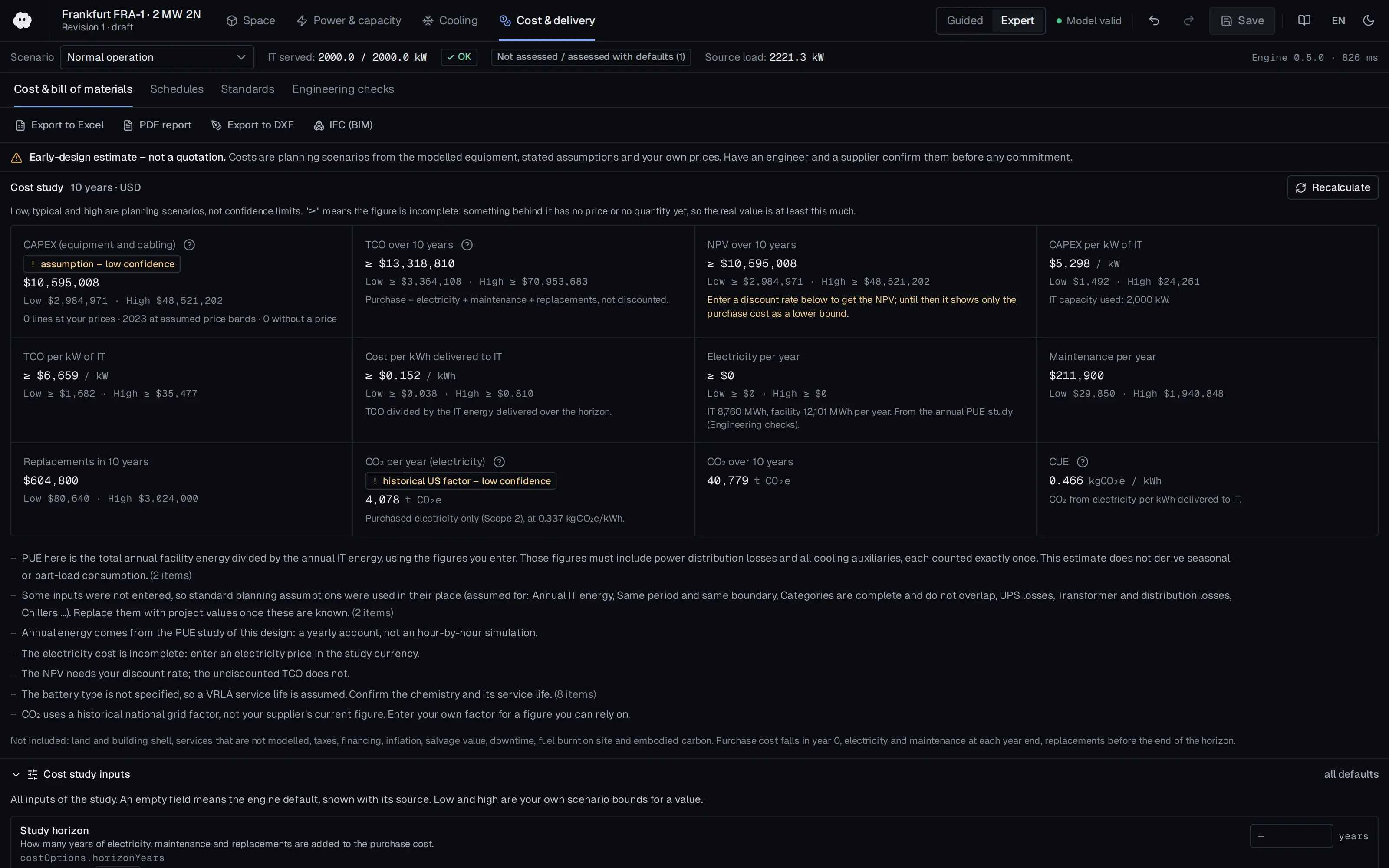
Who should read it
Investors, consultants and design teams working on energy strategy, site selection and carbon reporting.
Related standards
- ISO/IEC 30134-2 (PUE)
- GHG Protocol Scope 2 Guidance
Publication details
- Authors
- Arup
- Publisher
- Arup (Arup Foresight)
- Year
- 2025
- Document number
- Issue 02
- Document language
- English
- Source type
- Expert / community
- Access
- Free to read
- Licence
- Copyright retained; citation only — the publisher’s terms apply to the original document
Citation
Arup (2025). Data Centre Futures: Energy - Reimagining the role of data centres in the energy system (Issue 02). Arup (Arup Foresight). Issue 02. https://www.arup.com/globalassets/downloads/insights/t/the-future-of-data-centres-how-is-the-industry-changing-in-the-ai-era/data-centre-futures-energy-arup.pdf
Events on this subject
Browse the events calendarAll content and rights belong to the respective authors and publishers. SoSo CAD provides only the citation, its own summary and a link to the source, and is not responsible for the sources' content.
Related sources
All sources on this topic
arXiv preprint (cs.AI), Harvard T.H. Chan School of Public Health 2026
Assessing the Carbon Emissions and Energy Consumption of U.S. Hyperscale Data Centers
In fleet or facility energy estimation, use capacity × 8,760 × facility-load coefficient (0.48-0.70, central 0.58) and report the range (67.7-98.6 TWh) explicitly.
- State-level intensities (central scenario): Virginia 535, Oregon 440, Iowa 645, Nebraska 740, Wyoming 1035 gCO2/kWh; Virginia had 142 HDCs, 21.0 TWh, 11.5 Mt.
Huawei Digital Power 2022
Next-Generation Data Center Facility White Paper
Support CUE, WUE and a heat-reuse fraction next to PUE in reports.
- Above about 20 kW per rack liquid cooling becomes primary, with air as auxiliary.
Frontiers in Environmental Science (Frontiers Media SA) 2026
Net sustainability assessment of AI-driven data centers in the GCC: an MCDA approach framework
In AI data-centre investment assessment in hot, arid regions, weigh carbon, water, social and governance criteria together with explicit weights (0.40/0.25/0.20/0.15); indirect water (desalination energy) was about 0.68 times direct cooling water.
- In the extended boundary, embodied carbon adds 15-25% to the operational footprint.
Geothermal Energy (Springer Science and Business Media LLC) 2026
Potential of aquifer thermal energy storage (ATES) for data centres in Germany
Before linking data-centre waste heat to nearby building heating, check that site subsurface geology suits ATES and that the site is outside water-protection zones; only 13 of 19 sites did.
- Annual waste heat available for storage was Eth = Qth × F_load × (1 − F_free) × (1 − F_down), with a conservative mean annual load factor of 0.6.
arXiv preprint (cs.CY; formatted for ACM e-Energy '26) 2026
Beyond PUE: A Local-Impact Audit Framework for Data Center Environmental Accountability
In siting and community-acceptance files, present PUE, WUE and CUE together with regional water stress, grid headroom and verification maturity (L0-L4); back project commitments with contractual limits and independent metering (L2-L3).
- Compliance gate: any unresolved major regulatory violation caps the composite score at a ceiling of 40 (suggested, subject to calibration).
Open Compute Project Foundation 2026
Guidelines: Impact of Strategies on Data Center Energy Consumption, Carbon Footprint, and Water Consumption (March 2026)
Evaluate cooling and siting options on energy, carbon, site water and water scarcity together, not on PUE or WUE alone.
- Same example: emissions fall from 3,500 to 2,700 t CO2/yr with the carbon factor of 0.26 kg CO2/kWh.