
Datacenter Fire Frequency (Andy Lawrence)
Uptime Institute Journal · Andy Lawrence
Written after the OVHcloud Strasbourg fire, this piece quantifies how rare data center fires are in Uptime's incident databases and where they start.
On this page
Overview
Andy Lawrence's piece in the Uptime Institute Journal was written after the OVHcloud Strasbourg fire. It quantifies how rare data center fires are in Uptime's incident databases and where they start. Uptime's abnormal incident database holds 8,000+ member incidents since 1994, among which 11 data center fires were recorded. That is under 0.5 per year, and all were contained.
According to the article, the majority of fire incidents begin and end in the electrical room, often from UPS faults that produce heat and smoke. Batteries nearby can burn until the fuel is consumed. Another finding is that accidental discharge of fire suppression, especially high-pressure clean agent gas, has caused more serious disruption than fires, notably at banking and trading sites.
It closes with Uptime's recommended fire practices: VESDA early smoke detection, fire barriers and system separation, and well-maintained water sprinklers or low-pressure clean agent systems. The Tier IV requirement is 1-hour fire-rated partitions between complementary critical systems. As a limit, the article is an opinion and data summary; it covers only incidents reported by Uptime's members, so it may not represent the whole industry.
Key points
- Uptime's abnormal incident database (8,000+ member incidents since 1994) recorded 11 data center fires, under 0.5 per year, all contained.
- Most fire incidents begin and end in the electrical room, often from UPS faults; batteries nearby can burn until fuel is consumed.
- Accidental discharge of fire suppression, especially high-pressure clean agent gas, has caused more serious disruption than fires (notably at banking/trading sites).
- Uptime recommends VESDA early smoke detection, fire barriers and system separation, and well-maintained water sprinklers or low-pressure clean agent systems.
- Tier IV requires 1-hour fire-rated partitions between complementary critical systems.
Using it in design
- Require VESDA in white space and electrical rooms.
- For Tier IV designs, enforce 1-hour rated separation between A/B systems (UPS, switchgear, battery rooms).
- Catalogue the suppression type with a 'dischargeRisk' note; high-pressure clean agent can damage disks.
- Prefer low-pressure agent or sprinklers.
Monthly newsletter · free
Keep your reading list current
Once a month: new library sources, changes to Turkish regulations and upcoming data centre events.
SoSo CAD
Bring standards pre-checks into your project
Review model-based TS EN 50600 and Tier pre-checks, missing inputs and items requiring engineering review in SoSo CAD.
Request a demo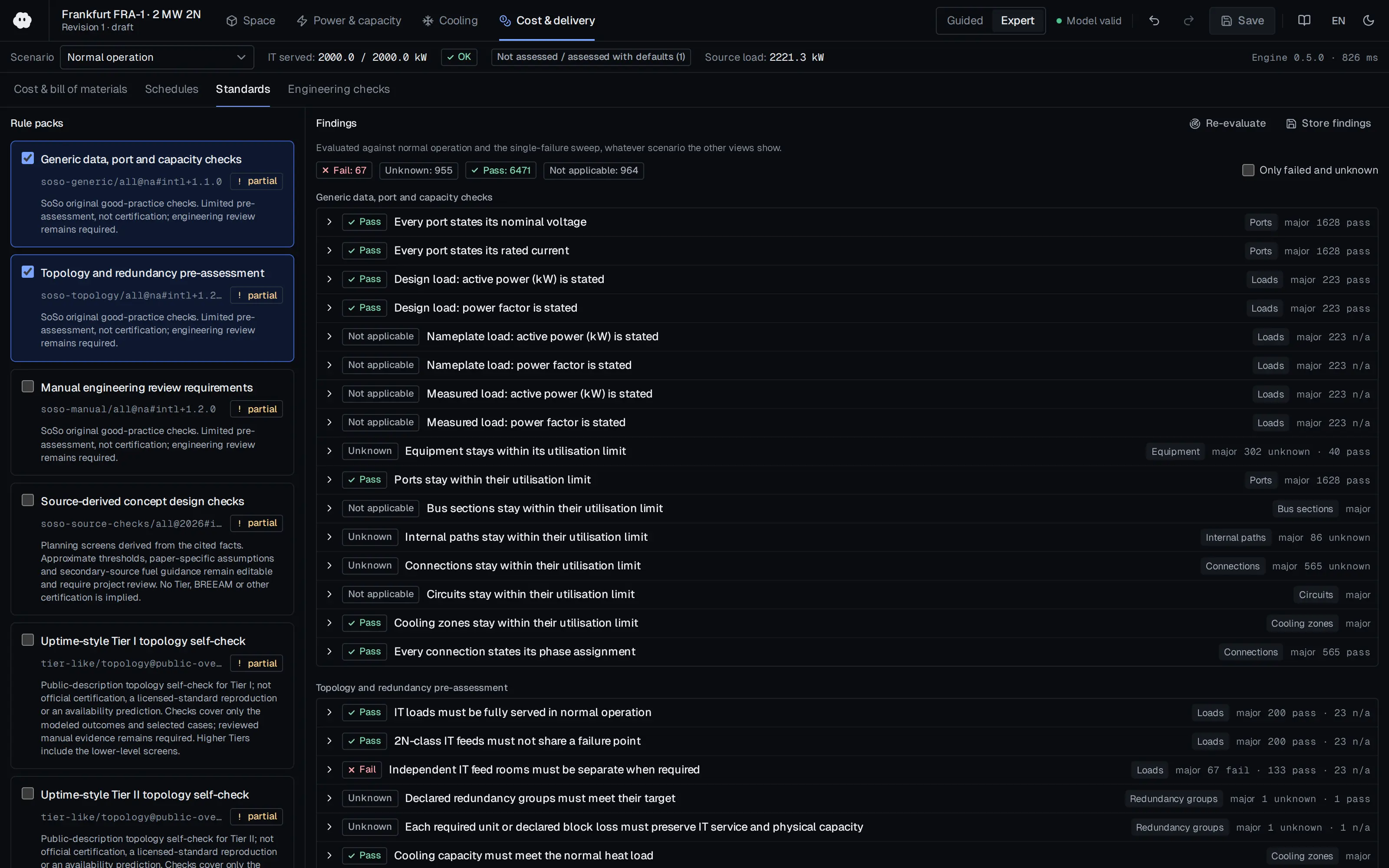
Who should read it
Engineers designing fire protection, consultants assessing Tier compliance and data center operators.
Related standards
- NFPA 75
- NFPA 76
- Uptime Institute Tier Standard: Topology
Publication details
- Authors
- Andy Lawrence
- Publisher
- Uptime Institute Journal
- Year
- 2021
- Document language
- English
- Source type
- Industry body
- Access
- Free to read
- Licence
- Copyright retained; citation only — the publisher’s terms apply to the original document
Citation
Andy Lawrence (2021). Datacenter Fire Frequency (Andy Lawrence). Uptime Institute Journal. https://journal.uptimeinstitute.com/datacenter-fire-frequency/
Events on this subject
Browse the events calendarAll content and rights belong to the respective authors and publishers. SoSo CAD provides only the citation, its own summary and a link to the source, and is not responsible for the sources' content.
Related sources
All sources on this topicUptime Institute Journal 2019
Lithium Ion Batteries for the data center. Are they ready for production yet? (Chris Brown)
Catalogue battery chemistry per UPS with an approved-location field (battery room versus data hall) and charger compatibility flags.
- Related standards: NFPA 855, UL 9540A.
Uptime Institute 2010
Tier Classification Myths and Misconceptions (Uptime Institute)
Avoid labelling designs by N-count; run a path-based concurrent-maintainability analysis in Tier advisory tools.
- N+1, N+2, S+S or 2(N+1) component counts do not determine Tier.
Fire (MDPI AG) 2026
Reframing Data Center Fire Safety as a Socio-Technical Reliability System: A Systematic Review
Ask for a fire-safety design file that covers a lifecycle plan (aligned with NFPA 75 and NFPA 76) including emergency response, damage control and post-fire recovery, not only prevention and suppression.
- The search found 806 records (Scopus 330, Web of Science 476); twelve empirical studies were synthesised and benchmarked against NFPA 75 and NFPA 76.
Open Compute Project Foundation 2026
White Paper: Requirements for Energy Storage Systems Used in Data Centers, Revision 1.0, Version 1.0 (OCP Ready Facilities, January 2026)
Fix the ESS architecture (DC or AC coupled, distributed or centralised, backup-only or grid-interactive), write the applicable NFPA 70, NFPA 855 and IEC 62933 parts into the design basis, and consult the authority having jurisdiction (AHJ) early.
- FM Global DS 5-33 (as cited) recommends battery installations in rooms with at least a 2-hour fire rating.
Batteries (MDPI AG) 2025
Experimental and Reduced-Order Modeling Research of Thermal Runaway Propagation in 100 Ah Lithium Iron Phosphate Battery Module
In LFP module design, evaluate inter-cell thermal resistance (interface insulation) together with measures that cut heat release to stop propagation; in the model an interface resistance of hR = 100 W·m^-2·K^-1 alone suppressed it.
- Venting phases (vent opening to runaway) lasted 204 s, 399 s, 156 s and 309 s for cells 1-4.

Open Compute Project Foundation 2023
Immersion Requirements Rev 2.0, First Amended (Revision 2.10, August 18, 2023)
Compare vendor offers on the same template: request W32 footprint density (kW/m2), full-solution static floor load, ceiling clearance and non-IT power per kW of IT in writing.
- Containment must hold at least 100% of the fluid volume of any single system without breach.