
Tier Classification Myths and Misconceptions (Uptime Institute)
Uptime Institute
Uptime Institute's 2009-2010 web page of Tier myths and Q&A explains that Tiers are not a checklist and are not set by component counts, utility feeds or site location.
On this page
Overview
The page gathers myths and questions that Uptime Institute published in its Tier Program emails. The entries date from 2009 and 2010 and correct, one by one, common misunderstandings about what Tier classification measures.
The central message is that Tiers evaluate a facility's capability to allow maintenance and to withstand a fault, and are not available in checklist form. The page also says Tiers are disconnected from TIA-942. Tier II requires shutdown for planned maintenance, whereas Concurrent Maintainability defines Tier III. Which class a design falls into therefore depends on how its paths behave during maintenance and faults, not on an equipment list.
Many hardware myths are addressed too. Tiers do not mandate an emergency power off (EPO) switch; if one is installed it must meet the Concurrent Maintainability or Fault Tolerance objective. The engine-generator plant must be sized to carry the critical load without runtime limits, yet need not run at all times. Component counts such as N+1, N+2, S+S or 2(N+1) do not determine Tier, and the number of utility feeds neither predicts nor influences it.
The Q&A section describes rack-mounted transfer switches as a concession for equipment with an odd number of power cords. Details like this show how the classification is interpreted in practice. Raised floors and specific security arrangements are likewise not Tier requirements; they are owner choices. Limits: the page is a period collection and does not reflect later changes to the standard. For designers its value is as a reminder to avoid arguing over the wrong criteria and to focus on path-based analysis when classification is debated.
Key points
- Tiers evaluate the capability to allow maintenance and to withstand a fault; they are not available as a checklist.
- Tiers do not require an EPO; if installed it must meet the Concurrent Maintainability or Fault Tolerance objective.
- The generator plant must carry critical load without runtime limits but need not run at all times.
- N+1, N+2, S+S or 2(N+1) component counts do not determine Tier.
- The number of utility feeds neither predicts nor influences Tier.
- Rack-mounted transfer switches are a concession for equipment with odd numbers of cords.
- Tier II requires shutdown for planned maintenance; Concurrent Maintainability defines Tier III.
- Tiers are independent of TIA-942; raised floors and specific security measures are not Tier requirements.
Using it in design
- Avoid labelling designs by N-count; run a path-based concurrent-maintainability analysis in Tier advisory tools.
- Present EPO and raised floor as owner choices, not Tier requirements.
- Size the generator plant on the principle of carrying critical load without runtime limits.
- Do not justify a Tier claim by the number of utility feeds; examine how each path behaves under maintenance and fault.
Monthly newsletter · free
Keep your reading list current
Once a month: new library sources, changes to Turkish regulations and upcoming data centre events.
SoSo CAD
Assess redundancy through scenarios
Compare normal operation and equipment failures in SoSo CAD, with supplied loads and capacity shortfalls in one view.
Request a demo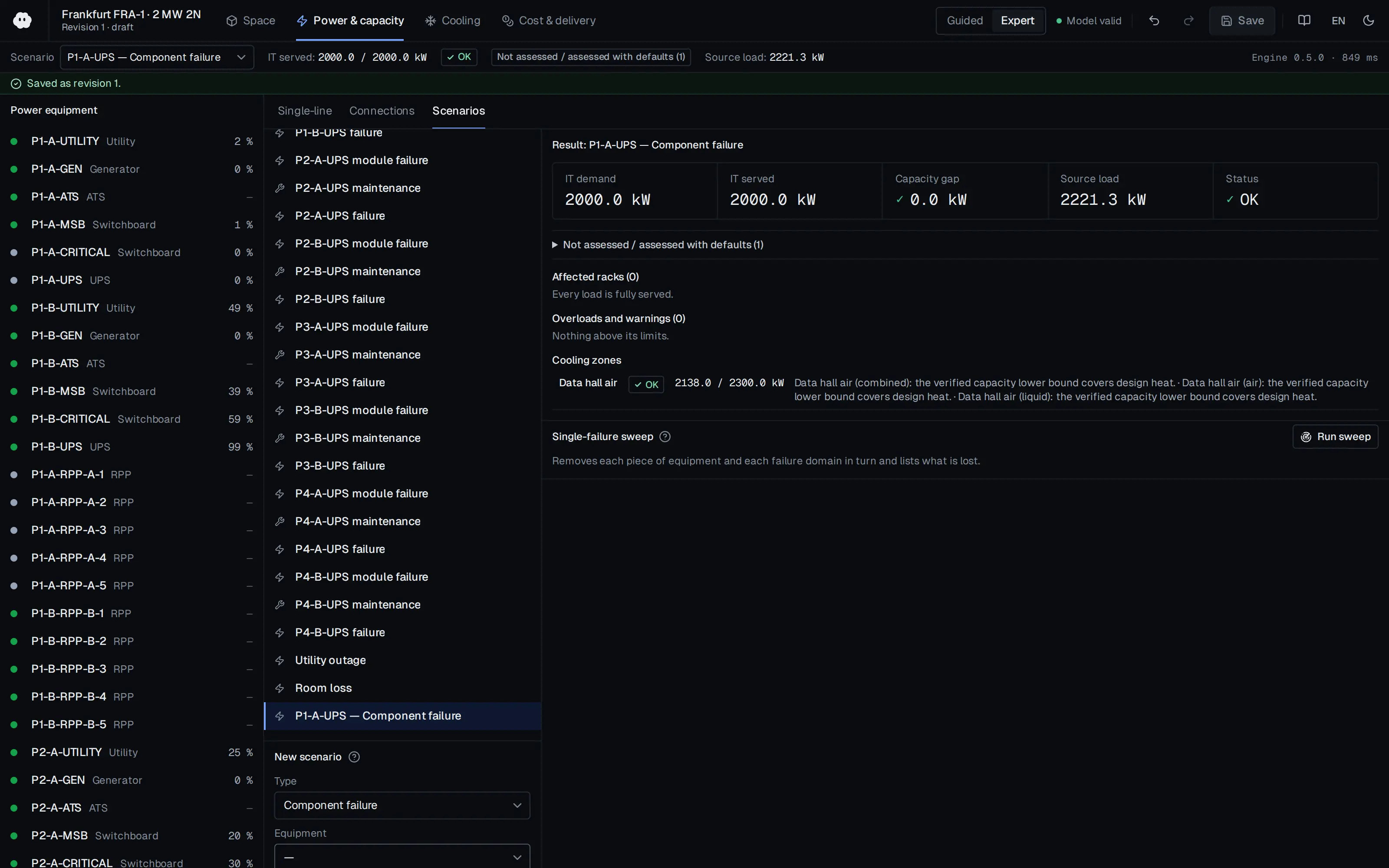
Who should read it
Engineers and consultants designing to a Tier target, and owners who use Tier language in contracts.
Related standards
- Uptime Tier Standard: Topology
- ANSI/TIA-942
Publication details
- Authors
- Uptime Institute
- Publisher
- Uptime Institute
- Year
- 2010
- Document language
- English
- Source type
- Industry body
- Access
- Free to read
- Licence
- Copyright retained; citation only — the publisher’s terms apply to the original document
Original licence note
Publisher press release / public web page; copyright Uptime Institute, no open licence. Citation only.
Citation
Uptime Institute (2010). Tier Classification Myths and Misconceptions (Uptime Institute). Uptime Institute. https://uptimeinstitute.com/myths
Events on this subject
- ICCI 2027 – Uluslararası Enerji ve Çevre Fuarı ve Konferansı
- Data Center World Middle East
- ELECO 2026 Elektrik-Elektronik ve Biyomedikal Mühendisliği Konferansı
All content and rights belong to the respective authors and publishers. SoSo CAD provides only the citation, its own summary and a link to the source, and is not responsible for the sources' content.