
Fire protection for data centers: a comprehensive approach
Siemens (with Jensen Hughes) · Siemens, Jensen Hughes
This 2025 Siemens white paper, written with Jensen Hughes, argues that traditional prescriptive fire protection is insufficient for high-density data centers and proposes a risk-based method. Note: the full text sits behind a registration form, so this summary rests only on the public landing page.
On this page
Overview
The starting point is that following prescriptive rules alone does not cover modern data centre risks. The landing page highlights three drivers: rising power density, the effect of cooling airflow on fire behaviour, and lithium-ion battery energy storage. They are presented as new factors that strain the detection and suppression assumptions built for a classic server hall. Prescriptive here means applying one fixed rule list to every room type.
The proposed method is a four-step chain: risk assessment first, then protection goals derived from standards and that assessment, then detection and suppression designed per area, and finally integration and maintenance for continuous operation. System selection is therefore tied to the hazard and goal of each area rather than a single standard package. The full paper is behind a download form and was not read, so the method's detail, worked calculations and numeric thresholds are absent here.
Everything stated comes from Siemens' landing-page key learnings and has no independent verification. Its practical value is a decision framework to hang on standards such as NFPA 75, NFPA 76, NFPA 855, EN 50600-2-5, ISO 14520 and VdS 3511: white space, UPS/battery rooms, lithium-ion BESS, generators and electrical rooms do not all need the same protection. This entry should therefore be read as a statement of direction, not as evidence for the method.
Key points
- Named risk drivers: rising power density, cooling airflow, lithium-ion battery energy storage.
- Approach: risk assessment, protection goals, area-specific detection and suppression, integration and maintenance.
- Traditional prescriptive protection is argued to be insufficient for high-density sites.
- Related standards: NFPA 75, NFPA 76, NFPA 855, EN 50600-2-5, ISO 14520, VdS 3511.
- Full text is behind a registration form; this summary rests on the landing page only.
Using it in design
- Structure the fire module by room type: white space, UPS/battery room, lithium-ion BESS, generator, electrical rooms.
- Add a protection-goal selector (life safety / asset / business continuity) and drive detection choice (VESDA/ASD) from it.
- Offer suppression options by goal: pre-action sprinkler, clean agent, water mist.
- Trigger NFPA 855 as a separate checklist for areas containing lithium-ion batteries.
Monthly newsletter · free
Keep your reading list current
Once a month: new library sources, changes to Turkish regulations and upcoming data centre events.
SoSo CAD
Bring standards pre-checks into your project
Review model-based TS EN 50600 and Tier pre-checks, missing inputs and items requiring engineering review in SoSo CAD.
Request a demo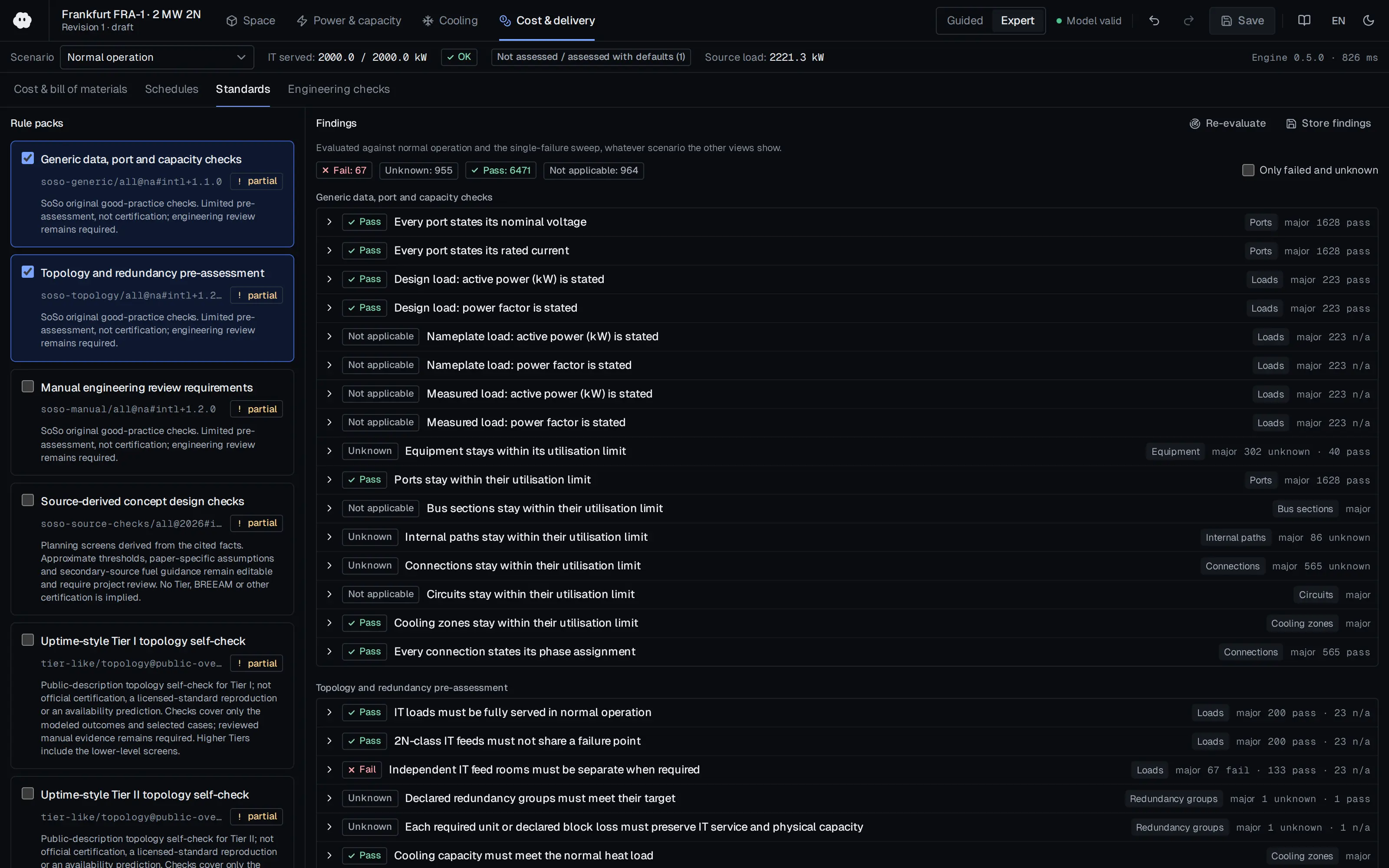
Who should read it
Designers and safety managers who want to build data centre fire detection and suppression strategy on a risk basis.
Related standards
- NFPA 75
- NFPA 76
- NFPA 855
- EN 50600-2-5
- ISO 14520
- VdS 3511
Publication details
- Authors
- Siemens; Jensen Hughes
- Publisher
- Siemens (with Jensen Hughes)
- Year
- 2025
- Document language
- English
- Source type
- Manufacturer
- Access
- Citation only
- Licence
- Copyright retained; citation only — the publisher’s terms apply to the original document
Citation
Siemens; Jensen Hughes (2025). Fire protection for data centers: a comprehensive approach. Siemens (with Jensen Hughes). https://resources.sw.siemens.com/en-US/white-paper-data-centers-fire-protection/
Events on this subject
Browse the events calendarAll content and rights belong to the respective authors and publishers. SoSo CAD provides only the citation, its own summary and a link to the source, and is not responsible for the sources' content.