
Top 10 Trends of Data Center Facility 2024 White Paper
Huawei Digital Power
Huawei's 2024 edition shifts emphasis to safety and reliability. It quantifies how much faster faults escalate at high density, notably lithium-battery thermal runaway and liquid-loop failures.
On this page
Overview
The trends cover high-reliability products, distributed cooling architecture, predictive maintenance, active safety, prefabricated modular construction, simplified O&M, air/liquid convergence, indirect evaporative cooling, efficient power links and AI energy optimisation. Uptime Institute 2023 attributes 19 % of data-centre accidents and outages to cooling systems. Rack power is expected to rise from 6-8 kW to 30-40 kW as intelligent computing grows.
The fault speeds are the most concrete part of the document. Lithium battery thermal runaway goes from trigger temperature T2 (150-250 C) to peak T3 (generally 500 C or less) in only 30-60 s. For a 30 kW cabinet with cold-plate plus air cooling, the emergency response time after a secondary-pipe fault is only 30 s to 1 min.
For hall design the paper expects mixed halls of racks at 15 kW or less and 30 kW or more, while about 90 % of new data centres remain at 15 kW or less and air-cooled. Indirect evaporative cooling is cited at about 20 % lower overall cost than chilled water. Prefabricated modular construction cuts a project from about 24 to about 10 months (time to market about 50 % shorter). A high-efficiency UPS mode reaches 99.1 % conversion, and a measured site PUE of 1.298 is reported at 30 % of design load.
Key points
- Uptime Institute 2023: cooling systems cause 19 % of data-centre accidents/outages.
- Rack power expected to rise from 6-8 kW to 30-40 kW.
- Lithium battery thermal runaway goes from T2 (150-250 C) to T3 (generally <= 500 C) in 30-60 s.
- 30 kW cold-plate plus air cabinet: only 30 s to 1 min to respond after a secondary-pipe fault.
- Prefabricated modular construction cuts a project from about 24 to about 10 months.
- Mixed halls of <= 15 kW and >= 30 kW racks expected; about 90 % of new DCs still <= 15 kW air-cooled.
- Indirect evaporative cooling cited at about 20 % lower overall cost than chilled water.
- High-efficiency UPS mode 99.1 %; measured site PUE 1.298 at 30 % of design load.
Using it in design
- For lithium BESS/UPS rooms, require detection and segregation sized for a 30-60 s runaway escalation.
- For liquid-cooled racks, require ride-through or redundant secondary loops given the 30-60 s response window.
- Support mixed-density zones (<= 15 kW air, >= 30 kW liquid) and an adjustable air/liquid ratio in hall planning.
- In the schedule model, compare prefab and stick-built durations.
Monthly newsletter · free
Keep your reading list current
Once a month: new library sources, changes to Turkish regulations and upcoming data centre events.
SoSo CAD
Assess redundancy through scenarios
Compare normal operation and equipment failures in SoSo CAD, with supplied loads and capacity shortfalls in one view.
Request a demo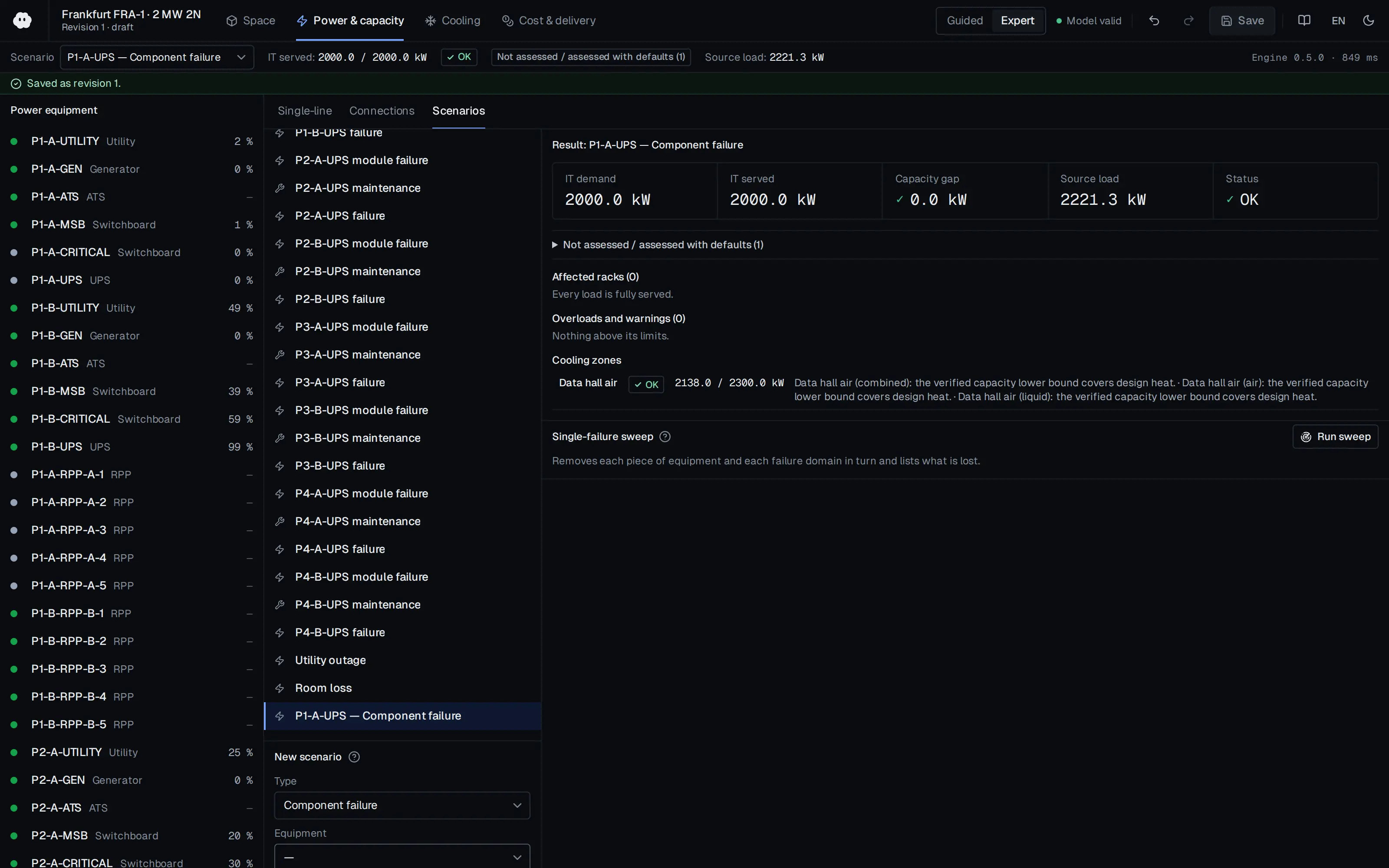
Who should read it
Designers and operations managers sizing fire, cooling-failure and maintenance-safety risk in high-density halls.
Related standards
- IEC 62619
- NFPA 855
Publication details
- Authors
- Huawei Digital Power
- Publisher
- Huawei Digital Power
- Year
- 2024
- Document language
- English
- Source type
- Manufacturer
- Access
- Free to read
- Licence
- Copyright retained; citation only — the publisher’s terms apply to the original document
Citation
Huawei Digital Power (2024). Top 10 Trends of Data Center Facility 2024 White Paper. Huawei Digital Power. https://digitalpower.huawei.com/attachments/index/1991747e83d947b686b012919c687a88.pdf
Events on this subject
Browse the events calendarAll content and rights belong to the respective authors and publishers. SoSo CAD provides only the citation, its own summary and a link to the source, and is not responsible for the sources' content.
Related sources
All sources on this topicHuawei Digital Power 2023
White Paper on the Top 10 Trends of Data Center Facilities
Show WUE alongside PUE in the metrics panel, with region-specific targets as policy presets.
- At 16 kW per rack, power-room area roughly equals IT space (1:1).

Open Compute Project Foundation 2023
Immersion Requirements Rev 2.0, First Amended (Revision 2.10, August 18, 2023)
Compare vendor offers on the same template: request W32 footprint density (kW/m2), full-solution static floor load, ceiling clearance and non-IT power per kW of IT in writing.
- Containment must hold at least 100% of the fluid volume of any single system without breach.
U.S. DOE FEMP 2021
Sandia's Liquid-Cooled Data Center Boosts Efficiency and Resiliency (FEMP success story, DOE/GO-102021-5582, July 2021)
Consider negative-pressure (vacuum) distribution as an option for reducing leak risk in direct liquid cooling; flexible hoses give layout flexibility.
- The system kept CPUs below 50 °C (122 °F); each CDU draws 3.4 kW at full load, about 1.6% of total system power.
U.S. DOE FEMP 2010
Operations & Maintenance Best Practices: A Guide to Achieving Operational Efficiency, Release 3.0 (August 2010)
Choose maintenance strategy by equipment criticality: predictive for critical equipment with random failures, preventive for equipment subject to wear, reactive for small non-critical items; build a master equipment list and priority matrix.
- Boiler combustion tuning and related O&M can yield fuel savings of 2% to 20%.
STULZ 2026
Liquid Cooling Whitepaper - End-to-End Cooling: The Key to Resilient AI Data Centers
In the liquid-cooling module size TCS flow at about 1.5 L/min/kW by default and store CDU approach temperature and external static pressure.
- Rack heat densities from about 125 kW today to beyond 500 kW.
TÜV NORD 2026
EN 50600 — data centre facilities and infrastructures (overview and certification)
In an 'EN 50600' standards profile, offer separate availability-class selectors for power, cooling and cabling (instead of a single Tier), plus a protection-class selector per room or zone
- Protection classes 1-4 for unauthorised access and other hazards; physical-security zoning required