
Uptime Institute Annual Outage Analysis 2026 (8th annual) — press release (with 2025 findings)
Uptime Institute
Public summary of Uptime's outage research: per-site outage frequency has fallen for five years, but the on-site power chain (UPS, transfer switch, generator) is still the leading cause.
On this page
Overview
The summary reports that per-site outage frequency has declined for five consecutive years but that improvement is slowing. A clear trend is the growing share of external infrastructure (grid, fibre/connectivity, third-party cloud) in publicly reported outages. Third-party providers (cloud, telco, colocation) account for about two-thirds of publicly reported outages over nine years. On site, power remains the leading cause, dominated by UPS, transfer-switch and generator failures. The 2025 release adds that IT and networking issues were 23% of impactful outages in 2024.
Building a redundant power chain is therefore not enough; transfer and switching points are a weak link in their own right. On cost, the 2026 release says 57% of respondents' most recent major outage cost more than $100,000, and one in five exceeded $1 million, for the second year running. Roughly one in ten outages has serious or severe impact. On human error, about 40% of organisations suffered a major human-error outage within three years, and 85% of those stemmed from staff not following procedures or from flawed procedures.
The full report requires registration; the figures here come from the 2026 and 2025 press releases, so breakdown detail is missing. The shared message of the findings is that outages often occur not in the redundant component itself but in the transitions between components and in human intervention: transfer-switch failures sit on the same list as UPS and generator failures, and procedure-related causes explain 85% of human-error outages.
Key points
- 57% of respondents said their most recent major outage cost more than $100,000; 1 in 5 exceeded $1 million (second year running)
- Power is the leading cause of impactful outages; UPS, transfer switch and generator failures dominate
- IT and networking issues were 23% of impactful outages in 2024
- About 40% of organisations had a major human-error outage in 3 years; 85% of those came from not following procedures or flawed procedures
- Third-party providers account for about two-thirds of publicly reported outages over nine years
- About 1 in 10 outages has serious or severe impact
- Per-site outage frequency fell for five consecutive years, but improvement is slowing
Using it in design
- Weight UPS, ATS/STS and generator failure modes highest in the reliability model
- Recommend maintenance bypass, ATS redundancy and generator load-bank testing by default
- Require MOP/SOP/EOP generation for each critical asset, since procedural failures dominate human error
- Add utility/grid and dual-carrier fibre diversity as explicit site-risk inputs
Monthly newsletter · free
Keep your reading list current
Once a month: new library sources, changes to Turkish regulations and upcoming data centre events.
SoSo CAD
Assess redundancy through scenarios
Compare normal operation and equipment failures in SoSo CAD, with supplied loads and capacity shortfalls in one view.
Request a demo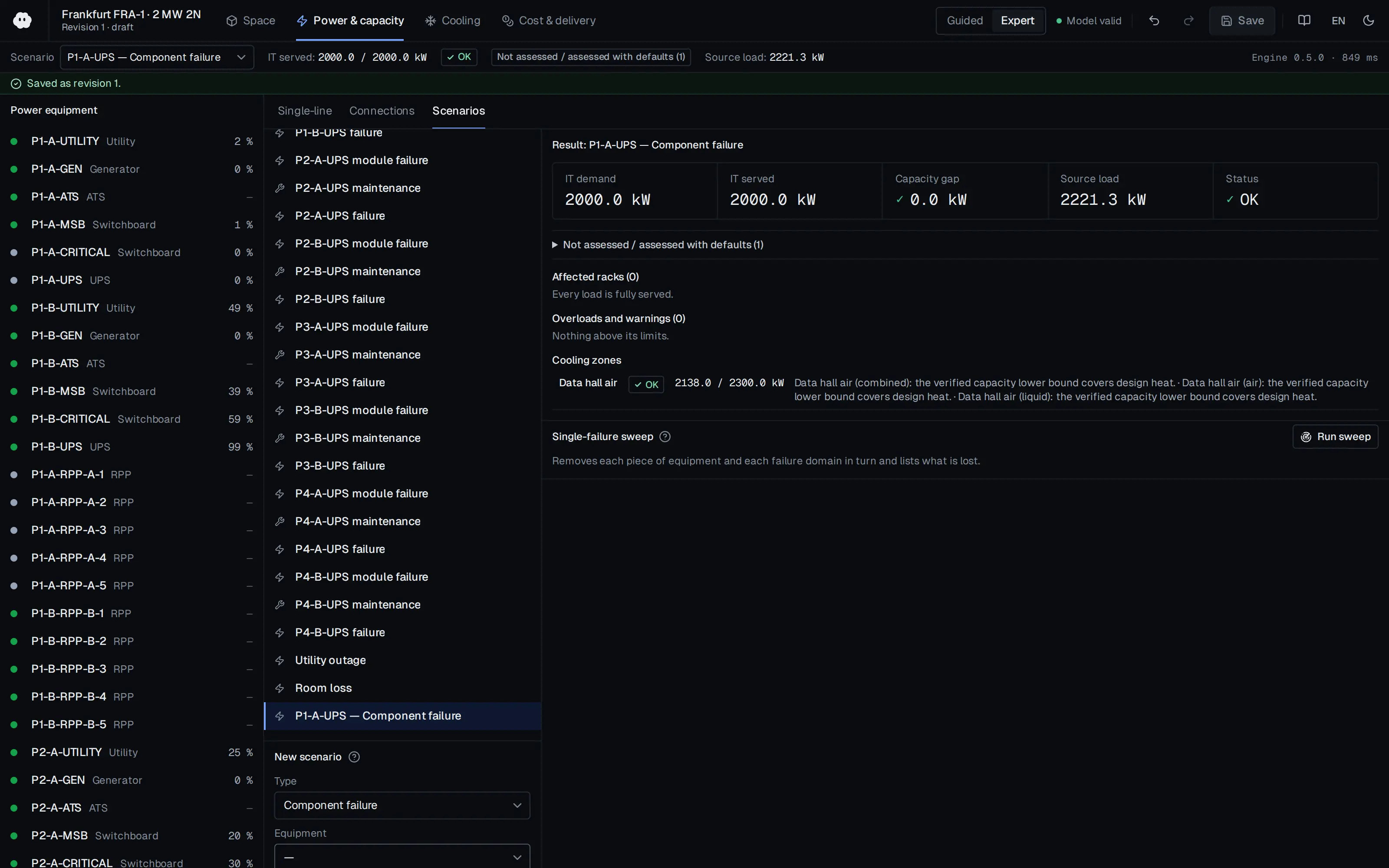
Who should read it
Engineers building reliability models, operations managers assessing risk, and consultants explaining outage cost to management.
Related standards
- NFPA 110
- IEEE 3006.7
- Uptime Tier Standard: Operational Sustainability
Publication details
- Authors
- Uptime Institute
- Publisher
- Uptime Institute
- Year
- 2026
- Document language
- English
- Source type
- Industry body
- Access
- Free to read
- Licence
- Copyright retained; citation only — the publisher’s terms apply to the original document
Citation
Uptime Institute (2026). Uptime Institute Annual Outage Analysis 2026 (8th annual) — press release (with 2025 findings). Uptime Institute. https://uptimeinstitute.com/about-ui/press-releases/uptime-announces-annual-outage-analysis-report-2026
Events on this subject
- Electricity Eurasia 2027
- ELECO 2026 Elektrik-Elektronik ve Biyomedikal Mühendisliği Konferansı
- ICCI 2027 – Uluslararası Enerji ve Çevre Fuarı ve Konferansı
All content and rights belong to the respective authors and publishers. SoSo CAD provides only the citation, its own summary and a link to the source, and is not responsible for the sources' content.
Related sources
All sources on this topicUptime Institute 2021
Uptime Institute Annual Outage Analysis 2021 (3rd annual) - press release
When building a failure-mode catalogue, list the UPS, ATS/STS and generator as the main power-outage contributors.
- 42% of operators had a human-error outage in the past three years.
Energies (MDPI AG) 2023
Reliability Assessment of the Configuration of Dynamic Uninterruptible Power Sources: A Case of Data Centers
When choosing among DRUPS or UPS configurations, first screen with the graph-based method to identify the best candidates, then do the detailed RBD calculation for that candidate only.
- Single system: λ = 3.10 × 10^-6 1/h, A = 0.999949, MTBF 306,600 h (35 years).
U.S. DoD (UFC) 2023
UFC 3-540-01 Engine-Driven Generator Systems for Prime and Standby Power Applications (1 August 2014, Change 3, 26 January 2023)
Include transient and steady-state loads, transformer inrush, motor starting and UPS load in the generator sizing study, and calculate UPS charging load using the minimum charging current allowed while on generator.
- Harmonic analysis is required when switching power supplies make up 25% or more of the system load.
FEMA 2014
FEMA P-1019, Emergency Power Systems for Critical Facilities: A Best Practices Approach to Improving Reliability (September 2014)
At critical-facility data centers, place generators, ATS, fuel tanks and pumps above the greatest of BFE + 3 ft, DFE + 1 ft and 500-year elevation + 1 ft, and prefer elevation to dry floodproofing.
- Generators over 300 kW are almost exclusively diesel-fueled.
Headquarters, Department of the Army (U.S. Army Corps of Engineers PREP) 2006
TM 5-698-5 Survey of Reliability and Availability Information for Power Distribution, Power Generation, and Heating, Ventilating and Air Conditioning (HVAC) Components for Commercial, Industrial, and Utility Installations (22 July 2006)
When modelling the power and cooling chain use these values as starting failure rates and MTBF/MTTR inputs and convert them into availability with the method of TM 5-698-1.
- Diesel engine generators overall: 0.528 failures/yr, MTBF about 16,590 h, MTTR 24.22 h, operational availability 0.99399.
U.S. Army Corps of Engineers (Headquarters, Department of the Army) 2002
TM 5-693 Uninterruptible Power Supply System Selection, Installation, and Maintenance for Command, Control, Communications, Computer, Intelligence, Surveillance, and Reconnaissance (C4ISR) Facilities (31 May 2002)
Calculate availability from MTBF and MTTR before choosing a UPS configuration; apply the same method to single-unit, N+1 and dual-redundant layouts to compare the gain from redundancy with the cost of the added components.
- C4ISR facilities require a reliability level of 99.9999 percent (the six-nine rule), which may call for greater redundancy.