
TM 5-693 Uninterruptible Power Supply System Selection, Installation, and Maintenance for Command, Control, Communications, Computer, Intelligence, Surveillance, and Reconnaissance (C4ISR) Facilities (31 May 2002)
U.S. Army Corps of Engineers (Headquarters, Department of the Army) · Headquarters, Department of the Army
A U.S. Army technical manual on static and rotary UPS systems for mission-critical command-and-control facilities. It gives sound fundamentals on operating principles, configurations, sizing, batteries, harmonics, installation and maintenance.
U.S. public domain — U.S. Government work; free to reuse
On this page
Overview
TM 5-693 is a Department of the Army technical manual published on 31 May 2002 and released for public use. Its purpose is to guide facilities engineers in selecting, installing and maintaining a UPS once the decision to install one has been made. It is written mainly for C4ISR (command, control, communications, computer, intelligence, surveillance and reconnaissance) facilities, which it says require a higher level of reliability, and it notes that it can be used as a reference for similar applications.
Chapters 1 and 2 introduce the concepts. A static UPS consists of a rectifier-charger, inverter, static switch and battery; the text describes static units from about 220 VA to over 1 MVA and notes that outputs above 1 MVA need some parallel internal components, which lowers reliability. A rotary UPS uses a motor-generator set, is mainly designed for 125 kVA and above, becomes cost competitive with static units around 300 kVA, produces more heat and gives complete electrical isolation. Chapter 2 also covers redundant, isolated-redundant and dual-redundant configurations.
Chapter 3 is the core of the selection process: determine need, then check safety (hydrogen accumulation, noise), availability, maintainability and affordability in turn. Availability is expressed as Ai = MTBF / (MTBF + MTTR). In the worked example a single unit with MTBF 500 hours and MTTR 20 hours has Ai = 0.962, a two-unit configuration where one unit is enough reaches 0.999, and one where both are required falls to 0.925. The text states plainly that redundancy raises system reliability while increasing the total number of failures.
Chapters 4 and 5 cover installation, grounding, acceptance testing and maintenance, and Appendix B gives a complete selection example. The main limit is age: the manual dates from 2002, so efficiency figures, battery technologies such as lithium-ion and the referenced standard editions no longer reflect current practice. It is valuable for principles and calculation methods, not for current product data. Battery maintenance is covered by weekly, monthly, quarterly and annual inspection tables (Tables 5-2 to 5-5), and troubleshooting by corrective-action tables for circuit breakers, rectifier/chargers, batteries, inverter/static switches, motors/engines and generators.
Key points
- C4ISR facilities require a reliability level of 99.9999 percent (the six-nine rule), which may call for greater redundancy.
- Static UPS: rectifier, inverter, static switch and battery; rotary UPS: motor-generator set, typically 125 kVA and above and competitive with static units from about 300 kVA.
- The typical required UPS availability is 98 percent; inherent availability is Ai = MTBF / (MTBF + MTTR). Example: MTBF 500 h and MTTR 20 h give 0.962 for one unit, 0.999 when one of two units suffices and 0.925 when both are required.
- Redundancy improves reliability but increases the total number of failures; a parallel redundant system can be less reliable if the units do not tolerate disturbances and overloads at their outputs.
- Typical rectifier/chargers recharge the battery in 8 to 10 hours with ripple below 2% RMS. Typical inverter: +/-2% voltage regulation for balanced load, recovery to +/-3% within 10 ms and +/-1% within 30 ms, 5% maximum THD, 500% overload for 1 cycle and 120% continuous. The static switch transfers in 0 s (make-before-break).
- A 30% margin is added to the required battery capacity for load growth and aging; IEEE 450 recommends replacement when actual capacity falls to 80% of rated. Lead-acid ratings are at 77 degrees F (25 degrees C) with end voltages of about 1.67-1.75 V per cell.
- Lead-acid battery life halves for every 15 degrees F rise in electrolyte temperature, while ni-cad loses only about 15% of its life.
- Harmonic effects should be analysed when static UPS capacity approaches 20% of the supply system capacity; ITIC recommends UPS input current THD of 5% or less with no single harmonic above 3%.
- Hydrogen in air is explosive above 4% by volume, and battery room alarms are typically set at 20-25% of that lower explosive limit.
- Battery comparison (Table 2-1): calcium lead-acid flooded 20 years typical life, valve-regulated gelled 5 years, ni-cad flooded 25 years and roughly 1,000-1,200 full discharges.
Using it in design
- Calculate availability from MTBF and MTTR before choosing a UPS configuration; apply the same method to single-unit, N+1 and dual-redundant layouts to compare the gain from redundancy with the cost of the added components.
- Size battery capacity with temperature correction, the 30% margin and the 80% replacement threshold; battery room temperature away from the 77 degrees F (25 degrees C) rating directly shortens life.
- For large non-linear loads, run a harmonic analysis when UPS capacity approaches 20% of the supply and write the input THD target (5%, single harmonic 3%) into the specification.
- Design battery room ventilation for hydrogen and set the gas alarm at 20-25% of the lower explosive limit.
- When comparing static and rotary UPS weigh capacity (125 kVA and above, cost parity near 300 kVA), efficiency, heat load and the need for full isolation together.
- Use the numbers for principle and method only; verify them against current product data, since the 2002 efficiency figures and the absence of lithium-ion limit their present value.
Monthly newsletter · free
Keep your reading list current
Once a month: new library sources, changes to Turkish regulations and upcoming data centre events.
SoSo CAD
Review your power design in SoSo CAD
Inspect supply paths, equipment loads and UPS failure scenarios in one model.
Request a demo
Who should read it
Electrical engineers selecting UPS configurations, redundancy and batteries, and facility operations teams.
Document contents
- Chapter 1 Introduction: purpose, scope, principles and configurations, design criteria and selection, installation and testing, maintenance
- Chapter 2 Principles and Configurations of Uninterruptible Power Supply (UPS) Systems
- 2-1 Principles of static UPS systems
- 2-2 Principles of rotary UPS systems
- 2-3 Common static UPS system configurations
- 2-4 Rotary UPS system configurations
- Chapter 3 Design and Selection of Uninterruptible Power Supply (UPS)
- 3-1 Selecting an UPS
- 3-2 Static UPS system ratings and size selection
- 3-3 Rotary UPS system ratings and size selection
- Chapter 4 Installation and Testing of Uninterruptible Power Supply (UPS)
- 4-3 Power distribution and equipment grounding and shielding requirements
- 4-4 Testing and start-up
- Chapter 5 Uninterruptible Power Supply (UPS) Systems Maintenance Procedures
- 5-2 UPS battery maintenance
- Appendix B Selecting an Uninterruptible Power Supply (UPS): An Example
Read the document
usace-tm-5-693-ups.pdf
U.S. public domain — U.S. Government work; free to reuse
The document is provided unaltered because its licence permits redistribution.
Publication details
- Authors
- Headquarters, Department of the Army
- Publisher
- U.S. Army Corps of Engineers (Headquarters, Department of the Army)
- Year
- 2002
- Document language
- English
- Source type
- Government / public
- Access
- Open licence — downloadable
- Licence
- U.S. public domain — U.S. Government work; free to reuse
- Licence evidence
- www.copyright.gov
Original licence note
DoD/USACE criteria marked "Approved for public release; distribution unlimited"; work of the U.S. Government (17 U.S.C. 105). Contains some figures credited to copyrighted 1981 source material; exclude those if republishing excerpts.
Citation
Headquarters, Department of the Army (2002). TM 5-693 Uninterruptible Power Supply System Selection, Installation, and Maintenance for Command, Control, Communications, Computer, Intelligence, Surveillance, and Reconnaissance (C4ISR) Facilities (31 May 2002). U.S. Army Corps of Engineers (Headquarters, Department of the Army). https://www.wbdg.org/FFC/ARMYCOE/COETM/tm_5_693.pdf
Events on this subject
Browse the events calendarAll content and rights belong to the respective authors and publishers. SoSo CAD provides only the citation, its own summary and a link to the source, and is not responsible for the sources' content.
Related sources
All sources on this topicHuawei Digital Power 2022
Data Center PowerPOD 3.0 Technology White Paper
Add a 'prefabricated power train' block type (transformer, LV, UPS, feeders) carrying footprint, weight and a clearance envelope.
- Average rack power rose from 4 kW to 6-8 kW and is heading to 12-16 kW.
Eaton 2016
Best Practices for Modernizing Vintage Data Centers
Add a designLifeYears catalog parameter per equipment type, default to the range midpoint, and drive a TCO/refresh timeline from it.
- Rack PDU 8-12 yr; power cables 8-20 yr; busway 8-20 yr
U.S. Army Corps of Engineers (Headquarters, Department of the Army) 2006
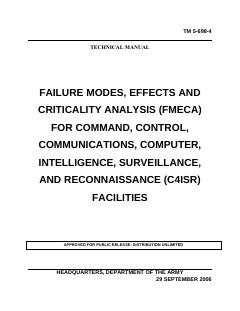
TM 5-698-4 Failure Modes, Effects and Criticality Analyses (FMECA) for Command, Control, Communications, Computer, Intelligence, Surveillance, and Reconnaissance (C4ISR) Facilities (29 September 2006)
At design stage run a functional FMEA of each critical system (power, generators, cooling); do not start without schematics, bill of materials, block diagram and the mission requirement.
- The Risk Priority Number is Severity (1-10) x Occurrence (1-10), optionally multiplied by Detection: RPN = S x O x D.
Uptime Institute 2026
Uptime Institute Annual Outage Analysis 2026 (8th annual) — press release (with 2025 findings)
Weight UPS, ATS/STS and generator failure modes highest in the reliability model
- About 1 in 10 outages has serious or severe impact
Socomec 2024
Data centre - How to ensure power availability, electrical safety and energy performance? (Expert advice & innovative solutions guide)
In the single-line editor, tag transfer devices as ATSE (IEC 60947-6-1) or STS with a transfer-time field, and suggest STS where the load needs under about 10 ms.
- Human error accounts for 22 % of unplanned outages.
U.S. Army Corps of Engineers 2006
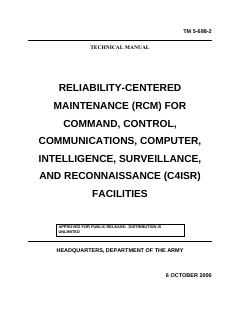
TM 5-698-2, Reliability-Centered Maintenance (RCM) for Command, Control, Communications, Computer, Intelligence, Surveillance, and Reconnaissance (C4ISR) Facilities (6 October 2006)
At design stage carry out an FMEA for each critical system and record failure modes, effects and detection methods as input to the RCM decision logic; the text stresses that RCM starts in design and continues for the life of the facility.
- For an exponential failure distribution with constant failure rate, an item with a 1000-hour MTBF has only a 37 percent probability of surviving 1000 hours of continuous operation.