
TM 5-698-2, Reliability-Centered Maintenance (RCM) for Command, Control, Communications, Computer, Intelligence, Surveillance, and Reconnaissance (C4ISR) Facilities (6 October 2006)
U.S. Army Corps of Engineers · Headquarters, Department of the Army
An Army manual on applying reliability-centered maintenance to mission-critical facilities whose power and cooling infrastructure closely resembles a data centre. It covers the logic for choosing preventive, predictive or run-to-failure tasks and performance-incentive maintenance contracts.
U.S. public domain — U.S. Government work; free to reuse
On this page
Overview
TM 5-698-2 gives a method for applying reliability-centered maintenance (RCM) to the mechanical, electrical and control systems of C4ISR facilities. RCM starts from this observation: it was once widely believed that every item had a right time for preventive maintenance (PM), that replacement or overhaul would reduce failure frequency, yet results often told a different story and PM sometimes made things worse by creating more chances for maintenance-induced failures. US airlines formed a task force with the FAA, which found that PM is effective only for items with a certain failure pattern and that, apart from safety, the PM decision should rest on economics.
The RCM precepts are six: the objective of maintenance is to preserve function, the focus is the end system, reliability is the basis for decisions (conditional probability of failure at specific ages), safety comes first and then economics, maintenance cannot raise inherent reliability and can only sustain it, and the process is continuing. The four Ws (what can fail, why, when, and what are the consequences) are the core of the logic. Chapter 5 extends from FMEA data to a decision logic tree (adapted from MSG-3) with separate branches for evident and hidden failures by hazardous, operational and economic effect.
The manual also describes how RCM applies to facility types: mechanical systems (chillers, cooling towers, valves, piping, boilers, HVAC distribution, generators, fuel systems), electrical systems (transformers, switchgear, circuit breakers, motor control centres, UPS and batteries) and SCADA control systems. In an existing facility whose PM programme is not RCM-based, supporting analyses such as FMEA must be done first; data is often missing and engineering judgment is used. It lists implementation pitfalls: run-to-failure shock, not accepting the preserve-function principle, resistance to challenging the past, organisational structure and fear of staff reduction.
Chapter 6 treats outsourced maintenance and derives performance measures from availability: maximum downtime, maximum time to restore for a single failure and turn-around time. An incentive example rewards a contractor whose downtime stays below 140 hours against a 150-hour annual maximum. The manual is dated 2006 and conceptual; it gives a method, not equipment-specific maintenance intervals. Appendix B covers the exponential, Weibull, normal and lognormal distributions, and Appendix E gives an example of a flexible RCM methodology.
Key points
- Operational availability Ao = MTBM / (MTBM + mean downtime), counting all maintenance including preventive and support delays.
- Inherent availability Ai = MTBF / (MTBF + MTTR), counting only corrective maintenance for design failures and ignoring support-system effects.
- Airline experience: moving turbine engine overhaul from scheduled to on-condition cut engine shop maintenance costs by 50 percent versus the DC-8; structural inspections required 4,000,000 hours with the traditional approach for the DC-8 against 66,000 hours with RCM for the B747.
- Of six age-reliability failure patterns, infant mortality accounts for 68 percent and constant failure rate 14 percent; 89 percent of items cannot benefit from an operating-age limit (only wearout 2 percent, bathtub 4 percent and gradual rise 5 percent can).
- For an exponential failure distribution with constant failure rate, an item with a 1000-hour MTBF has only a 37 percent probability of surviving 1000 hours of continuous operation.
- RCM is driven first by safety and then by economics; when safety is not an issue PM must be justified economically, and run-to-failure is sometimes cheaper.
- Criteria for applying RCM: many PM tasks, very high maintenance cost, frequent corrective maintenance, or hazardous conditions possible on failure.
- In an existing facility supporting analyses such as FMEA must be done before RCM starts if absent; where data rights were not procured, engineering judgment and more time are needed.
- An outsourced maintenance contract uses three availability measures: maximum downtime (for example 150 hours per year), maximum time to restore for any single failure and turn-around time; incentives may be positive or negative.
- The three main RCM candidate systems are mechanical, electrical and control; generators and fuel systems are noted as mission critical yet frequently neglected.
Using it in design
- At design stage carry out an FMEA for each critical system and record failure modes, effects and detection methods as input to the RCM decision logic; the text stresses that RCM starts in design and continues for the life of the facility.
- Separate PM tasks by age-failure pattern: an age limit for mechanical parts that show wearout, condition monitoring or run-to-failure for randomly failing electronics.
- Build maintainability into the design: access, diagnostics and repair time set MTTR and thus availability; adding redundancy is comparatively easy in a facility in terms of space and weight.
- When drafting a maintenance contract write the annual maximum downtime, maximum time to restore per failure and spare turn-around time, and divide supply and authority between contractor and customer in detail.
- Explicitly add flooded and gel lead-acid UPS batteries, chillers, generators and fuel systems to the RCM candidate list; they are critical yet often neglected.
- When reducing a PM programme plan for staff resistance, run-to-failure shock and training needs, and explain the preserve-function principle to the team.
Monthly newsletter · free
Keep your reading list current
Once a month: new library sources, changes to Turkish regulations and upcoming data centre events.
SoSo CAD
Assess redundancy through scenarios
Compare normal operation and equipment failures in SoSo CAD, with supplied loads and capacity shortfalls in one view.
Request a demo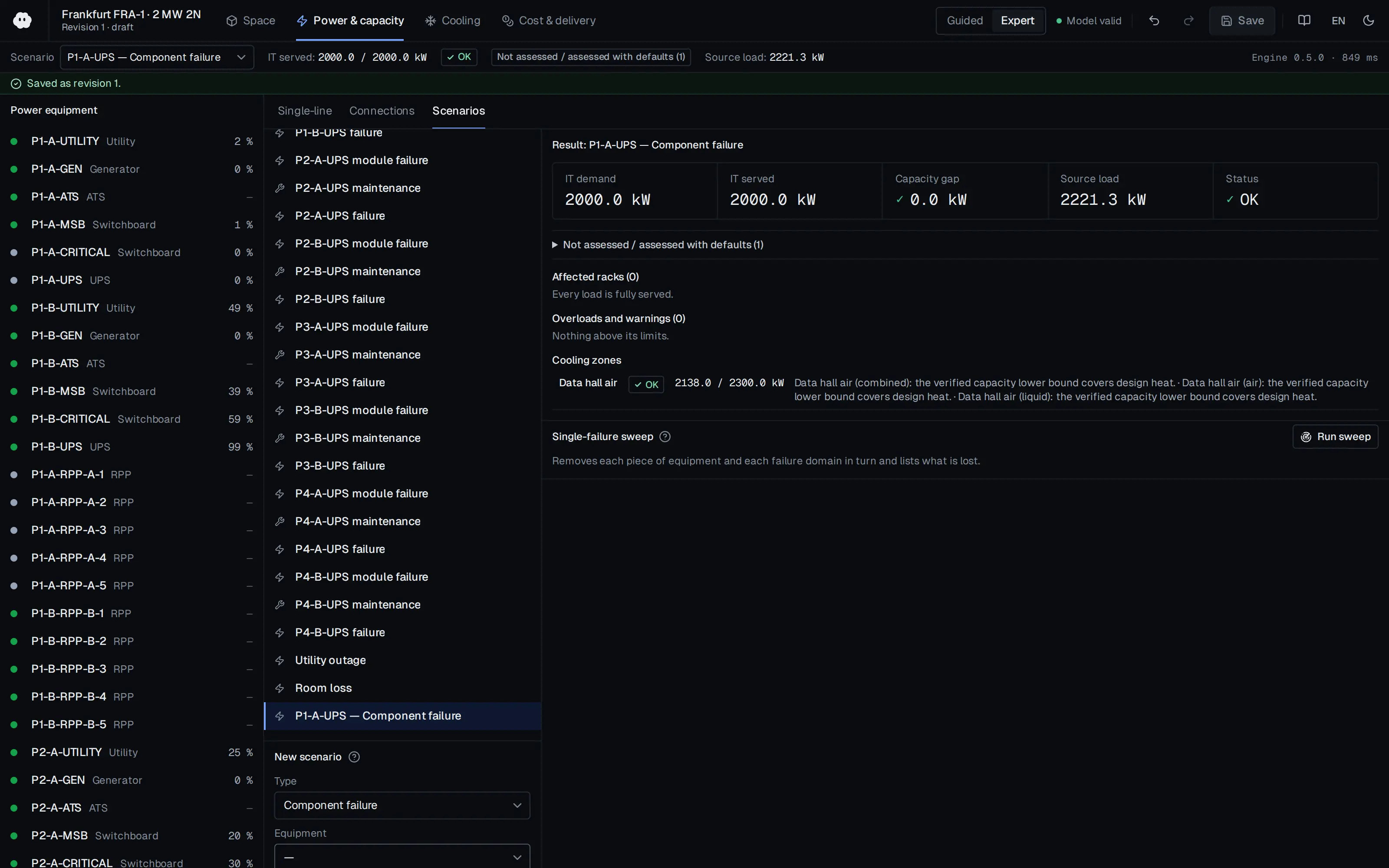
Who should read it
Operations and design engineers working on data centre maintenance strategy, maintenance contracts and design for maintainability.
Document contents
- Chapter 1 Introduction to Reliability-Centered Maintenance: availability, the RCM concept, benefits, origins
- Chapter 2 Essential Elements of a Successful RCM Program
- 2-1 RCM implementation plan
- 2-2 Data collection requirements
- 2-5 RCM as a part of design
- 2-6 Focus on the four Ws
- Chapter 3 Maintenance of Systems: categories of maintenance, maintenance concepts, packaging a maintenance program
- Chapter 4 Fundamental Concepts of a Reliability-Centered Maintenance Program: objectives, applicability of PM, failure, modeling
- Chapter 5 The Reliability-Centered Maintenance Process
- 5-2 C4ISR candidates for RCM analysis
- 5-5 The RCM process (decision logic)
- 5-6 Specific considerations for implementing RCM for C4ISR facilities
- 5-7 Evaluation of alternatives
- Chapter 6 Contracting for Maintenance: measures of performance, scope, monitoring, incentives
- Appendix B Statistical Distribution Used in Reliability and Maintainability
- Appendix C Availability and Operational Readiness
- Appendix E Flexible RCM Methodology Example
Read the document
usace-tm-5-698-2-rcm.pdf
U.S. public domain — U.S. Government work; free to reuse
The document is provided unaltered because its licence permits redistribution.
Publication details
- Authors
- Headquarters, Department of the Army
- Publisher
- U.S. Army Corps of Engineers
- Year
- 2006
- Document language
- English
- Source type
- Government / public
- Access
- Open licence — downloadable
- Licence
- U.S. public domain — U.S. Government work; free to reuse
- Licence evidence
- www.copyright.gov
Original licence note
DoD/USACE criteria marked "Approved for public release; distribution unlimited"; work of the U.S. Government (17 U.S.C. 105).
Citation
Headquarters, Department of the Army (2006). TM 5-698-2, Reliability-Centered Maintenance (RCM) for Command, Control, Communications, Computer, Intelligence, Surveillance, and Reconnaissance (C4ISR) Facilities (6 October 2006). U.S. Army Corps of Engineers. https://www.wbdg.org/FFC/ARMYCOE/COETM/tm_5_698_2.pdf
Events on this subject
Browse the events calendarAll content and rights belong to the respective authors and publishers. SoSo CAD provides only the citation, its own summary and a link to the source, and is not responsible for the sources' content.
Related sources
All sources on this topic
U.S. Army Corps of Engineers (Headquarters, Department of the Army) 2006
TM 5-698-4 Failure Modes, Effects and Criticality Analyses (FMECA) for Command, Control, Communications, Computer, Intelligence, Surveillance, and Reconnaissance (C4ISR) Facilities (29 September 2006)
At design stage run a functional FMEA of each critical system (power, generators, cooling); do not start without schematics, bill of materials, block diagram and the mission requirement.
- The Risk Priority Number is Severity (1-10) x Occurrence (1-10), optionally multiplied by Detection: RPN = S x O x D.
U.S. Army Corps of Engineers (Headquarters, Department of the Army) 2002
TM 5-693 Uninterruptible Power Supply System Selection, Installation, and Maintenance for Command, Control, Communications, Computer, Intelligence, Surveillance, and Reconnaissance (C4ISR) Facilities (31 May 2002)
Calculate availability from MTBF and MTTR before choosing a UPS configuration; apply the same method to single-unit, N+1 and dual-redundant layouts to compare the gain from redundancy with the cost of the added components.
- C4ISR facilities require a reliability level of 99.9999 percent (the six-nine rule), which may call for greater redundancy.

Open Compute Project Foundation 2022
Leak Detection and Intervention, Revision 1.0 (OCP Advanced Cooling Solutions white paper)
Run a probability-and-impact leak risk analysis at project start, specify BSPP/O-ring joints for serviceable connections and check the O-ring compound against the coolant chemistry using the full wetted-materials list.
- A UQD2 dry-break quick disconnect is specified to drip less than 0.063 cc when disconnected at 200 psi.
Uptime Institute 2026
Uptime Institute Tier Certification (TCDD, TCCF, TCOS)
Add a three-gate certification pathway to the project plan, starting with a TCDD-like design review before construction drawings freeze
- TCDD awards issued after 1 Jan 2014 expire two years after the award date
Schneider Electric 2025
Direct Liquid Cooling System Challenges in Data Centers
Use the eight challenges as a DLC readiness checklist in the commissioning and design-review module.
- Heat capture ratio defines the air share: 80% liquid capture leaves 20% for air cooling.
Mortenson 2024
New Colocation Data Centers: Meeting Increasing Demands through Smarter Building Solutions
In the phasing module, model staged handovers with live-side/build-side separation.
- The article is dated 16 October 2024; authors are Nathan Welch and Cameron McClay.