
Design of an Highly Efficient AC-DC-AC Three-Phase Converter Using SiC for UPS Applications
Electronics (MDPI AG) · Wendell C. Alves, Lenin M. F. Morais et al.
A 10 kW three-phase double-conversion UPS power stage built with silicon-carbide (SiC) MOSFETs and Schottky diodes switching at about 100 kHz; benchmarked against a commercial 15 kHz IGBT UPS of the same rating, its losses roughly halve.
CC BY 4.0 — share with attribution
On this page
Overview
The study asks whether SiC devices can reduce the low efficiency and high cost of double-conversion UPS while raising efficiency and power density. Design targets were 10 kW output, 400 V DC link, 127 V phase-neutral, 40 °C ambient and 95% efficiency, with the rectifier switching at 102 kHz and the inverter at 101.34 kHz (a Vienna rectifier plus a two-level inverter). The paper walks through loss estimation with a parasitic-aware switching-energy simulation and the sizing of heat sink, inductors and capacitors.
Including PCB and lead parasitic inductances raised simulated switching energy by about 70% at the maximum-current point compared with datasheet curves, which matters for predicting losses accurately and not oversizing or undersizing the heat sink. At the nominal point, losses were 950 W for the commercial IGBT-based UPS (15 kHz) and 500 W for the SiC prototype (100 kHz), a -47.3% difference. Hardware mass fell from 21.36 kg to 6.88 kg (-67.8%) and volume from 11.9 L to 4.38 L (-63.2%); heat-sink mass fell 50% and fan mass 72.5%.
The 450 W loss reduction is worth about 1380 USD per year of continuous operation at German electricity prices. Measured efficiency is over 95% for most operating points, peaking at 95.6% at 140 V input and 75% load; the converter ran continuously at 10% overload and met IEC 62040-3 power-quality requirements. Inductors were shown to have a large effect on UPS efficiency and cost.
Limits: a single 10 kW prototype and a single comparison product; higher efficiency may require lowering switching frequency or improving the inductor core material, which can raise cost. Results were not scaled to MW-class UPS.
Key points
- Design target: 10 kW output, 400 V DC link, 127 V phase-neutral, 40 °C ambient, 95% efficiency; rectifier at 102 kHz and inverter at 101.34 kHz.
- Including PCB and lead parasitic inductances raised simulated switching energy by about 70% at the maximum-current point compared with datasheet curves.
- Nominal-point losses: 950 W for the commercial IGBT-based UPS (15 kHz) vs 500 W for the SiC prototype (100 kHz), a -47.3% difference.
- Hardware mass fell from 21.36 kg to 6.88 kg (-67.8%) and volume from 11.9 L to 4.38 L (-63.2%); heat-sink mass -50% and fan mass -72.5%.
- The 450 W loss reduction is worth about 1380 USD per year of continuous operation at German electricity prices.
- Measured efficiency is over 95% for most operating points, peaking at 95.6% at 140 V input and 75% load; the converter ran continuously at 10% overload.
Using it in design
- When selecting double-conversion UPS, include the measured efficiency curve by load point and the annual energy cost of the loss difference (here about 1380 USD per year for 450 W) in total cost of ownership.
- Calculate UPS heat load and cooling requirement from loss in watts rather than a single efficiency figure; in the SiC design loss and mass reductions shrink heat-sink and fan size.
- For high-switching-frequency designs, verify losses with a calculation that includes parasitic inductance rather than datasheet energy alone.
Monthly newsletter · free
Keep your reading list current
Once a month: new library sources, changes to Turkish regulations and upcoming data centre events.
SoSo CAD
Review your power design in SoSo CAD
Inspect supply paths, equipment loads and UPS failure scenarios in one model.
Request a demo
Who should read it
Power-electronics engineers evaluating UPS power-stage design, efficiency and power density.
Document contents
- 1. Introduction
- 2. UPS Specifications
- 3. Hardware Design (3.1 Thermal Design, 3.2 Inductor Design, 3.3 Capacitor Sizing)
- 4. Converter Control
- 5. Prototype Analysis and Experimental Results (5.1 Prototype, 5.2 Experimental Results)
- 6. Conclusions
Related standards
- IEC 62040-3
Read the document
sic-ac-dc-ac-ups-converter-2018.pdf
CC BY 4.0 — share with attribution
The document is provided unaltered because its licence permits redistribution.
Publication details
- Authors
- Wendell C. Alves; Lenin M. F. Morais; Porfirio C. Cortizo
- Publisher
- Electronics (MDPI AG)
- Year
- 2018
- Volume
- 7
- Issue
- 12
- Pages
- 425
- Document language
- English
- Source type
- Scientific
- Access
- Open licence — downloadable
- Licence
- CC BY 4.0 — share with attribution
- Licence evidence
- www.mdpi.com
Original licence note
PDF p.19 states the article is distributed under the Creative Commons Attribution (CC BY) license (http://creativecommons.org/licenses/by/4.0/).
Citation
Wendell C. Alves; Lenin M. F. Morais; Porfirio C. Cortizo (2018). Design of an Highly Efficient AC-DC-AC Three-Phase Converter Using SiC for UPS Applications. Electronics (MDPI AG). 7(12), 425. https://doi.org/10.3390/electronics7120425
Events on this subject
- Electricity Eurasia 2027
- ELECO 2026 Elektrik-Elektronik ve Biyomedikal Mühendisliği Konferansı
- The smarter E Europe (Intersolar Europe, ees Europe, Power2Drive, EM-Power)
All content and rights belong to the respective authors and publishers. SoSo CAD provides only the citation, its own summary and a link to the source, and is not responsible for the sources' content.
Related sources
All sources on this topic
IEEE Access (Institute of Electrical and Electronics Engineers (IEEE)) 2026
Review of the 800-VDC Power Delivery Architecture and Isolated 800-V to 48-V Converter Solutions for Future AI Data Centers
Define 800 VDC unipolar, ±400 VDC bipolar and 48/54 VDC busbar as separate voltage classes in the single-line diagram, each with its own conductor ampacity, breaker pole count and clearance (IEC 60664-1) checks.
- The OCP Open Rack V3 PSU specification targets above 97.5% peak efficiency and at least 96.5% across 30%-100% load.
arXiv preprint (University of Michigan) 2026
Grid Integration of AI Data Centers: A Critical Review of Energy Storage Solutions (arXiv preprint)
Layer storage by timescale (chip/server sub-ms to ms, rack ms to seconds, UPS and GiUPS sub-second to 10 s, BESS minutes to hours) and show each layer's duty in the coordination scheme.
- Rapid AI load variations often induce 5-10% voltage swings within milliseconds.
Advances in Applied Energy (Elsevier BV) 2026
Grid Integration of AI Data Centers: A Critical Review of Energy Storage Solutions
Layer storage by timescale: GPU/server supercapacitors for sub-second swings, rack BBUs for minutes, facility GiUPS and BESS for grid services and longer durations; show each layer's duty and coordination separately in the architecture.
- BESS cost fell from about $7,500/kWh in 1991 to $133/kWh in 2024, with about $80/kWh projected by 2030.
IEEE Access (Institute of Electrical and Electronics Engineers (IEEE)) 2025
Fast Frequency Response Potential of Data Centers Through Workload Modulation and UPS Coordination
For a UPS that will provide grid services, define the SOC window (for example 20-80%) and show by calculation that backup autonomy is preserved inside it.
- The coordinated strategy cut nadir deviation by 57% and recovery time by 34%, with task delay below 2%.
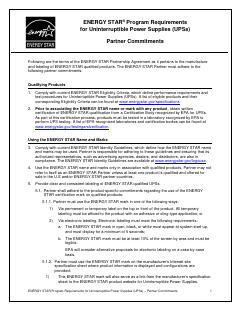
U.S. EPA / ENERGY STAR 2017
ENERGY STAR Program Requirements for Uninterruptible Power Supplies (UPSs) - Partner Commitments, Eligibility Criteria Version 2.0, and Test Method (Rev. Dec-2017)
Write the Version 2.0 thresholds into UPS procurement as a floor; for VFI units above 10,000 W compute the minimum from 0.0058 x ln(P) + 0.886 for the actual rating.
- Modular UPSs in the 1,500-10,000 W range receive an efficiency allowance (EMOD) of 0.004.
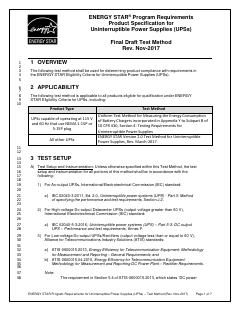
U.S. Environmental Protection Agency (ENERGY STAR) 2017
ENERGY STAR Program Requirements for Uninterruptible Power Supplies (UPSs): Test Method (Rev. Nov-2017), Version 2.0
Store efficiency at 25/50/75/100% load for each normal mode (double-conversion, eco/ESS) in UPS catalogue entries, measured to IEC 62040-3.
- The boundary between high-voltage and low-voltage dc output is 60 V.