
ENERGY STAR Program Requirements for Uninterruptible Power Supplies (UPSs): Test Method (Rev. Nov-2017), Version 2.0
U.S. Environmental Protection Agency (ENERGY STAR) · U.S. Environmental Protection Agency, U.S. Department of Energy
The method for measuring efficiency and input power factor under the ENERGY STAR UPS Version 2.0 criteria. It rests on IEC 62040-3 for ac-output UPSs, IEC 62040-5-3 Annex F for high-voltage dc-output data-centre UPSs and ATIS methods for low-voltage dc systems.
U.S. public domain — U.S. Government work; free to reuse
On this page
Overview
This seven-page document is the test method for determining compliance with the ENERGY STAR UPS criteria. Scope depends on product type: UPSs that run at 115 V and 60 Hz with a NEMA 1-15P or 5-15P plug are covered by 10 CFR 430 Appendix Y, while all other UPSs follow this method. Ac-output UPSs use IEC 62040-3:2011 Ed. 2.0 (Section J.2), high-voltage dc-output data-centre UPSs (above 60 V) use IEC 62040-5-3:2016 Annex F, and dc-output UPSs or rectifiers of 60 V or less use the ATIS-0600015 standards.
The unit is tested as shipped, with exceptions: dc output ports that deliver under 90% of rated output power stay unloaded, features unrelated to keeping storage charged or delivering load (such as an LCD) are switched off, and unrelated communication cables stay disconnected. Input voltage follows the precedence in Table 1, from 600 V delta down to 100 V. Dc output follows Table 2; for example 380 V dc is tested at 418 V and 48 V dc at 53 V. Power of 2 W or more is measured with uncertainty of 0.5% or better, and below 2 W with 0.01 W.
Units with several normal modes are tested at the lowest and highest input dependency, in the highest-efficiency sub-mode of each. The reference load must be resistive, and modular UPSs are tested twice, at the vendor's minimum and maximum non-redundant (N+0) configurations. Above 100 kW, back-feeding may replace a load if output power factor stays above 0.99. The energy storage system is disconnected where possible; otherwise the battery must be fully charged.
The calculations are PAVG = ETOT / t and Eff = PAVG_OUT / PAVG_IN. The unit stabilises for 125% of the manufacturer time, and in the final 20 minutes at 100% load two efficiency values (each from at least 5 minutes of data, at least 10 minutes apart) must differ by less than 1%. Efficiency is measured for 15 minutes at each load point: 100, 75, 50, 25 and 0% for ac-output and high-voltage dc-output UPSs, and 80, 70, 60, 50, 40, 30 and 0% for low-voltage dc systems. Input power factor is reported at 100% load for each mode.
Key points
- Ac-output UPS: IEC 62040-3:2011 Ed. 2.0; dc output above 60 V: IEC 62040-5-3:2016 Annex F; dc output 60 V or less: ATIS-0600015.
- The boundary between high-voltage and low-voltage dc output is 60 V.
- Products with several normal modes are tested at lowest and highest input dependency, in the highest-efficiency sub-mode of each.
- The IEC 62040-3 reference load must be resistive; modular UPSs are tested at minimum and maximum N+0 configurations.
- Stabilisation lasts 125% of the manufacturer time; in the final 20 minutes at 100% load, two efficiency values must differ by less than 1%.
- Ac-output and high-voltage dc UPSs are measured at 100, 75, 50, 25 and 0% load; low-voltage dc systems at 80, 70, 60, 50, 40, 30 and 0%.
- Energy is accumulated at 1 Hz or faster over a 15-minute period at each load point.
- Power of 2 W or more is measured with uncertainty of 0.5% or better at 95% confidence.
- Above 100 kW, back-feeding may replace a load if output power factor stays above 0.99.
Using it in design
- Store efficiency at 25/50/75/100% load for each normal mode (double-conversion, eco/ESS) in UPS catalogue entries, measured to IEC 62040-3.
- In the loss model, interpolate this curve at the computed UPS loading, including the effect of N+1 or 2N redundancy.
- Show a warning when only 100% load data are available, since redundant designs typically run UPSs at low load.
- Keep the 0% load (no-load loss) point as its own field; it is measured at the input only.
- Note that input power factor is reported at 100% load only and must be estimated separately at partial load.
- For modular UPSs, record that measurements were made at minimum and maximum N+0 module counts and that intermediate counts are the user's interpolation.
Monthly newsletter · free
Keep your reading list current
Once a month: new library sources, changes to Turkish regulations and upcoming data centre events.
SoSo CAD
Review your power design in SoSo CAD
Inspect supply paths, equipment loads and UPS failure scenarios in one model.
Request a demo
Who should read it
Electrical design engineers who select UPSs and model losses, product-data teams, and ENERGY STAR test laboratories.
Document contents
- 1 Overview
- 2 Applicability
- 3 Test Setup (setup and instrumentation, as-shipped configuration, ac-input power, ac-output power, dc-output power, measurement accuracy, relative humidity)
- 4.1 UPS Operating Mode Conditions
- 4.2 ENERGY STAR Guidance for Implementation of IEC 62040-3 (reference load, modular UPSs, back-feeding, energy storage system)
- 5 Test Procedures for All Products: required calculations
- Steady-state check
- Efficiency measurements
- Input power factor measurements
- 6 References
Related standards
- IEC 62040-3:2011
- IEC 62040-5-3:2016
- ATIS-0600015.2013
- ENERGY STAR UPS V2.0 Specification
Read the document
energystar-ups-test-method-v2.pdf
U.S. public domain — U.S. Government work; free to reuse
The document is provided unaltered because its licence permits redistribution.
Publication details
- Authors
- U.S. Environmental Protection Agency; U.S. Department of Energy
- Publisher
- U.S. Environmental Protection Agency (ENERGY STAR)
- Year
- 2017
- Document number
- Rev. Nov-2017
- Document language
- English
- Source type
- Government / public
- Access
- Open licence — downloadable
- Licence
- U.S. public domain — U.S. Government work; free to reuse
- Licence evidence
- www.copyright.gov
Original licence note
Work of the U.S. Environmental Protection Agency ENERGY STAR program (federal agency publication on energystar.gov); not subject to copyright under 17 U.S.C. 105.
Citation
U.S. Environmental Protection Agency; U.S. Department of Energy (2017). ENERGY STAR Program Requirements for Uninterruptible Power Supplies (UPSs): Test Method (Rev. Nov-2017), Version 2.0. U.S. Environmental Protection Agency (ENERGY STAR). Rev. Nov-2017. https://www.energystar.gov/sites/default/files/asset/document/Final%20Draft%20Version%202.0%20UPS%20Test%20Method_0.pdf
Events on this subject
- Electricity Eurasia 2027
- ELECO 2026 Elektrik-Elektronik ve Biyomedikal Mühendisliği Konferansı
- The smarter E Europe (Intersolar Europe, ees Europe, Power2Drive, EM-Power)
All content and rights belong to the respective authors and publishers. SoSo CAD provides only the citation, its own summary and a link to the source, and is not responsible for the sources' content.
Related sources
All sources on this topic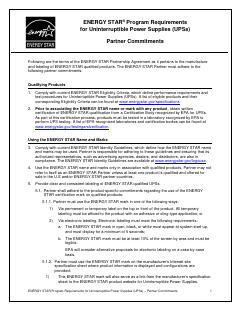
U.S. EPA / ENERGY STAR 2017
ENERGY STAR Program Requirements for Uninterruptible Power Supplies (UPSs) - Partner Commitments, Eligibility Criteria Version 2.0, and Test Method (Rev. Dec-2017)
Write the Version 2.0 thresholds into UPS procurement as a floor; for VFI units above 10,000 W compute the minimum from 0.0058 x ln(P) + 0.886 for the actual rating.
- Modular UPSs in the 1,500-10,000 W range receive an efficiency allowance (EMOD) of 0.004.
IEEE Access (Institute of Electrical and Electronics Engineers (IEEE)) 2026
Review of the 800-VDC Power Delivery Architecture and Isolated 800-V to 48-V Converter Solutions for Future AI Data Centers
Define 800 VDC unipolar, ±400 VDC bipolar and 48/54 VDC busbar as separate voltage classes in the single-line diagram, each with its own conductor ampacity, breaker pole count and clearance (IEC 60664-1) checks.
- The OCP Open Rack V3 PSU specification targets above 97.5% peak efficiency and at least 96.5% across 30%-100% load.
arXiv preprint (University of Michigan) 2026
Grid Integration of AI Data Centers: A Critical Review of Energy Storage Solutions (arXiv preprint)
Layer storage by timescale (chip/server sub-ms to ms, rack ms to seconds, UPS and GiUPS sub-second to 10 s, BESS minutes to hours) and show each layer's duty in the coordination scheme.
- Rapid AI load variations often induce 5-10% voltage swings within milliseconds.
Advances in Applied Energy (Elsevier BV) 2026
Grid Integration of AI Data Centers: A Critical Review of Energy Storage Solutions
Layer storage by timescale: GPU/server supercapacitors for sub-second swings, rack BBUs for minutes, facility GiUPS and BESS for grid services and longer durations; show each layer's duty and coordination separately in the architecture.
- BESS cost fell from about $7,500/kWh in 1991 to $133/kWh in 2024, with about $80/kWh projected by 2030.
IEEE Access (Institute of Electrical and Electronics Engineers (IEEE)) 2025
Fast Frequency Response Potential of Data Centers Through Workload Modulation and UPS Coordination
For a UPS that will provide grid services, define the SOC window (for example 20-80%) and show by calculation that backup autonomy is preserved inside it.
- The coordinated strategy cut nadir deviation by 57% and recovery time by 34%, with task delay below 2%.
Electronics (MDPI AG) 2018
Design of an Highly Efficient AC-DC-AC Three-Phase Converter Using SiC for UPS Applications
When selecting double-conversion UPS, include the measured efficiency curve by load point and the annual energy cost of the loss difference (here about 1380 USD per year for 450 W) in total cost of ownership.
- The 450 W loss reduction is worth about 1380 USD per year of continuous operation at German electricity prices.