
Discussions of Cold Plate Liquid Cooling Technology and Its Applications in Data Center Thermal Management
Frontiers in Energy Research (Frontiers Media SA) · Yufeng Zhang, Chengcheng Fan et al.
This short opinion paper from Southeast University reviews where cold-plate (indirect, direct-to-chip) liquid cooling stands for data centres: how a cold plate, CDU, pump and chiller fit together, single- versus two-phase cold plates, water-cooled rear panels and hybrid schemes, and heat recovery.
CC BY 4.0 — share with attribution
On this page
Overview
With 5G, big data and cloud computing, data-centre size and capacity are increasing rapidly and electronic devices are increasingly integrated, raising heat generation power and heat flux density. Typical rack loads quoted are about 7 kW per rack for a traditional data centre against 50 kW per rack for new high-performance servers, expected to exceed 100 kW within 5 years. Liquid specific heat capacity is quoted as 1,000-3,500 times that of air and thermal conductivity as 15-25 times. The paper explains how a cold plate, CDU, pump and chiller fit together, and separates single-phase from two-phase cold plates.
Reported gains: open water-cooled backplanes reach 8-12 kW of cooling per cabinet, while closed water-cooled backplanes (air recirculated inside a closed cabinet) reach 12-35 kW. Cabinets with enclosed water-cooled backplanes can save nearly 35% of annual energy compared with air-cooled backplanes. A hybrid scheme with cold plates on the main loads (for example CPU) and air for the remaining heat (drives, cards) can keep average annual PUE below 1.2. Raising the cold-plate share to 90% (CPU and memory on cold plates) can cut energy use by up to 50% compared with traditional air-cooled data centres.
The heat-recovery benefit of warmer coolant (district heating, absorption cooling and power-plant integration) is covered; recovering heat from a 3.5 MW data centre for district heating is cited as reducing CO2 emissions by 4,102 tons per year. Open challenges: retrofit cost alongside air-cooled servers, leak and corrosion prevention, and the trade-off between higher coolant temperature for reuse and chip cooling margin.
Limits: this is a short opinion paper; all figures are cited from earlier literature with no new measurements, and the cited gains were reported under different conditions and cannot be compared directly.
Key points
- Typical rack loads quoted: about 7 kW per rack for a traditional data centre versus 50 kW per rack for new high-performance servers, expected to exceed 100 kW within 5 years.
- Liquid specific heat capacity is quoted as 1,000-3,500 times that of air and liquid thermal conductivity as 15-25 times that of air.
- Open water-cooled backplanes reach 8-12 kW of cooling per cabinet, while closed water-cooled backplanes (air recirculated inside a closed cabinet) reach 12-35 kW.
- Cabinets with enclosed water-cooled backplanes can save nearly 35% of annual energy compared with air-cooled backplanes.
- A hybrid scheme with cold plates on the main loads (e.g. CPU) and air for the remaining heat can keep average annual PUE below 1.2.
- Raising the cold-plate share to 90% (CPU and memory on cold plates) can cut energy use by up to 50% compared with traditional air-cooled data centres.
- Recovering heat from a 3.5 MW data centre for district heating is cited as reducing CO2 emissions by 4,102 tons per year.
Using it in design
- For loads of 50 kW per rack and above, evaluate a hybrid cold-plate scheme (main loads on cold plates, remaining heat in air) for a PUE target below 1.2.
- Make the trade-off between higher coolant temperature for heat recovery and chip cooling margin a design criterion.
- Add retrofit cost alongside air-cooled servers and leak and corrosion prevention (CDU, disconnects, material compatibility) to the design specification.
Monthly newsletter · free
Keep your reading list current
Once a month: new library sources, changes to Turkish regulations and upcoming data centre events.
SoSo CAD
Check cooling capacity alongside your design
Review zone heat loads, available capacity and the capacity balance after the largest unit is lost in SoSo CAD.
Request a demo
Who should read it
Cooling designers evaluating cold-plate liquid cooling for high-density racks.
Document contents
- Introduction
- Cold plate liquid cooling system components: cold plate, CDU, pump and chiller
- Single-phase and two-phase cold plates
- Water-cooled rear panels and hybrid cold plate/air schemes
- Heat recovery from warmer coolant: district heating, absorption cooling, power-plant integration
- Open challenges and conclusion
Read the document
cold-plate-liquid-cooling-dc-discussion-2022.pdf
CC BY 4.0 — share with attribution
The document is provided unaltered because its licence permits redistribution.
Publication details
- Authors
- Yufeng Zhang; Chengcheng Fan; Guanru Li
- Publisher
- Frontiers in Energy Research (Frontiers Media SA)
- Year
- 2022
- Volume
- 10
- Pages
- 954718
- Document language
- English
- Source type
- Scientific
- Access
- Open licence — downloadable
- Licence
- CC BY 4.0 — share with attribution
- Licence evidence
- doi.org
Original licence note
Article states it is open access under a Creative Commons Attribution (CC BY / CC BY 4.0) licence (verified in PDF text).
Citation
Yufeng Zhang; Chengcheng Fan; Guanru Li (2022). Discussions of Cold Plate Liquid Cooling Technology and Its Applications in Data Center Thermal Management. Frontiers in Energy Research (Frontiers Media SA). 10, 954718. https://doi.org/10.3389/fenrg.2022.954718
Events on this subject
- ISK-SODEX Istanbul 2027
- SC26 – International Conference for High Performance Computing, Networking, Storage and Analysis
- ASHRAE Winter Conference
All content and rights belong to the respective authors and publishers. SoSo CAD provides only the citation, its own summary and a link to the source, and is not responsible for the sources' content.
Related sources
All sources on this topic
Open Compute Project Foundation 2024
30 C Coolant - A Durable Roadmap for the Future, Revision 1.0 (Oct 2024)
Default the liquid cooling design wizard to an S30 (30 C) TCS supply with a 6 C CDU approach (24 C FWS) and 1.5 LPM per kW.
- Typical CDU flow design is cited as 1.5 LPM per kW; CDU approach temperature is typically 4-8 C.
Energies (MDPI AG) 2023
Cooling Technologies for Internet Data Center in China: Principle, Energy Efficiency, and Applications
In China, define project design targets from GB 50174-2017 temperature and humidity limits (18-27 °C, dew point 5.5-15 °C, RH at most 60%) and provincial PUE caps (for example Guangdong 1.25).
- Cooling accounts for about 35-40% of total IDC energy consumption, the second largest consumer after IT equipment.
Open Compute Project Foundation 2023
Evaluating the Limits of Door Heat Exchanger Solutions Optimized for Open Rack V3
Build a rear-door HX sizing helper that takes rack kW, airflow (cfm), facility water temperature and liquid-capture fraction and returns approach, leaving air temperature and fan power, with 27 C facility water and 30 C air as default reference points.
- Assumptions: 30 C ambient (cold-aisle upper limit), sea level, 12-15 C air delta T, W27 facility water.
Energies (MDPI AG) 2023
Thermal Management and Energy Consumption in Air, Liquid, and Free Cooling Systems for Data Centers: A Review
In preliminary cooling selection, make climate (humidity, haze/dust) and the free-cooling switchover point decisive inputs; direct airside economisers may be unsuitable in haze- and dust-prone regions.
- An indirect evaporative cooling unit in Shenzhen achieved a PUE of 1.249 at 5.3 kW per cabinet.
U.S. DOE FEMP 2021
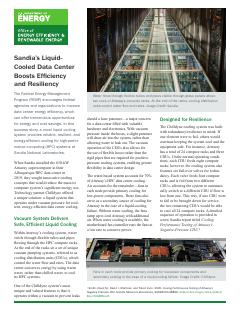
Sandia's Liquid-Cooled Data Center Boosts Efficiency and Resiliency (FEMP success story, DOE/GO-102021-5582, July 2021)
Consider negative-pressure (vacuum) distribution as an option for reducing leak risk in direct liquid cooling; flexible hoses give layout flexibility.
- The system kept CPUs below 50 °C (122 °F); each CDU draws 3.4 kW at full load, about 1.6% of total system power.
Danfoss 2026
Data center solutions powering the digital economy
In the cooling-plant builder keep a component list per subsystem (chiller, CDU, pump skid, heat recovery) with fields for maximum chilled-water temperature, HX approach temperature and VFD THDi.
- Advanced Active Filter with SiC switches quoted at 98.2% efficiency.