
ENERGY STAR Program Requirements for Computer Servers, Version 4.0 (Partner Commitments, Eligibility Criteria, and Final Test Method Rev. April 2023)
U.S. EPA / ENERGY STAR · U.S. EPA ENERGY STAR
The U.S. EPA ENERGY STAR Version 4.0 specification for enterprise servers, effective January 2024. It sets power supply efficiency, power factor, power management, SERT-based active-state efficiency and monitoring-data requirements, and is a direct reference for server procurement specifications.
U.S. public domain — U.S. Government work; free to reuse
On this page
Overview
The document has three parts: partner commitments, eligibility criteria and the final test method. It covers blade, multi-node, rack and pedestal servers with up to four processor sockets. Fully fault-tolerant servers, server appliances, high-performance computing systems, large servers, hyperconverged servers, storage products and large network equipment are excluded. The specification took effect on January 12, 2024, and a product is judged against the specification in force on its date of manufacture.
Power supply requirements come in two tables. Single-output ac-dc supplies rated 750 W or more must reach at least 90%, 94%, 96% and 91% efficiency at 10%, 20%, 50% and 100% load; multi-output units of 750 W or more must reach 90%, 92% and 89% at 20%, 50% and 100%, with no 10% requirement. Power factor limits apply only where output is 75 W or more; for single-output units above 1,000 W the minimums are 0.80 at 10% load, 0.90 at 20%, and 0.95 at 50% and 100%. Testing follows the Generalized Internal Power Supply Efficiency Test Protocol Rev. 6.7.
Active-state efficiency is measured with the SPEC SERT tool. The EffACTIVE score is a weighted geometric mean of processor (65%), memory (30%) and storage (5%) sub-scores, each derived from performance per watt for individual workloads. Minimums vary by product type and processor count: 26.4 for one-processor rack servers, 30.4 for two-processor rack, 29.1 for two-processor blade or multi-node, and 31.9 for rack servers with more than two processors. Storage-heavy servers have no active-state threshold yet. Idle power must also be measured and reported.
Processor power management (DVFS or reduced power states) must be enabled by default, and any pre-installed hypervisor or operating system must offer power management too. A server must expose input power, inlet air temperature and average utilisation of all logical CPUs to third-party management software over a standard network. Power accuracy must be at least ±5% (never required better than ±10 W per PSU), temperature accuracy ±2 °C, sampled at least every 10 seconds. Blade and multi-node systems must offer real-time inlet temperature monitoring and fan speed management.
The test method fixes the conditions: ambient temperature 25 ± 5 °C, relative humidity 15% to 80%, a true-RMS power analyzer accurate to 1% or better, and measurement between the ac source and the unit with no UPS in between. The document covers IT equipment only, not facility infrastructure. Topics flagged for later revisions include dc servers, a review of PSU load points, an active-state criterion for storage-heavy servers and the next SERT release.
Key points
- Version 4.0 took effect on January 12, 2024; a product is assessed against the specification in force on its date of manufacture.
- Single-output ac-dc PSUs of 750 W or more must reach at least 90% / 94% / 96% / 91% efficiency at 10% / 20% / 50% / 100% load.
- Multi-output ac-dc PSUs of 750 W or more must reach at least 90% / 92% / 89% at 20% / 50% / 100% load; there is no 10% requirement.
- Below 750 W the thresholds are lower: 83% / 90% / 94% / 91% for single-output, and 87% / 90% / 87% for multi-output (20% / 50% / 100% load).
- For single-output PSUs above 1,000 W the power factor must be at least 0.80 at 10% load, 0.90 at 20% and 0.95 at 50% and 100%, applied only where output is 75 W or more.
- Minimum EffACTIVE: 26.4 for one-socket rack, 30.4 for two-socket rack, 29.1 for blade or multi-node (two processors); tower and resilient types have separate thresholds.
- EffACTIVE = EXP(0.65 ln EffCPU + 0.30 ln EffMEMORY + 0.05 ln EffSTORAGE).
- Servers report input power to ±5%, inlet air temperature to ±2 °C, sampled at least once every 10 seconds.
- Testing uses 25 ± 5 °C and 15%-80% relative humidity, with power measured between the ac source and the unit and no UPS in the path.
- Scope is IT equipment only; hyperconverged, large and fully fault-tolerant servers and storage products are excluded.
Using it in design
- Write ENERGY STAR Version 4.0 certification and the PSU efficiency steps (at 10% to 100% load points) into the server procurement specification; look especially at 10% and 20% load efficiency for redundant supplies that run lightly loaded.
- When estimating rack-level PSU losses, use the 96% floor at 50% load for single-output units above 750 W, but set the real load ratio carefully, since redundant feeds leave each supply lightly loaded.
- Check power factor in UPS and distribution design: values of 0.65 to 0.80 at 10% load affect UPS and cable sizing in highly redundant layouts.
- Write the requirement that servers expose input power, inlet temperature and CPU utilisation over a standard network into DCIM or BMS integration requirements.
- Compare products on the complete SERT report and EffACTIVE score rather than a single workload result; EPA prohibits selective reporting.
Monthly newsletter · free
Keep your reading list current
Once a month: new library sources, changes to Turkish regulations and upcoming data centre events.
SoSo CAD
Compare the cost of design decisions
Evaluate equipment costs, energy expenses and total cost of ownership (TCO) using your inputs and assumptions in SoSo CAD.
Request a demo
Who should read it
Designers and IT procurement teams who write server specifications, calculate rack power budgets and PSU losses, or define monitoring integration.
Document contents
- Definitions
- Scope
- Certification Criteria
- Power Supply Requirements
- Power Management Requirements
- Blade and Multi-Node System Criteria
- Active State Efficiency Criteria
- Idle State Efficiency Criteria
- Standard Information Reporting Requirements
- Standard Performance Data Measurement and Output Requirements
- Testing
- Effective Date
- Considerations for Future Revisions
- Final Test Method: Test Setup and Test Conduct
Read the document
energystar-servers-spec-v4.pdf
U.S. public domain — U.S. Government work; free to reuse
The document is provided unaltered because its licence permits redistribution.
Publication details
- Authors
- U.S. EPA ENERGY STAR
- Publisher
- U.S. EPA / ENERGY STAR
- Year
- 2024
- Document language
- English
- Source type
- Government / public
- Access
- Open licence — downloadable
- Licence
- U.S. public domain — U.S. Government work; free to reuse
- Licence evidence
- www.copyright.gov
Original licence note
Published by U.S. EPA (ENERGY STAR program); U.S. Government work.
Citation
U.S. EPA ENERGY STAR (2024). ENERGY STAR Program Requirements for Computer Servers, Version 4.0 (Partner Commitments, Eligibility Criteria, and Final Test Method Rev. April 2023). U.S. EPA / ENERGY STAR. https://energystar.gov/sites/default/files/asset/document/ENERGY%20STAR%20Version%204.0%20Computer%20Servers%20Final%20Specification.pdf
Events on this subject
- Electricity Eurasia 2027
- ELECO 2026 Elektrik-Elektronik ve Biyomedikal Mühendisliği Konferansı
- 7x24 Exchange Spring Conference
All content and rights belong to the respective authors and publishers. SoSo CAD provides only the citation, its own summary and a link to the source, and is not responsible for the sources' content.
Related sources
All sources on this topic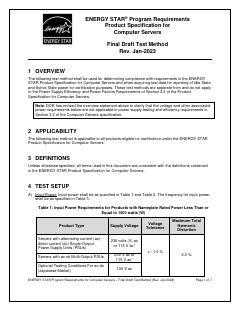
U.S. Environmental Protection Agency (ENERGY STAR) 2023
ENERGY STAR Program Requirements for Computer Servers: Final Draft Test Method (Rev. Jan-2023), Version 4.0
When importing server power data, keep the 25 ± 5 °C test ambient as metadata and warn that fan power rises at higher inlet set points.
- Ambient temperature during testing is 25 ± 5 °C and relative humidity 15% to 80%.
U.S. Environmental Protection Agency (ENERGY STAR) 2022
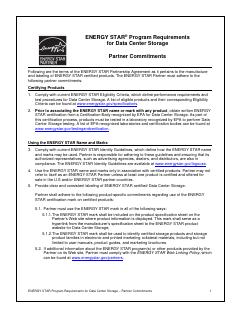
ENERGY STAR Program Requirements for Data Center Storage, Version 2.1 (Partner Commitments and Eligibility Criteria)
Catalogue entries for storage should carry ENERGY STAR status, PSU efficiency curve points (20/50/100%) and power factor, so the rack power model can derive input power and heat from IT load rather than nameplate.
- PSU power factor minimums: 0.80/0.90/0.95 at 20/50/100% load.
IEEE Access (Institute of Electrical and Electronics Engineers (IEEE)) 2026
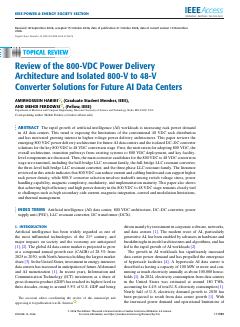
Review of the 800-VDC Power Delivery Architecture and Isolated 800-V to 48-V Converter Solutions for Future AI Data Centers
Define 800 VDC unipolar, ±400 VDC bipolar and 48/54 VDC busbar as separate voltage classes in the single-line diagram, each with its own conductor ampacity, breaker pole count and clearance (IEC 60664-1) checks.
- The OCP Open Rack V3 PSU specification targets above 97.5% peak efficiency and at least 96.5% across 30%-100% load.
IEEE Open Journal of Power Electronics (Institute of Electrical and Electronics Engineers (IEEE)) 2026
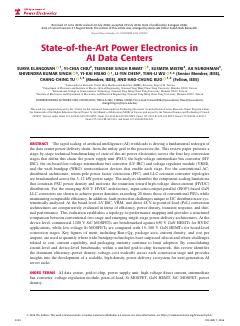
State-of-the-Art Power Electronics in AI Data Centers
In rack power templates, model PSU count per shelf and the 33 kW shelf limit for AC distribution, and check busbar, PDU and cooling impact together for racks that exceed 100 kW with several shelves.
- AI rack density is 30-100+ kW against 7-10 kW for traditional racks; an 8-GPU DGX H100 draws around 10,200 W.
arXiv preprint (National Laboratory of the Rockies) 2026
Measurement of Generative AI Workload Power Profiles for Whole-Facility Data Center Infrastructure Planning
Size AI data-centre facility power with measured profiles rather than the rated design: even with all servers utilised, facility power reached only 73-80% of rated design.
- Online inference server power saturated near 2.8 kW at modest request rates.
International Energy Agency 2026
Key Questions on Energy and AI (World Energy Outlook Special Report)
For on-site generation sizing, when users choose islanded or behind-the-meter gas, apply an N+x overbuild check (30-70% above load per IEA) and model BESS for AI power swings.
- AI server power density rose 11 times in 2020-2025 and rises a further four times by 2027.