
Information technology - Data centres key performance indicators - Part 7: Cooling efficiency ratio (CER)
ISO/IEC · ISO/IEC JTC 1
ISO/IEC 30134-7:2023 defines the Cooling Efficiency Ratio (CER), which measures how efficiently energy is used to control temperature in data centre spaces. It is a cooling-only indicator that complements PUE.
On this page
Overview
The standard defines the Cooling Efficiency Ratio (CER), which quantifies the efficient use of energy to control the temperature of spaces within a data centre. Its scope covers measurement, calculation, reporting and interpretation. Edition 1 was published on 10 March 2023 and runs to 16 pages. It is a paid standard; this record rests only on the publisher's public catalogue abstract and product metadata, and the full text was not read.
The annexes support use of the indicator: Annex A covers correlation with other KPIs, Annex B usage examples, Annex C the parameters that affect CER, and Annex D derivative KPIs. This structure shows the indicator is meant as a tool for interpretation and improvement, not merely a formula.
One significant exclusion applies: cooling systems not powered by electricity, for example heat-driven absorption chillers, fall outside the standard. A design that uses absorption chillers therefore cannot report CER in the sense of this standard.
As context, the standard belongs to the ISO/IEC 30134 family of indicators and is related to ISO/IEC 30134-2 (PUE) and EN 50600-4-7. The abstract does not detail the calculation method, so the standard itself should be consulted for formulas and measurement points.
Key points
- CER quantifies efficient use of energy to control temperature of spaces within a data centre.
- It covers measurement, calculation, reporting and interpretation.
- Annex A: correlation with other KPIs; Annex B: usage examples; Annex C: parameters affecting CER; Annex D: derivative KPIs.
- Cooling systems not powered by electricity, such as heat-driven absorption chillers, are excluded.
- Edition 1, published 2023-03-10, 16 pages.
- Related standards: ISO/IEC 30134-2 and EN 50600-4-7.
- Paid standard; the record is based on the catalogue abstract only.
Using it in design
- In the cooling module, report CER from the hourly model as heat removed (kWh_th) divided by cooling-system electricity (kWh_e).
- Show CER as annual and per-season values.
- For designs with absorption chillers, disable CER and show 'n/a' per the scope exclusion.
- Read CER alongside PUE to isolate cooling-driven inefficiency.
Monthly newsletter · free
Keep your reading list current
Once a month: new library sources, changes to Turkish regulations and upcoming data centre events.
SoSo CAD
Compare the cost of design decisions
Evaluate equipment costs, energy expenses and total cost of ownership (TCO) using your inputs and assumptions in SoSo CAD.
Request a demo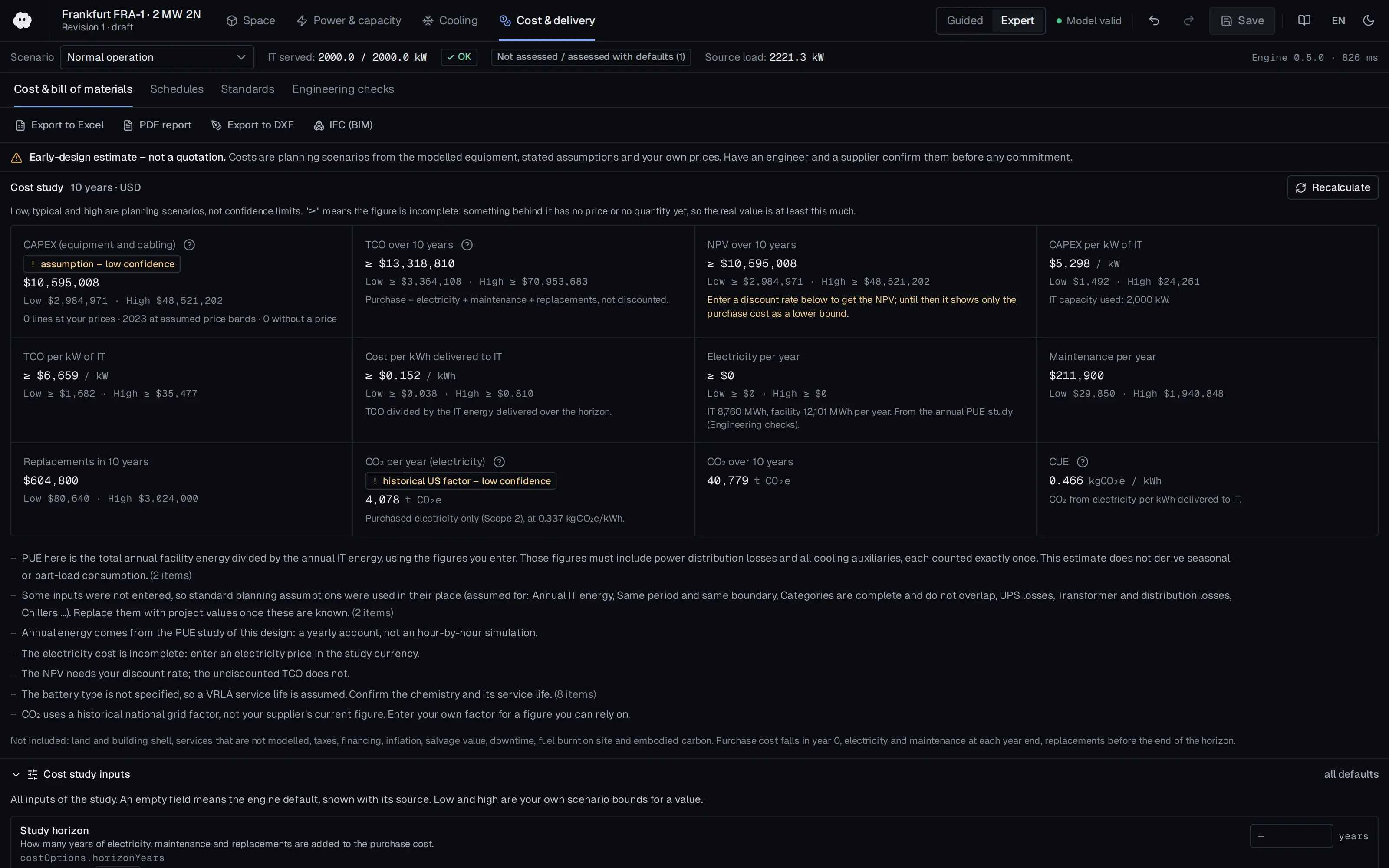
Who should read it
Cooling design engineers and operations and sustainability teams preparing energy efficiency reports.
Related standards
- ISO/IEC 30134-2
- EN 50600-4-7
Publication details
- Authors
- ISO/IEC JTC 1
- Publisher
- ISO/IEC
- Year
- 2023
- Document number
- ISO/IEC 30134-7:2023
- Document language
- English
- Source type
- Standard
- Access
- Citation only
- Licence
- Copyright retained; citation only — the publisher’s terms apply to the original document
Original licence note
Paid standard. Record built only from the publisher's public catalogue abstract and product metadata; full text not redistributed.
Citation
ISO/IEC JTC 1 (2023). Information technology - Data centres key performance indicators - Part 7: Cooling efficiency ratio (CER). ISO/IEC. ISO/IEC 30134-7:2023. https://webstore.iec.ch/en/publication/83876
Events on this subject
Browse the events calendarAll content and rights belong to the respective authors and publishers. SoSo CAD provides only the citation, its own summary and a link to the source, and is not responsible for the sources' content.
Related sources
All sources on this topic
Energies (MDPI AG) 2025
Energy Efficiency Measurement Method and Thermal Environment in Data Centers—A Literature Review
In PUE comparisons state the facility type (edge, SMB, enterprise, colocation, hyperscale) and assign IT/facility power categories per The Green Grid definitions in detail; PUE across types is not directly comparable.
- No study of staff thermal comfort in data centres was found; in one computer lab PMV was 1.1-1.4, outside the ISO ±0.5 band.
International Energy Agency 2025
Energy and AI (World Energy Outlook Special Report)
Use the IEA component split (servers about 60%, storage about 5%, network up to 5%, cooling 7-30%) to sanity-check modelled energy breakdowns.
- The 2035 range across cases is 700-1,700 TWh; the High Efficiency Case is 20% below the Base Case.
European Commission JRC 2025
2025 Best Practice Guidelines for the EU Code of Conduct on Data Centre Energy Efficiency (JRC141521, EUR 40267)
Design the facility to operate within the ASHRAE Class A2 allowable range and require A2 operation within warranty in IT procurement; plan separate environmental zones (practice 5.3.4) for legacy equipment.
- IT equipment AC/DC power converters should be rated at 90% efficiency or better across expected load ranges.
Open Compute Project Foundation 2025
Reference Designs for Data Center Heat Reuse, Revision 1.0
Provide a heat-recovery-station block in the site layout with space sized from capacity (plate HX footprint, 10 m2 per MW for heat pumps, about 43 m3 per MW per 30 minutes of storage) and a demarcation boundary to the heat host.
- ORC heat-to-power converts less than 4% of the heat to electricity at these low temperatures.
Buildings (MDPI AG) 2024
Data Center Energy Evaluation Tool Development and Analysis of Power Usage Effectiveness with Different Economizer Types in Various Climate Zones
Choose economiser type by climate zone: consider indirect economisers in 0A/0B and wet zones (PUE 0.03-0.07 lower) and adding evaporative cooling in dry zones (0.02-0.05).
- More than 95% of a data centre's total cooling load comes from heat generated by IT equipment.
U.S. DOE FEMP / NREL 2024
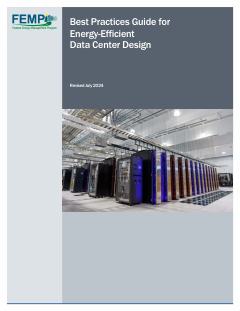
Best Practices Guide for Energy-Efficient Data Center Design (Revised July 2024)
Weigh the supply air setpoint against server fan energy: raise it in small steps within the ASHRAE recommended range so the most demanding inlet nears 80 °F, only after air management is in place, and control to IT inlet temperature rather than return temperature.
- Compute racks reached 60 kW in 2013, and recent liquid-cooled racks exceed 125 kW.