
Prototype energy models for data centers
Energy and Buildings (Elsevier) · Kaiyu Sun, Na Luo et al.
A paper by LBNL researchers describing two data centre prototype energy models built in EnergyPlus/OpenStudio to complement DOE's commercial building prototypes.
On this page
Overview
This paper was published in Energy and Buildings (Elsevier) in 2021; its authors are Kaiyu Sun, Na Luo, Xuan Luo and Tianzhen Hong, and the work comes from Lawrence Berkeley National Laboratory. It builds two data centre prototype energy models in EnergyPlus and OpenStudio to complement the US Department of Energy's commercial building prototypes.
The small model is a computer room cooled by CRAC units. The large model is a stand-alone data centre with CRAH units and a central chiller plant. IT densities are 40 and 100 W/ft2 for the computer room and 100 and 500 W/ft2 for the stand-alone facility. The models follow ASHRAE 90.1 minimum requirements across vintages and cover all US climate zones.
The paper's methodological novelty is a new approach-temperature method implemented in EnergyPlus. It represents non-uniform air temperatures for different loads and containment conditions. The contribution is to bring the effect of airflow on temperature distribution into the models instead of assuming a single uniform room temperature. The approach temperatures are described as precomputed by CFD. This approach aims to show the energy effect of measures such as containment more realistically in simulation.
There are limits: the models are built for US climates and US standards, and the densities given are specific scenarios. Even so, these prototypes, linked to ASHRAE 90.1 and ASHRAE 90.4, give tools that want to calibrate an hourly cooling model and containment effectiveness a common reference point. They also provide a consistent set of models for energy code analyses.
Key points
- The small model is a computer room with CRACs; the large model is a stand-alone data centre with CRAHs and a central chiller plant.
- IT densities are 40 and 100 W/ft2 for the computer room and 100 and 500 W/ft2 for the stand-alone facility.
- A new approach-temperature method in EnergyPlus represents non-uniform air temperatures for different loads and containment.
- The approach temperatures are precomputed by CFD.
- The models follow ASHRAE 90.1 minimum requirements across vintages.
- The models cover all US climate zones.
- The paper appeared in Energy and Buildings in 2021; the authors are from LBNL.
Using it in design
- Use the prototype densities and the approach-temperature concept to calibrate the tool's hourly cooling model and containment effectiveness.
- Design the EnergyPlus export to target these prototypes.
- In energy code comparisons, take these models, linked to ASHRAE 90.1 and 90.4, as the reference.
- Model the containment effect through a temperature distribution rather than a single room temperature.
Monthly newsletter · free
Keep your reading list current
Once a month: new library sources, changes to Turkish regulations and upcoming data centre events.
SoSo CAD
Compare the cost of design decisions
Evaluate equipment costs, energy expenses and total cost of ownership (TCO) using your inputs and assumptions in SoSo CAD.
Request a demo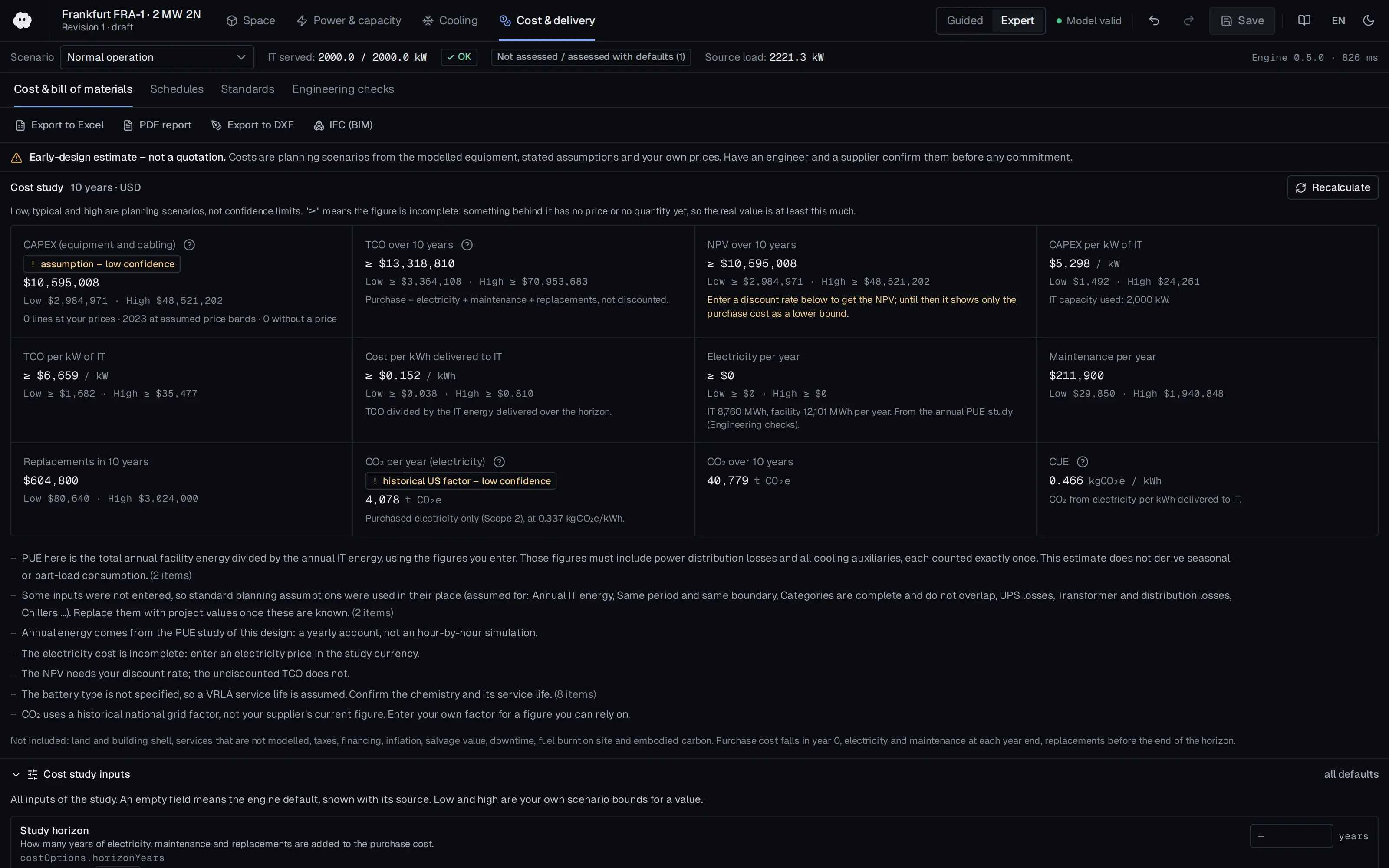
Who should read it
Engineers doing data centre energy modelling, energy code compliance consultants and developers of simulation tools.
Related standards
- ASHRAE 90.1
- ASHRAE 90.4
Publication details
- Authors
- Kaiyu Sun; Na Luo; Xuan Luo; Tianzhen Hong
- Publisher
- Energy and Buildings (Elsevier)
- Year
- 2021
- Document language
- English
- Source type
- Scientific
- Access
- Citation only
- Licence
- Copyright retained; citation only — the publisher’s terms apply to the original document
Original licence note
Journal article (publisher copyright); cited only.
Citation
Kaiyu Sun; Na Luo; Xuan Luo; Tianzhen Hong (2021). Prototype energy models for data centers. Energy and Buildings (Elsevier). https://doi.org/10.1016/j.enbuild.2020.110603
Events on this subject
Browse the events calendarAll content and rights belong to the respective authors and publishers. SoSo CAD provides only the citation, its own summary and a link to the source, and is not responsible for the sources' content.
Related sources
All sources on this topic
Applied System Innovation (MDPI AG) 2026
Proactive Cooling Control Algorithm for Data Centers Based on LSTM-Driven Predictive Thermal Analysis
For predictive cooling control, plan at least one inlet and one outlet temperature sensor per rack; below that, prediction error rose by about 22%.
- The LSTM uses a 60 min input window and a 30 min prediction horizon, with a reported RMSE of 0.25 and R² of 0.985.
Sustainability (MDPI AG) 2026
Retrofit Optimization of Raised-Floor Plenum Thermal Performance for Energy-Efficient and Sustainable Operation of Non-Standard Campus Data Centers
For plenum imbalance, consider a 50%-perforated transverse baffle about 0.3 m from the unit outlet; 50% open gave a smaller resistance increase than 30% (8.5% against 18.7%).
- For S4, SHI fell from 0.42 to 0.35, maximum rack inlet temperature fell from 27.2 °C to 26.7 °C, and all racks met the 27 °C ASHRAE recommended limit.
European Commission JRC 2025
2025 Best Practice Guidelines for the EU Code of Conduct on Data Centre Energy Efficiency (JRC141521, EUR 40267)
Design the facility to operate within the ASHRAE Class A2 allowable range and require A2 operation within warranty in IT procurement; plan separate environmental zones (practice 5.3.4) for legacy equipment.
- IT equipment AC/DC power converters should be rated at 90% efficiency or better across expected load ranges.
U.S. DOE FEMP / NREL 2024
Best Practices Guide for Energy-Efficient Data Center Design (Revised July 2024)
Weigh the supply air setpoint against server fan energy: raise it in small steps within the ASHRAE recommended range so the most demanding inlet nears 80 °F, only after air management is in place, and control to IT inlet temperature rather than return temperature.
- Compute racks reached 60 kW in 2013, and recent liquid-cooled racks exceed 125 kW.
Energies (MDPI AG) 2018
Analysis of Air-Side Economizers in Terms of Cooling-Energy Performance in a Data Center Considering Exhaust Air Recirculation
In airside economiser design, plan exhaust grilles and the building envelope so recirculation stays below 5%; 15% recirculation raised energy about 6.1% for direct and 9% for indirect.
- The authors recommend placing exhaust-air grilles so recirculation is below 5%, or handling it in the envelope plan at design stage.
European Commission JRC 2018
2018 Best Practice Guidelines for the EU Code of Conduct on Data Centre Energy Efficiency - Version 9.1.0 (JRC110666, EUR 29103 EN)
Keep the 2018 edition practices as a selectable compliance baseline for projects designed in 2018.
- 5.4.1.8 (value 5): investigate free cooling in all new builds and retrofits.