
Guidelines for Pre-Commission Preparation of Technology Cooling System (TCS) Row Manifolds in Liquid Cooled Data Centers
Open Compute Project Foundation · Sivapalan, S., O'Brien, D. (Nvidia) et al.
An OCP guideline for the hydrotest, cleaning, flushing and pre-commissioning of secondary TCS row-manifold pipework before CDUs and cold-plate racks are connected. Cold-plate channels are about 100 microns wide, so construction debris must be removed.
CC BY-SA 4.0 — share with attribution under the same licence
On this page
Overview
The guideline proposes practices for pre-commissioning cleaning of pipework before connections are made to liquid-cooled racks and CDUs. Cleaning and subsequent flushing ensure the system is free of corrosion by-products, dirt and construction debris that could foul the narrow (about 100 microns) flow channels of current single-phase cold plates; cleanliness extends to fittings and terminal units. It is one contribution toward a full commissioning specification for liquid-cooled rack systems. The primary audience is design and facility engineers and managers responsible for design, procurement, setup and operation of the TCS loop.
Assumptions bound the scope: stainless steel pipework of at least grade 304, internal surfaces pre-treated to standards such as ASTM A380, welds made under inert atmosphere to standards such as AWS D10.18, rack manifolds and CDUs not yet connected to the row manifold, and contamination that is mainly inorganic dust and dirt. Commissioning of CDUs and racks is out of scope. Planning stresses a wastewater discharge plan agreed with the authority having jurisdiction, risk assessment, hydrotest followed immediately by flushing, and minimal stagnant-water time.
The equipment section defines the flushing skid (pump, full-flow filter, pressure gauges, calibrated flow meter, pot feeder, sample port) and instruments such as calibrated pH and conductivity meters, refractometer, bacteria test kit and colorimeter. Filtration steps down from 50-100 microns toward the final rating; industry finals range from 1 to 25 microns and the document recommends 5 microns, with roughly 98.7% capture (Beta = 75) as a starting point. Flushing velocities of about 3-5 ft/s are recommended, sand and clay suspension needs about 0.6-0.9 m/s, and BSRIA BG-29 tables give minimum flow by pipe size (for example 1.11 m/s and 2.47 L/s for DN50).
Procedure water must have conductivity of at most 50 uS/cm, pH of at least 6 and total aerobic bacteria of at most 1000 CFU/ml; disinfected RO or deionized water normally qualifies. The hydrostatic test is a proof test at 1.3-1.5 times expected working pressure, and water should not sit without circulation or treatment for more than 24 hours. Cleaning consists of recirculate, clean and drain: the system volume is filtered at least 3 times until turbidity is under 20 NTU and conductivity under 60 uS/cm, then a chemical clean of at least 4 hours runs with no rise in filter differential pressure for 1 hour.
Flushing removes the cleaning chemistry: fill, recirculate at least 8 system volumes, drain, and repeat until outlet conductivity is within 10-20 uS/cm of the procedure water or at most 60 uS/cm, with final turbidity under 5 NTU. Filters are isolated and replaced when differential pressure exceeds 10 psi. Preparation for commissioning follows immediately; the preferred path is to fill with glycol-based coolant, water-based coolant is added only when continuous recirculation is available, and otherwise the loop is purged dry and sealed under a nitrogen blanket. CDUs should not be connected during the secondary clean and flush; if they are, warranty impact must be checked with the CDU manufacturer.
Key points
- Single-phase cold-plate flow channels are about 100 microns, so TCS pipework must be cleaned and flushed before IT connection.
- CDUs should not be connected during secondary pipework clean and flush; if they are, check warranty and expect to need extra filtration.
- Skid filters step down from 50-100 micron to a final rating; industry finals are 1-25 micron and the document adopts 5 micron (Beta = 75, about 98.7%).
- Recommended flushing velocity is about 3-5 ft/s; sand/clay suspension needs about 0.6-0.9 m/s; BSRIA BG-29 tables give minimum flow by pipe size.
- Procedure water: conductivity at most 50 uS/cm, pH at least 6, total aerobic bacteria at most 1000 CFU/ml.
- The hydrostatic test is a proof test at 1.3-1.5 x working pressure; water must not sit more than 24 hours without circulation or treatment.
- Cleaning: filter at least 3 system volumes to under 20 NTU and under 60 uS/cm, then chemical clean for at least 4 hours.
- Flushing: at least 8 system volumes per cycle until outlet conductivity is within 10-20 uS/cm of procedure water or at most 60 uS/cm; final turbidity under 5 NTU.
- Isolate and replace filters when differential pressure exceeds 10 psi; a 0 psi reading may mean a breached filter.
- For commissioning, filling with glycol-based coolant at once is preferred; water-based coolant needs continuous recirculation, otherwise purge dry under nitrogen.
Using it in design
- Generate a TCS pre-commissioning test script from the piping model: proof pressure at 1.3-1.5 x design working pressure, minimum flushing flow per pipe size at 3-5 ft/s, and sequential leg isolation.
- Specify flush and fill connections, loop-backs and temporary filter positions on row manifolds in the design.
- Put acceptance criteria in the commissioning checklist: 5 micron final filtration, turbidity under 20 NTU (under 5 NTU after flushing), conductivity at most 60 uS/cm, bacteria at most 1000 CFU/ml.
- Close the wastewater discharge plan with the authority having jurisdiction early; the guideline calls it a frequent stumbling block.
- Schedule a repeat hydrostatic test after any disassembly of tested connections and design out dead legs.
- Plan coolant and fill logistics so the time between flushing and fill is short.
Monthly newsletter · free
Keep your reading list current
Once a month: new library sources, changes to Turkish regulations and upcoming data centre events.
SoSo CAD
Bring standards pre-checks into your project
Review model-based TS EN 50600 and Tier pre-checks, missing inputs and items requiring engineering review in SoSo CAD.
Request a demo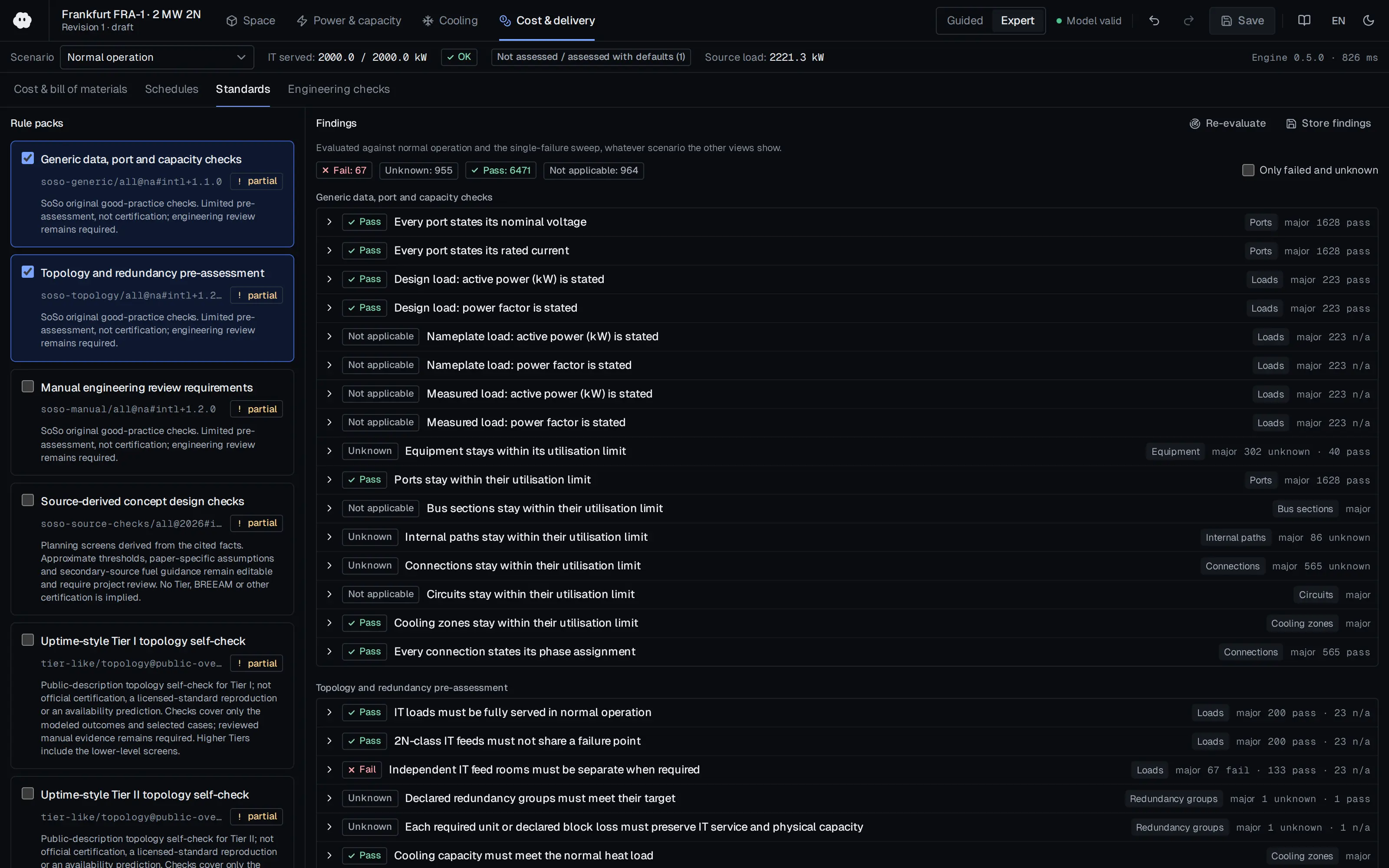
Who should read it
Mechanical designers, MEP consultants and contractors who design, install and commission secondary cooling pipework in liquid-cooled data centres.
Document contents
- Introduction
- Scope
- Detailed Description of Work
- Definitions
- Assumptions
- Compliance with Open Compute Project Tenets
- Preparation for Cleaning Secondary Piping after Installation
- Planning and Coordination Activities
- Site and System Preparation
- Equipment and Materials
- Operating Procedures
- Pre-Hydrostatic Test System Check
- Hydrostatic Test
- Cleaning of Rack Piping Loop
- Flushing
- Preparation for Commissioning
- Conclusion
- Glossary
- References
Related standards
- ASTM A380/A380M
- BSRIA BG 29 (pre-commission cleaning)
- OCP Liquid Cooling Integration and Logistics white paper
- ASHRAE TC 9.9 Liquid Cooling Guidelines
Read the document
ocp-tcs-row-manifold-precommissioning.pdf
CC BY-SA 4.0 — share with attribution under the same licence
The document is provided unaltered because its licence permits redistribution.
Publication details
- Authors
- Sivapalan, S.; O'Brien, D. (Nvidia); Myers, C. (Nalco Ecolab)
- Publisher
- Open Compute Project Foundation
- Year
- 2025
- Document language
- English
- Source type
- Industry body
- Access
- Open licence — downloadable
- Licence
- CC BY-SA 4.0 — share with attribution under the same licence
- Licence evidence
- www.opencompute.org
Original licence note
Pages 31-32 state the materials are licensed under the Creative Commons Attribution-ShareAlike 4.0 International License.
Citation
Sivapalan, S.; O'Brien, D. (Nvidia); Myers, C. (Nalco Ecolab) (2025). Guidelines for Pre-Commission Preparation of Technology Cooling System (TCS) Row Manifolds in Liquid Cooled Data Centers. Open Compute Project Foundation. https://www.opencompute.org/documents/ocp-document-submission-guidelines-for-pre-commission-preparation-of-technology-cooling-system-tcs-row-manifolds-revq-pdf-1/
Events on this subject
Browse the events calendarAll content and rights belong to the respective authors and publishers. SoSo CAD provides only the citation, its own summary and a link to the source, and is not responsible for the sources' content.
Related sources
All sources on this topic
Open Compute Project Foundation 2023
Guidelines for Using Water-Based Transfer Fluids in Single-Phase Cold Plate-Based Liquid-Cooled Racks
Write the Table 1 targets (TSS, TDS, conductivity, copper and iron, pH, hardness, turbidity, bacteria, azole inhibitor, chloride) into the fluid specification as acceptance criteria and request a certificate of analysis from the supplier.
- pH 8.0-10.5; total hardness below 30 ppm (below 2 ppm for fresh fill); turbidity below 5 NTU.
ASHRAE TC 9.9 2019
Water-Cooled Servers: Common Designs, Components, and Processes
Enforce TCS supplyTemp >= roomDewPoint + 2 degC.
- pH: FWS 7-9; TCS 8.0-9.5.

Open Compute Project Foundation 2026
Single-Phase Direct-to-Chip Cold Plate Test Specification, Version 1.0.0 (OCP Cooling Environments: Cold Plate Sub-Project, effective September 3, 2026)
Reference the specification in a cold plate purchase requirement and state which tests, limits and sampling the customer requires, since many limits are examples.
- Flow rate testing goes up to velocities below 1.5 m/s to ensure no erosion or leaks.
Open Compute Project Foundation 2026
Whitepaper: Thermal Boundaries in AI Infrastructure - Matching cooling technologies to compute through the power inflection, Version 1.00 (October 2026)
Choose cooling architecture against target rack power and each method's usable envelope: a 45 kW air ceiling (60-80 kW with rear doors), 120-250 kW class cold-plate racks, and the paper's anchor values for announced 600 kW-class racks.
- Practical air-cooled rack ceiling is taken as 45 kW, extendable to about 60-80 kW with rear-door heat exchangers.
Open Compute Project Foundation 2026
Guidelines for Using Dielectric Heat Transfer Fluids in Two-Phase Cold Plate-Based Liquid-Cooled Racks, Revision 1.1 (March 2026)
Apply refrigerant-specific rules to two-phase DLC designs in place of water-loop rules: GWP below 700, A1 safety class, and vapour/liquid line sizing with under 0.2 bar evaporator-to-condenser loss.
- Minimal filtration is about 100 um; ambient during operation should stay within 5-35 C.

Open Compute Project Foundation 2026
OCP Cooling Environments: Cold Plate Sub-Project Design Specification, Universal Quick Disconnect (UQD), v2.0.0 (effective September 22, 2026)
Select size (02-08) by rack or server loop flow: rated flows run from 2.27 to 17.79 L/min; estimate pressure drop from the Cv range and ask for correction or extra testing where the fluid differs from water.
- Cv ranges: 0.30-0.43 for size 02, 1.1-1.6 for 04, 2.2-3.3 for 06 and 3.6-5.6 for 08.