
Power Stabilization for AI Training Datacenters
arXiv preprint (Microsoft / OpenAI / NVIDIA) · Esha Choukse, Brijesh Warrier et al.
An industry paper from Microsoft, OpenAI and NVIDIA examining the synchronous power swings of large training jobs, their effect on the grid and three mitigation approaches.
On this page
Overview
This arXiv preprint (arXiv:2508.14318, 2025) comes from a large group of authors at Microsoft, OpenAI and NVIDIA. Using production telemetry from DGX-H100 racks, it characterises the synchronous power swings of large training jobs and explains why their sub-synchronous frequency content threatens turbine-generator shafts and transmission networks. The subject is how the power profile of training jobs looks from the grid side.
The paper also sets out how utilities express requirements: in the time domain (ramp rates, dynamic power range) and in the frequency domain (critical band, maximum spectral magnitude). The FFT energy of training power is concentrated between 0.2 and 3 Hz, close to known resonant modes of turbine-generator shafts and long transmission lines. A typical frequency-domain spec example caps spectral magnitude at 20% of total harmonic energy in a critical range of 0.1-20 Hz.
Three mitigations are compared: a software secondary-workload filler (Firefly), GB200 GPU power smoothing with a minimum power floor and ramp limits, and rack-level energy storage. Firefly kept primary-workload overhead below 5% but needed considerable CPU and host-device bandwidth to process GPU power data at 1 ms granularity. Simulating GPU smoothing with the floor at 90% of TDP on a real training waveform gave a total energy overhead of 10.5%.
The GB200 limits are a maximum minimum power floor of 90% of TDP and a minimum EDP of 1.1x TDP, leaving at least 20% of TDP as dynamic range. GPU smoothing alone therefore cannot meet, for example, a 10 MW range on a 100 MW job. Rack-level energy storage is identified as the best placement because AC-DC converters are already at rack level and a rack failure domain barely affects the site waveform. The authors recommend combining GPU-level smoothing with rack-level storage, plus a fast telemetry backstop and larger BESS for future sites.
Key points
- Training power FFT energy is concentrated between 0.2-3 Hz, close to known resonant modes of turbine-generator shafts and long transmission lines.
- A typical frequency-domain utility spec: critical range 0.1-20 Hz with spectral magnitude capped at 20% of total harmonic energy.
- GPUs contribute more than 50% of provisioned server power (GB200 breakdown), so GPU phase changes appear as large swings at rack, row and datacenter feed level.
- GPU power smoothing with the floor at 90% of TDP gave a total energy overhead of 10.5% in simulation.
- GB200 limits: maximum power floor of 90% of TDP and minimum EDP of 1.1x TDP, leaving at least 20% of TDP as dynamic range.
- The Firefly software approach kept primary-workload overhead below 5% but needed considerable CPU and bandwidth for 1 ms data.
- Rack-level energy storage is identified as the best placement.
- The authors recommend GPU-level smoothing with rack-level storage, a fast telemetry backstop and larger BESS for future sites.
Using it in design
- For AI-training halls, carry a 'synchronous load' flag and capture utility time-domain (MW/s ramp up/down, dynamic range) and frequency-domain (critical band, spectral cap) limits as interconnection inputs.
- Offer a mitigation selector: GPU power floor/ramp limits (with an energy overhead of up to about 10% at a 90% floor), rack-level BESS or supercapacitors sized for compute/communicate swings, and site BESS.
- Check that the chosen combination meets the spec.
- Warn that UPS and PDU exposure to swings grows when storage is placed higher in the hierarchy, and recommend fast power telemetry with FFT monitoring as an operational backstop.
Monthly newsletter · free
Keep your reading list current
Once a month: new library sources, changes to Turkish regulations and upcoming data centre events.
SoSo CAD
Review your power design in SoSo CAD
Inspect supply paths, equipment loads and UPS failure scenarios in one model.
Request a demo
Who should read it
Electrical engineers and energy consultants planning the power architecture and grid interconnection of AI training halls.
Related standards
- IEC 61000-3-3
Publication details
- Authors
- Esha Choukse; Brijesh Warrier; Scot Heath; Luz Belmont; April Zhao; Hassan Ali Khan; Brian Harry; Matthew Kappel; Russell J. Hewett; Kushal Datta; Yu Pei; Caroline Lichtenberger; John Siegler; David Lukofsky; Zaid Kahn; Gurpreet Sahota; Andy Sullivan; Charles Frederick; Hien Thai; Rebecca Naughton; Daniel Jurnove; Justin Harp; Reid Carper; Nithish Mahalingam; Srini Varkala; Alok Gautam Kumbhare; Satyajit Desai; Venkatesh Ramamurthy; Praneeth Gottumukkala; Girish Bhatia; Kelsey Wildstone; Laurentiu Olariu; Ileana Incorvaia; Alex Wetmore; Prabhat Ram; Melur Raghuraman; Mohammed Ayna; Mike Kendrick; Ricardo Bianchini; Aaron Hurst; Reza Zamani; Xin Li; Michael Petrov; Gene Oden; Rory Carmichael; Tom Li; Apoorv Gupta; Pratikkumar Patel; Nilesh Dattani; Lawrence Marwong; Rob Nertney; Hirofumi Kobayashi; Jeff Liott; Miro Enev; Divya Ramakrishnan; Ian Buck; Jonah Alben
- Publisher
- arXiv preprint (Microsoft / OpenAI / NVIDIA)
- Year
- 2025
- Document number
- arXiv:2508.14318
- Document language
- English
- Source type
- Scientific
- Access
- Free to read
- Licence
- CC BY-NC-SA 4.0 — share with attribution for noncommercial purposes under the same licence
Original licence note
arXiv CC BY-NC-SA 4.0 (non-commercial) - citation only
Citation
Esha Choukse; Brijesh Warrier; Scot Heath; Luz Belmont; April Zhao; Hassan Ali Khan; Brian Harry; Matthew Kappel; Russell J. Hewett; Kushal Datta; Yu Pei; Caroline Lichtenberger; John Siegler; David Lukofsky; Zaid Kahn; Gurpreet Sahota; Andy Sullivan; Charles Frederick; Hien Thai; Rebecca Naughton; Daniel Jurnove; Justin Harp; Reid Carper; Nithish Mahalingam; Srini Varkala; Alok Gautam Kumbhare; Satyajit Desai; Venkatesh Ramamurthy; Praneeth Gottumukkala; Girish Bhatia; Kelsey Wildstone; Laurentiu Olariu; Ileana Incorvaia; Alex Wetmore; Prabhat Ram; Melur Raghuraman; Mohammed Ayna; Mike Kendrick; Ricardo Bianchini; Aaron Hurst; Reza Zamani; Xin Li; Michael Petrov; Gene Oden; Rory Carmichael; Tom Li; Apoorv Gupta; Pratikkumar Patel; Nilesh Dattani; Lawrence Marwong; Rob Nertney; Hirofumi Kobayashi; Jeff Liott; Miro Enev; Divya Ramakrishnan; Ian Buck; Jonah Alben (2025). Power Stabilization for AI Training Datacenters. arXiv preprint (Microsoft / OpenAI / NVIDIA). arXiv:2508.14318. https://doi.org/10.48550/arXiv.2508.14318
Events on this subject
- Electricity Eurasia 2027
- ELECO 2026 Elektrik-Elektronik ve Biyomedikal Mühendisliği Konferansı
- 7x24 Exchange Spring Conference
All content and rights belong to the respective authors and publishers. SoSo CAD provides only the citation, its own summary and a link to the source, and is not responsible for the sources' content.
Related sources
All sources on this topic
IEEE Access (Institute of Electrical and Electronics Engineers (IEEE)) 2021
A Novel Reliability Index to Assess the Computational Resource Adequacy in Data Centers
Set the number of spare PSUs/servers in a rack with a LOWP-style calculation from target service reliability and the load duration curve, avoiding unnecessary overprovisioning.
- The rack model assumes 10 blade servers rated 800 W each (400 W idle) with 40 local fans.
arXiv preprint (University of Michigan) 2026
Grid Integration of AI Data Centers: A Critical Review of Energy Storage Solutions (arXiv preprint)
Layer storage by timescale (chip/server sub-ms to ms, rack ms to seconds, UPS and GiUPS sub-second to 10 s, BESS minutes to hours) and show each layer's duty in the coordination scheme.
- Rapid AI load variations often induce 5-10% voltage swings within milliseconds.
arXiv preprint (National Laboratory of the Rockies) 2026
Measurement of Generative AI Workload Power Profiles for Whole-Facility Data Center Infrastructure Planning
Size AI data-centre facility power with measured profiles rather than the rated design: even with all servers utilised, facility power reached only 73-80% of rated design.
- Online inference server power saturated near 2.8 kW at modest request rates.
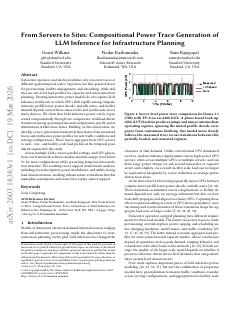
arXiv preprint (Stanford University / Microsoft Azure Research) 2026
From Servers to Sites: Compositional Power Trace Generation of LLM Inference for Infrastructure Planning
For an AI inference facility, set interconnection capacity from traces generated from the workload, not nameplate TDP or mean power; TDP sizing gave 1.19 MW against 0.75 MW trace-based (about 60% too much).
- Generated facility traces show a peak-to-average ratio of 1.19, a load factor of 0.84 and a maximum 15-minute ramp of 0.11 MW.
arXiv preprint (University of Texas at Austin; formatted for IEEE Transactions on Power Systems) 2025
Wide-Area Power System Oscillations from Large-Scale AI Workloads
Model AI data-centre load as a persistent periodic forcing (0.3-1.5 Hz band, about 20% of peak fluctuating) rather than a ramp, and add oscillation analysis to the grid-interconnection study.
- The fine-tuning model uses a dominant frequency U(0.3, 0.7) Hz and compute fraction 0.7-0.9.
arXiv preprint (University of Alberta) 2024
The Unseen AI Disruptions for Power Grids: LLM-Induced Transients
Define AI load not only by energy but by peak/average (about 1 in training), peak/idle ratio and ramp/decline rates; make sub-second dynamics inputs for UPS, generator and grid-connection studies.
- Traditional computing is 10-15 kW/rack versus 30+ kW/rack for AI workloads.