
Recommendations for Measuring and Reporting Overall Data Center Efficiency Version 2 - Measuring PUE for Data Centers
The Green Grid (multi-org task force) · 7x24 Exchange, ASHRAE et al.
Joint recommendations (2011) from a task force of 7x24 Exchange, ASHRAE, The Green Grid, SVLG, US DOE, EPA ENERGY STAR, USGBC and Uptime Institute on how to measure and publish PUE.
On this page
Overview
The document sets out joint recommendations from a task force of eight organizations on how to measure and publish PUE: 7x24 Exchange, ASHRAE, The Green Grid, Silicon Valley Leadership Group, US DOE, US EPA ENERGY STAR, USGBC and Uptime Institute. Its core contribution is to split PUE into categories by where IT energy is measured and to require that a reported PUE name its category and averaging period.
The categories are: PUE0, peak demand (kW) at UPS output; PUE1, 12-month energy at UPS output; PUE2, 12-month energy at PDU output; PUE3, 12-month energy at IT equipment input. PUE0 is a peak-demand calculation over a 12-month period and may be used only for all-electric data centers. For categories 1-3, the reported PUE should include the 12-month averaging period.
The document also introduced source-energy weighting: non-electric energy such as natural gas or district chilled water is converted with weighting factors before PUE is computed, so facilities using fuels or district utilities can be compared with all-electric sites. The record notes that the category table is widely summarised in public; the text dates from 2011.
Key points
- PUE0: peak demand (kW) at UPS output; PUE1: 12-month energy at UPS output.
- PUE2: 12-month energy at PDU output; PUE3: 12-month energy at IT equipment input.
- A reported PUE should name its category and, for categories 1-3, a 12-month averaging period.
- PUE0 is a peak-demand calculation and may only be used for all-electric data centers.
- Non-electric energy (natural gas, district chilled water, etc.) is converted with source-energy weighting factors.
- Authors are a joint task force of eight organizations.
Using it in design
- Tag every PUE result with a category (0-3) and period; report the design-model PUE as category 3-equivalent annual energy.
- When on-site fuel (CHP, gas absorption chillers) or district cooling is modelled, convert to electricity-equivalent with configurable weighting factors.
- Offer PUE0 (peak demand) only for all-electric facility models and disable it when fuel or district cooling is present.
Monthly newsletter · free
Keep your reading list current
Once a month: new library sources, changes to Turkish regulations and upcoming data centre events.
SoSo CAD
Compare the cost of design decisions
Evaluate equipment costs, energy expenses and total cost of ownership (TCO) using your inputs and assumptions in SoSo CAD.
Request a demo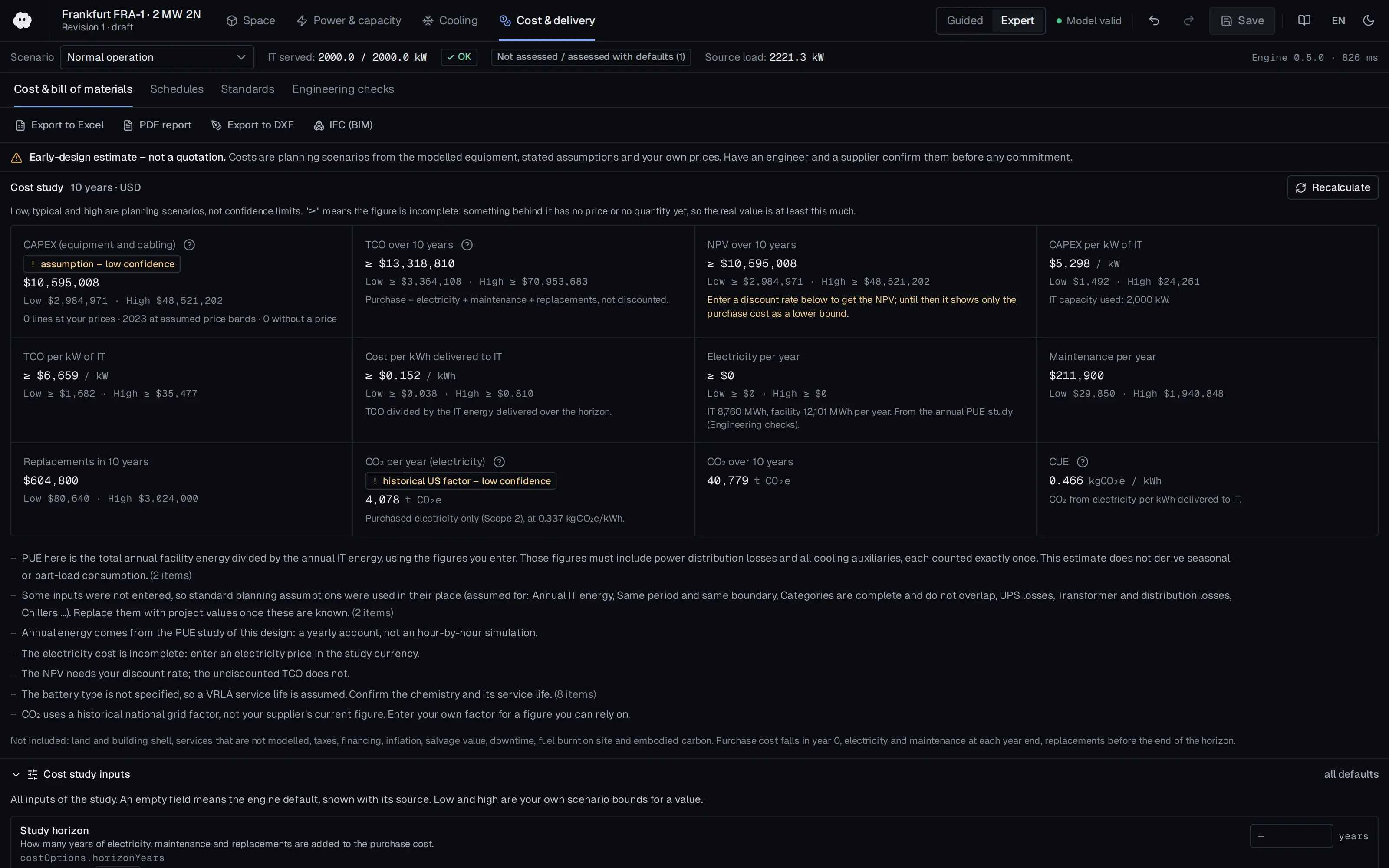
Who should read it
Design and operations engineers who publish or benchmark PUE results.
Related standards
- ISO/IEC 30134-2
- ENERGY STAR Data Center rating
Publication details
- Authors
- 7x24 Exchange; ASHRAE; The Green Grid; Silicon Valley Leadership Group; U.S. Department of Energy; U.S. Environmental Protection Agency ENERGY STAR Program; U.S. Green Building Council; Uptime Institute
- Publisher
- The Green Grid (multi-org task force)
- Year
- 2011
- Document language
- English
- Source type
- Industry body
- Access
- Free to read
- Licence
- Copyright retained; citation only — the publisher’s terms apply to the original document
Citation
7x24 Exchange; ASHRAE; The Green Grid; Silicon Valley Leadership Group; U.S. Department of Energy; U.S. Environmental Protection Agency ENERGY STAR Program; U.S. Green Building Council; Uptime Institute (2011). Recommendations for Measuring and Reporting Overall Data Center Efficiency Version 2 - Measuring PUE for Data Centers. The Green Grid (multi-org task force). https://www1.eere.energy.gov/manufacturing/datacenters/pdfs/task_force_metrics_recommendations.pdf
Events on this subject
- iMasons Climate Accord Summit
- Data Center World Middle East
- ELECO 2026 Elektrik-Elektronik ve Biyomedikal Mühendisliği Konferansı
All content and rights belong to the respective authors and publishers. SoSo CAD provides only the citation, its own summary and a link to the source, and is not responsible for the sources' content.