
TIA-942-C Data Center Standard Brings a Host of Changes and Updates
Cabling Installation & Maintenance · Patrick McLaughlin
Summary of a TIA webinar reported by Patrick McLaughlin in Cabling Installation & Maintenance (May 2024): ANSI/TIA-942-C folds in the edge data centre amendment and adds a micro edge data centre (µEDC) class.
On this page
Overview
The article is a trade-press summary of a TIA webinar by contributors to ANSI/TIA-942-C and reports the standard as published in May 2024. Revision C folds the edge data centre amendment to 942-B into the main text. The source is a second-hand summary, and the standard's full text was not read. The most visible novelty is a classification for micro edge data centres (µEDC) in prefabricated, remotely monitored enclosures.
Type A is part of a network of µEDCs that can take over for each other; Type B is self-reliant, for example in retail. The distinction settles whether resilience is provided inside the site or at network level through workload failover. The revision also updates cabling requirements, floor loading and minimum cabinet width; a minimum of 2 fibres is recommended for horizontal and backbone cabling, and broadband coax is recognised.
The rating tables in Annex D become normative, with 'Required/Not Required' replacing Yes/No, and the UPS, battery, fire-protection and seismic rows are simplified. The article's limit is that it summarises a webinar rather than comparing full texts; numeric thresholds such as the floor-load value are not given and must be checked in the standard. The engineering consequence of the Type A/Type B split is that in Type A, peer nodes take over each other's load, so full redundancy inside a single enclosure may not be needed; in Type B the enclosure must stand alone, which pulls UPS, battery and cooling decisions inside it.
Key points
- ANSI/TIA-942-C published May 2024
- Micro edge data centre classes: Type A (networked, failover to peers) and Type B (self-contained resilience)
- Annex D rating tables now normative; 'Required/Not Required' replaces Yes/No
- Minimum 2 fibres recommended for horizontal/backbone cabling; broadband coax recognised
- New requirements on floor-loading capacity and minimum cabinet width
- Revision folds in the edge data centre amendment to 942-B
Using it in design
- Add an 'edge / micro-edge' project type with a Type A/Type B resilience choice; Type A can justify lower site redundancy because workload fails over
- Carry cabinet width and floor-load parameters in the rack catalogue so TIA-942-C checks can run
- Default horizontal and backbone cabling templates to at least 2 fibres
Monthly newsletter · free
Keep your reading list current
Once a month: new library sources, changes to Turkish regulations and upcoming data centre events.
SoSo CAD
Assess redundancy through scenarios
Compare normal operation and equipment failures in SoSo CAD, with supplied loads and capacity shortfalls in one view.
Request a demo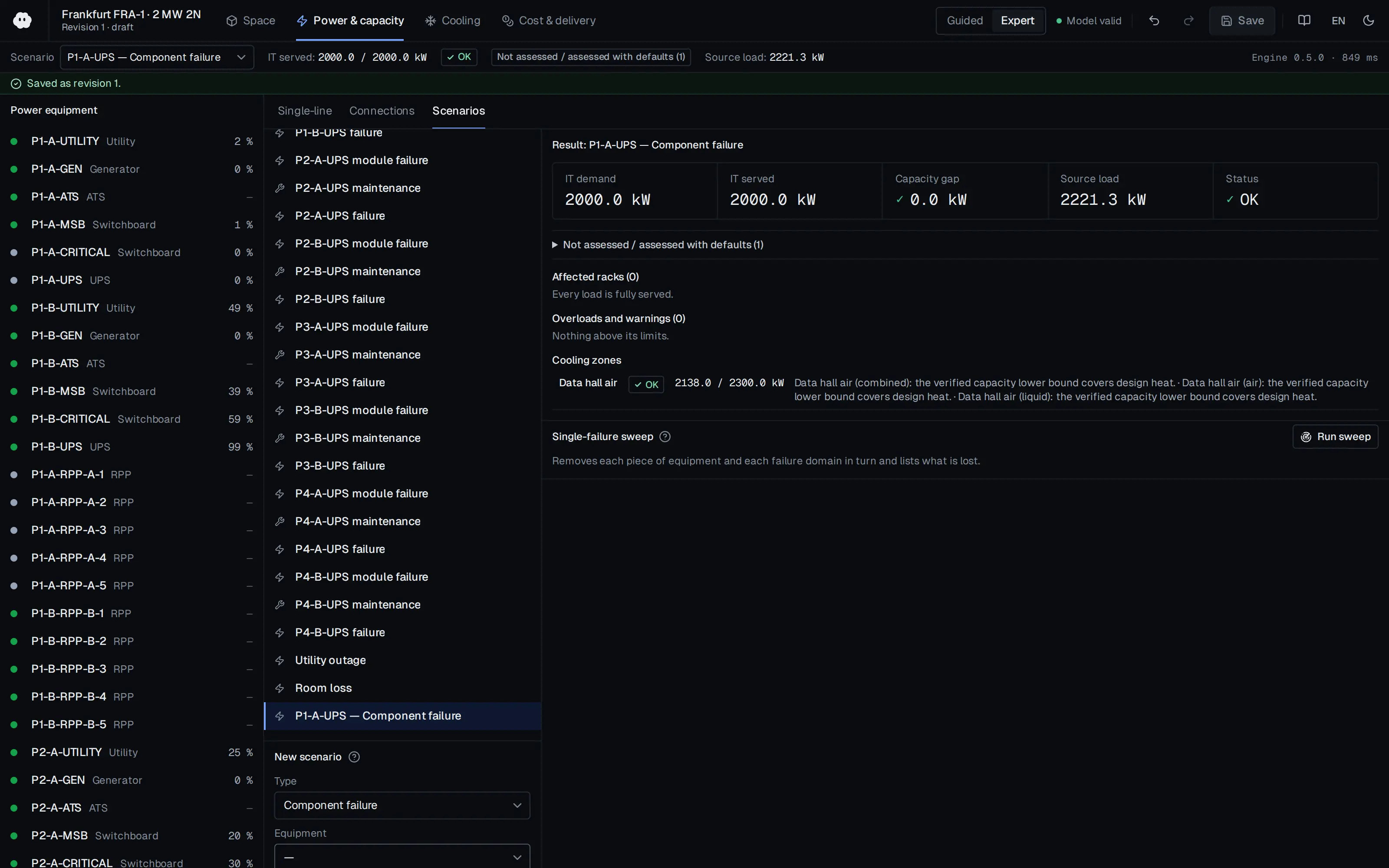
Who should read it
Engineers designing edge and micro-edge data centres, and cabling consultants assessing the move from 942-B to 942-C.
Related standards
- ANSI/TIA-942-C
Publication details
- Authors
- Patrick McLaughlin
- Publisher
- Cabling Installation & Maintenance
- Year
- 2024
- Document language
- English
- Source type
- Expert / community
- Access
- Free to read
- Licence
- Copyright retained; citation only — the publisher’s terms apply to the original document
Citation
Patrick McLaughlin (2024). TIA-942-C Data Center Standard Brings a Host of Changes and Updates. Cabling Installation & Maintenance. https://cablinginstall.com/standards/article/55245177/tia-942-c-data-center-standard-brings-a-host-of-changes-and-updates
Events on this subject
Browse the events calendarAll content and rights belong to the respective authors and publishers. SoSo CAD provides only the citation, its own summary and a link to the source, and is not responsible for the sources' content.
Related sources
All sources on this topicBICSI 2024
ANSI/BICSI 002-2024, Data Center Design and Implementation Best Practices (overview page)
Offer BICSI classes as an alternate standards profile alongside Uptime/TIA/EN, with an F1~Tier I/Rated-1/Class 1 ... F4~Tier IV/Rated-4/Class 4 table labelled 'conceptual equivalence only'
- A 2010 draft used F0-F5; current editions use F0-F4
Telecommunications Industry Association 2024
ANSI/TIA-942 Telecommunications Infrastructure Standard for Data Centers — TIA overview page
In a 'TIA-942' standards profile, let users pick a rating per discipline (for example electrical Rated-3, mechanical Rated-3, telecom Rated-2)
- 'Tier' terminology replaced by 'Rated 1-4' after an agreement with Uptime; the schemes are not interchangeable
CIGRE US National Committee, 2026 Grid of the Future Symposium (arXiv preprint) 2026
Comparative Analysis of Large Load Interconnection Requirements Across U.S. Transmission Entities
Design data-centre UPS and load control to the most restrictive entity's requirement: 6.0 s ride-through at 0.70-0.90 pu (CAISO), six fault-clearing attempts within 90 s (SPP), six 50-70 ms reclosings (Dominion), and the ban on constant-power control (SPP).
- MISO's proposal requires withstanding three voltage disturbances within 10 s and phase-angle jumps up to 25 degrees.
Springer Science and Business Media LLC (preprint) 2026
Design and Development of a Next-Generation Medium-Voltage Architecture for AI Data Centre Infrastructure
Make the 0.1-10 Hz oscillation, 1.40 peak-to-mean ratio and coincidence factor explicit inputs in the AI campus load model, and check storage and buffering against grid ramp limits.
- Conductor mass falls by 97.1%, electrical footprint by 58.1%, annual PUE from 1.42 to 1.11 and 15-year TCO by 32.4%.

Open Compute Project Foundation 2026
Diablo 400 Project: Rack and Power, Base Specification Version 0.7.0 (effective March 1, 2026)
Check that the facility's AC feed (480, 415 or 400 V, single or dual) and the rack power range match the planned IT block, including up to 1.1 MW per sidecar and the parallel option.
- AC input is 3-phase at 480, 415 or 400 Vrms +/-10%, single feed or dual N+N, 50/60 Hz +/-3 Hz.
Open Compute Project Foundation 2026
Interface Specification Between Hyperscalers and Utility Grid for Disturbance Performance (Version 1.0.0)
For a new site, write the POI LVRT/HVRT envelope and the PFAPR requirement (90% within 2 s) as design criteria, and settle which voltage measurement (line-to-neutral or line-to-line) governs during protection coordination with the utility.
- In ERCOT NOGRR 282, cooling load is subtracted from the pre-fault load used to judge PFAPR.