
Comparative Analysis of Large Load Interconnection Requirements Across U.S. Transmission Entities
CIGRE US National Committee, 2026 Grid of the Future Symposium (arXiv preprint) · Rafi Zahedi, Rahul Anilkumar et al.
A comparison of large-load interconnection rules across eleven U.S. entities (AEP, Ameren, CAISO, Dominion, Duke, ERCOT, LIPA, MISO, PJM, Southern Company, SPP) under seven categories, including fault ride-through, curtailment, dispatchability, power quality and reactive power.
CC0 1.0 — public domain dedication; free to reuse
On this page
Overview
The rapid growth of large loads, especially AI-driven data centres, is creating unprecedented demands on the North American electric grid. Data centres account for nearly 80% of large-load interconnection requests in the Western Interconnection, and DOE projects U.S. data-centre use of 325-580 TWh by 2028. Despite this, technical interconnection requirements for large loads have not yet matured and contain gaps. The paper compares eleven entities across seven technical categories: large-load definition, load data and modelling, fault ride-through, load curtailment and shedding, dispatchability, power quality and reactive power control.
The lowest large-load threshold is 10 MW (SPP, loads at 69 kV); LIPA uses 20 MW and 50 MW is the most common threshold. ERCOT's proposed VRT: continuous 0.90-1.10 pu, current during disturbances not above 150% of normal maximum for no more than 0.5 s, and return to at least 90% of pre-disturbance consumption within 2 s after voltage exceeds 0.90 pu. SPP requires staying connected through at least six fault-clearing attempts within 90 s and prohibits constant-power control during disturbances; Dominion requires riding through at least six reclosing attempts of 50-70 ms. CAISO requires up to 6.0 s ride-through in the 0.70-0.90 pu band, roughly 3× the 2.0 s required by ERCOT, SPP, MISO and LIPA; all five numeric envelopes permit tripping above 1.20 pu.
Ramp-rate limits: Southern 20 MW/min, Duke 10 MW/min, MISO 30 MW/min (plus 10 MW max change in a sliding 5 s window), SPP 20 MW/min, LIPA 20 MW/min, CAISO 20 MW/min. Southern Company FFT oscillation limit: 10 MW max per 0.1 Hz bin for 0.1-5 Hz and 2.5 MW for 5-55 Hz; LIPA caps any two adjacent bins at 10 MW and all bins at 20 MW in 0.1-5 Hz, and 3.5 MW in 5-55 Hz. MISO's proposal requires withstanding three voltage disturbances within 10 s and phase-angle jumps up to 25 degrees.
The maturity assessment finds LIPA covering all categories and Dominion/Duke close behind, while dispatchability and oscillation limits remain inconsistent. The authors argue that on-site generators and BESS let hyperscale sites act as grid resources rather than only loads. Limits: rules are evolving quickly and measurement methods differ between entities; it is a preprint.
Key points
- Data centres make up nearly 80% of large-load interconnection requests in the Western Interconnection; DOE projects U.S. data-centre use of 325-580 TWh by 2028.
- The lowest large-load threshold is 10 MW (SPP, loads at 69 kV); LIPA uses 20 MW and 50 MW is the most common threshold.
- ERCOT's proposed VRT: continuous 0.90-1.10 pu, current during disturbances not above 150% of normal maximum for no more than 0.5 s, and return to at least 90% of pre-disturbance consumption within 2 s after voltage exceeds 0.90 pu.
- SPP requires staying connected through at least six fault-clearing attempts within 90 s and prohibits constant-power control during disturbances; Dominion requires riding through at least six reclosing attempts of 50-70 ms.
- CAISO requires up to 6.0 s ride-through in the 0.70-0.90 pu band, roughly 3× the 2.0 s required by ERCOT, SPP, MISO and LIPA; all five numeric envelopes permit tripping above 1.20 pu.
- Ramp-rate limits: Southern 20 MW/min, Duke 10 MW/min, MISO 30 MW/min (plus 10 MW max change in a sliding 5 s window), SPP 20 MW/min, LIPA 20 MW/min, CAISO 20 MW/min.
- Southern Company FFT oscillation limit: 10 MW max per 0.1 Hz bin for 0.1-5 Hz and 2.5 MW for 5-55 Hz; LIPA caps any two adjacent bins at 10 MW and all bins at 20 MW in 0.1-5 Hz, and 3.5 MW in 5-55 Hz.
- MISO's proposal requires withstanding three voltage disturbances within 10 s and phase-angle jumps up to 25 degrees.
Using it in design
- Design data-centre UPS and load control to the most restrictive entity's requirement: 6.0 s ride-through at 0.70-0.90 pu (CAISO), six fault-clearing attempts within 90 s (SPP), six 50-70 ms reclosings (Dominion), and the ban on constant-power control (SPP).
- Make ramp limits (10-30 MW/min) and FFT oscillation limits (Southern: 10 MW per bin at 0.1-5 Hz, 2.5 MW at 5-55 Hz) inputs to the load profile and storage sizing.
- Add the post-disturbance recovery target (ERCOT proposal: at least 90% within 2 s) to UPS and load-reconnection logic.
- Verify the large-load definition (10-50 MW thresholds) early in application scoping.
Monthly newsletter · free
Keep your reading list current
Once a month: new library sources, changes to Turkish regulations and upcoming data centre events.
SoSo CAD
Review your power design in SoSo CAD
Inspect supply paths, equipment loads and UPS failure scenarios in one model.
Request a demo
Who should read it
Grid engineers and designers preparing large data-centre load interconnection across several U.S. entities.
Document contents
- 1. Introduction
- 2. Comparative Findings of U.S. Transmission Entities (2.1 Large load definition, 2.2 Load data and modeling, 2.3 Fault ride-through, 2.4 Load curtailment and load shedding, 2.5 Dispatchability, 2.6 Power quality, 2.7 Reactive power control)
- 3. Conclusion
Related standards
- IEEE 2800-2022
- NERC PRC-029-1
- ITI (CBEMA) curve
- IEEE 519
- IEEE 1453
Read the document
large-load-interconnection-requirements-us-2026.pdf
CC0 1.0 — public domain dedication; free to reuse
The document is provided unaltered because its licence permits redistribution.
Publication details
- Authors
- Rafi Zahedi; Rahul Anilkumar; Amin Zamani
- Publisher
- CIGRE US National Committee, 2026 Grid of the Future Symposium (arXiv preprint)
- Year
- 2026
- Document number
- arXiv:2610.36645
- Document language
- English
- Source type
- Scientific
- Access
- Open licence — downloadable
- Licence
- CC0 1.0 — public domain dedication; free to reuse
- Licence evidence
- arxiv.org
Original licence note
arXiv record licence is http://creativecommons.org/publicdomain/zero/1.0/ (CC0, checked via arXiv OAI-PMH)
Citation
Rafi Zahedi; Rahul Anilkumar; Amin Zamani (2026). Comparative Analysis of Large Load Interconnection Requirements Across U.S. Transmission Entities. CIGRE US National Committee, 2026 Grid of the Future Symposium (arXiv preprint). arXiv:2610.36645. https://doi.org/10.48550/arXiv.2610.36645
Events on this subject
Browse the events calendarAll content and rights belong to the respective authors and publishers. SoSo CAD provides only the citation, its own summary and a link to the source, and is not responsible for the sources' content.
Related sources
All sources on this topic
Open Compute Project Foundation 2026
Interface Specification Between Hyperscalers and Utility Grid for Disturbance Performance (Version 1.0.0)
For a new site, write the POI LVRT/HVRT envelope and the PFAPR requirement (90% within 2 s) as design criteria, and settle which voltage measurement (line-to-neutral or line-to-line) governs during protection coordination with the utility.
- In ERCOT NOGRR 282, cooling load is subtracted from the pre-fault load used to judge PFAPR.
arXiv preprint (Black & Veatch / University of Central Missouri) 2025
Enhancing Grid Resilience for Giga-Watt Scale Data Centers Using High Voltage Circuit Breaker Operated Braking Resistors
In gigawatt-scale data-centre interconnection studies, add the load-loss scenario from IT load transferring to UPS in a voltage dip (for example 5 × 200 MW with a 1:1 split giving 500 MW) to the grid frequency and voltage analysis.
- Data-centre plant sizes are cited as ranging between 500 MW and 2 GW.
CIGRE US National Committee, 2025 Grid of the Future Symposium (arXiv preprint) 2025
Best Practices for Large Load Interconnections: A North American Perspective on Data Centers
In a large-load interconnection application, verify the relevant entity's large-load threshold (10-75 MW) and ramp limit (Southern ≤20 MW/min) early; definitions differ widely between entities.
- Southern Company is the only entity in this review with a numeric ramp cap: ≤20 MW/min under normal operation.
U.S. DoD (UFC) 2019
UFC 3-550-01 Exterior Electrical Power Distribution (1 September 2016, Change 3, 01 November 2019)
Settle the loop or alternate-feed arrangement and the maintenance isolation points for the MV run from utility entry to the building early; the text treats shortening maintenance outages as a direct design driver.
- Elbow-type arresters go at the ends of all radials and at normally open loop points, for all voltages above 5 kV.
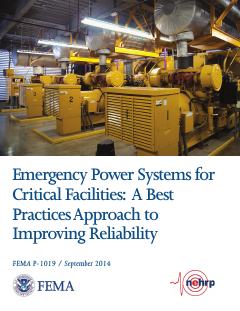
FEMA 2014
FEMA P-1019, Emergency Power Systems for Critical Facilities: A Best Practices Approach to Improving Reliability (September 2014)
At critical-facility data centers, place generators, ATS, fuel tanks and pumps above the greatest of BFE + 3 ft, DFE + 1 ft and 500-year elevation + 1 ft, and prefer elevation to dry floodproofing.
- Generators over 300 kW are almost exclusively diesel-fueled.

FEMA 2007
FEMA 543, Design Guide for Improving Critical Facility Safety from Flooding and High Winds (Risk Management Series, January 2007)
For site selection, look beyond the 100-year flood to the 500-year (0.2%) flood and the facility's occupancy category, and avoid flood hazard areas where possible.
- A freeboard of 1 to 3 feet above the flood elevation is often applied to critical facilities.