
FEMA 543, Design Guide for Improving Critical Facility Safety from Flooding and High Winds (Risk Management Series, January 2007)
FEMA · Federal Emergency Management Agency (FEMA)
FEMA's guide to siting, designing and retrofitting critical facilities such as hospitals, emergency operations centres, police and fire stations and schools. It is not data-center specific, but applies directly to flood and wind risk, emergency power and utility protection at mission-critical sites.
U.S. public domain — U.S. Government work; free to reuse
On this page
Overview
The guide is a Risk Management Series document, shaped by the damage of Hurricane Katrina, that aims to keep critical facilities functioning under flooding and high winds. It has four main chapters: an overview of design considerations, protection from flooding, protection from high winds, and observations on how hospitals, schools and emergency response facilities performed in Katrina. The appendices give acronyms, a glossary and FEMA grant programmes. The target audience is owners, managers and designers of critical facilities.
Chapter 1 stresses that risk reduction starts with site selection and then facility design, and introduces performance-based design. Four flood performance levels are defined: operational (no damage), moderate impact, high impact and severe impact. Most critical facilities fall into ASCE 7 Occupancy Category III or IV, with IV covering essential facilities such as hospitals, emergency services and power stations. The guide recommends basing risk decisions for critical facilities on the 0.2%-annual-chance (500-year) flood, not only the 1%-annual-chance (100-year) flood.
The flood chapter explains the design flood elevation (DFE), the base flood elevation (BFE) and freeboard, often 1 to 3 feet for critical facilities. Loads are hydrostatic, hydrodynamic, debris impact and scour; hydrodynamic loads from water moving under 10 feet per second can be treated as equivalent hydrostatic loads. Probabilities are given: a 100-year flood has a 26% chance over 30 years and 50% over 70 years; the 500-year flood has 18% over 70 years. Elevation, resistant materials and dry floodproofing are covered for A Zones, V Zones and Coastal A Zones. Utilities and generators should sit above the DFE plus freeboard, at least 2 to 3 feet above the DFE.
The wind chapter defines the ASCE 7 basic wind speed as a 3-second peak gust 33 ft above grade in Exposure C: 90 mph over most of the U.S. and up to 170 mph in Guam. It covers the envelope, roof coverings, rooftop equipment, ductwork and equipment screens, wind-borne debris and lightning protection attachment. It recommends anchoring rooftop equipment for design wind loads and, where possible, placing it in penthouses. Separate best-practice sections cover hurricane and tornado regions and retrofit of existing facilities.
On power outages, the guide recommends for facilities needed during or within weeks after a hurricane emergency generators rated for prime (continuous) power, standby generators interconnected through manual transfer switches, and an exterior cam-lock box for a portable generator. Generators should sit in buildings resistant to wind-borne debris, not outdoors or in weak enclosures. The document dates from 2007, rests on U.S. codes and is not specific to data centers, so its criteria must be checked against local regulation and current standards.
Key points
- Most critical facilities fall into ASCE 7 Occupancy Category III or IV; Category IV covers essential facilities such as hospitals, emergency services and power stations.
- Critical facility risk decisions should be based on the 0.2%-annual-chance (500-year) flood rather than only the 1%-annual-chance (100-year) flood.
- A 100-year flood has a 26% chance of occurring over 30 years and 50% over 70 years; the 500-year flood has an 18% chance over 70 years.
- A freeboard of 1 to 3 feet above the flood elevation is often applied to critical facilities.
- Hydrodynamic loads from floodwaters moving under 10 feet per second can be treated as equivalent hydrostatic loads.
- Building and utility systems in flood hazard areas should be protected to at least the 500-year flood level or, at minimum, 2 to 3 feet above the DFE.
- Generators installed at grade are inundated in a flood; underground tanks can float and should be checked for stability assuming they are empty.
- ASCE 7 basic wind speed is a 3-second peak gust at 33 ft above grade in Exposure C; most of the U.S. is 90 mph, with 170 mph in Guam as the highest.
- Facilities needed during or shortly after a hurricane should have emergency generators rated for prime power, standby generators interconnected via manual transfer switches, and an exterior cam-lock box for portable generator hookup.
- Generators belong in wind-borne debris resistant buildings; outdoor siting or weak enclosures is not recommended.
Using it in design
- For site selection, look beyond the 100-year flood to the 500-year (0.2%) flood and the facility's occupancy category, and avoid flood hazard areas where possible.
- Place critical equipment (electrical rooms, UPS, switchgear, chillers, generators) above the DFE plus freeboard; target the 500-year flood level or 2 to 3 feet above the DFE, and give the ground floor non-critical uses.
- Keep inlets, fill openings and vents of fuel tanks above the DFE and check buoyancy stability of underground tanks assuming an empty tank.
- Require anchorage to design wind loads for generators and rooftop equipment, and house equipment in debris-resistant enclosures or penthouses where possible.
- In the backup power architecture consider prime-rated generators, standby generators tied through manual transfer switches, and an exterior cam-lock box for a portable generator.
- Write the flood performance level (operational, moderate, high or severe impact) into the design criteria, and use the guide's vulnerability checklist for existing facilities.
Monthly newsletter · free
Keep your reading list current
Once a month: new library sources, changes to Turkish regulations and upcoming data centre events.
SoSo CAD
Assess redundancy through scenarios
Compare normal operation and equipment failures in SoSo CAD, with supplied loads and capacity shortfalls in one view.
Request a demo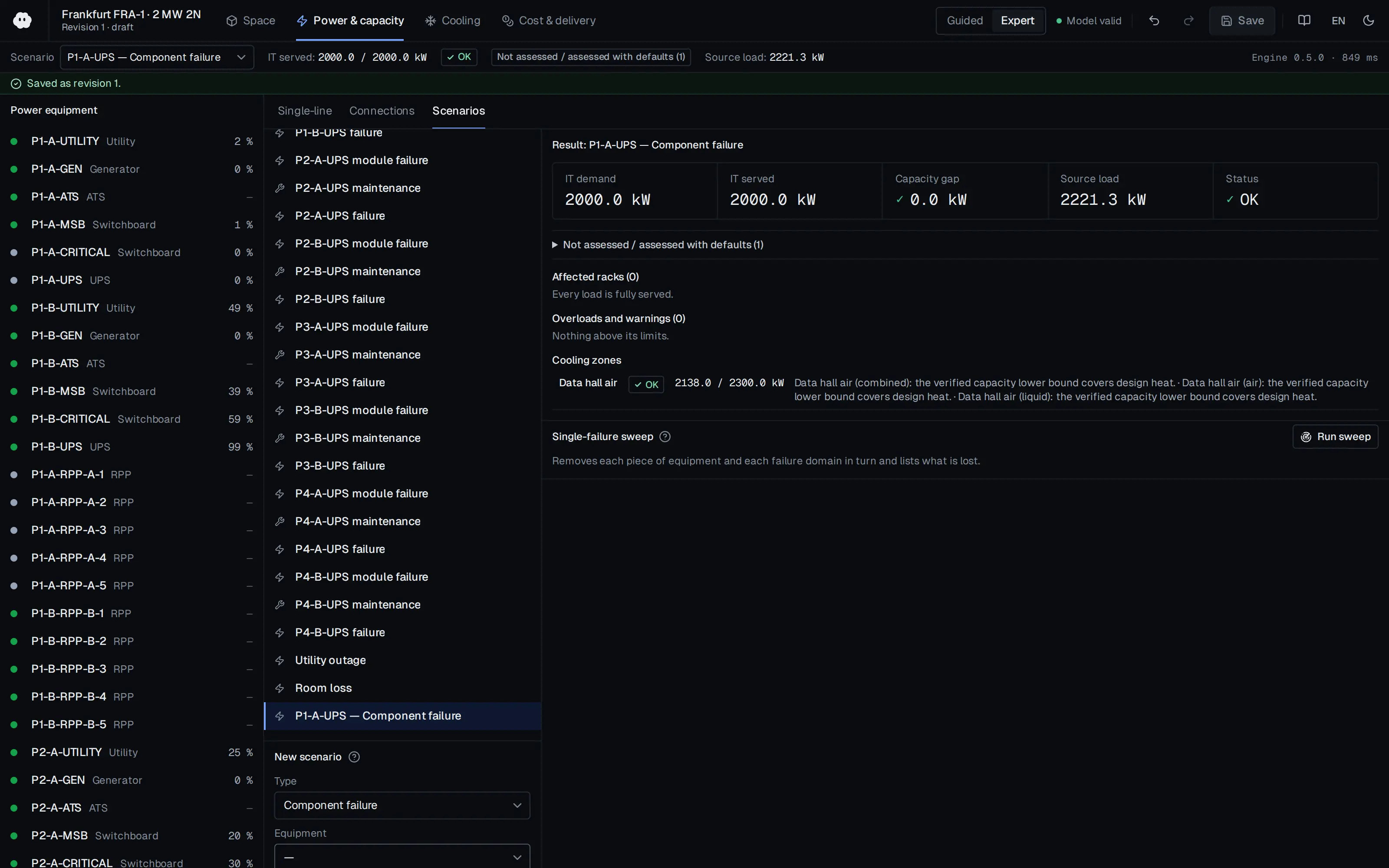
Who should read it
Designers and risk managers who handle siting, architectural and electrical-mechanical design of mission-critical facilities such as data centers and who assess flood and wind risk.
Document contents
- Foreword and Acknowledgments
- Chapter 1 - Critical Facility Design Considerations
- Hazard Mitigation: Site Selection and Facility Design
- Performance-Based Design
- Chapter 2 - Making Critical Facilities Safe from Flooding
- Flood Loads: Hydrostatic, Hydrodynamic, Debris Impact, Scour
- Floodplain Management Requirements and Building Codes
- Requirements and Best Practices in Special Hazard Areas (A Zones, V Zones, Coastal A Zones)
- Utility Installations
- Risk Reduction for Existing Critical Facilities
- Checklist for Building Vulnerability of Flood-Prone Critical Facilities
- Chapter 3 - Making Critical Facilities Safe from High Wind
- Critical Facility Design Considerations for High Wind
- Best Practices in Hurricane-Prone Regions
- Best Practices in Tornado-Prone Regions
- Chapter 4 - Observations on the Performance of Critical Facilities in Hurricane Katrina
- Appendix C - FEMA Grant Programs
Read the document
fema-543-critical-facilities-flood-wind.pdf
U.S. public domain — U.S. Government work; free to reuse
The document is provided unaltered because its licence permits redistribution.
Publication details
- Authors
- Federal Emergency Management Agency (FEMA)
- Publisher
- FEMA
- Year
- 2007
- Document language
- English
- Source type
- Government / public
- Access
- Open licence — downloadable
- Licence
- U.S. public domain — U.S. Government work; free to reuse
- Licence evidence
- www.copyright.gov
Original licence note
FEMA publication (prepared under FEMA contract, published by DHS/FEMA); U.S. Government work; mirrored on WBDG because fema.gov blocks automated clients.
Citation
Federal Emergency Management Agency (FEMA) (2007). FEMA 543, Design Guide for Improving Critical Facility Safety from Flooding and High Winds (Risk Management Series, January 2007). FEMA. https://www.wbdg.org/FFC/DHS/fema543.pdf
Events on this subject
Browse the events calendarAll content and rights belong to the respective authors and publishers. SoSo CAD provides only the citation, its own summary and a link to the source, and is not responsible for the sources' content.
Related sources
All sources on this topic
FEMA 2014
FEMA P-1019, Emergency Power Systems for Critical Facilities: A Best Practices Approach to Improving Reliability (September 2014)
At critical-facility data centers, place generators, ATS, fuel tanks and pumps above the greatest of BFE + 3 ft, DFE + 1 ft and 500-year elevation + 1 ft, and prefer elevation to dry floodproofing.
- Generators over 300 kW are almost exclusively diesel-fueled.
Siemens 2013
Totally Integrated Power - Application Models for Power Distribution: Data Centres
Use the tier factors as defaults in the early-stage area estimator: grey space = white space x factor.
- Critical (ICT) to infrastructure power split is about 2:1 (PUE about 1.5).
CIGRE US National Committee, 2026 Grid of the Future Symposium (arXiv preprint) 2026
Comparative Analysis of Large Load Interconnection Requirements Across U.S. Transmission Entities
Design data-centre UPS and load control to the most restrictive entity's requirement: 6.0 s ride-through at 0.70-0.90 pu (CAISO), six fault-clearing attempts within 90 s (SPP), six 50-70 ms reclosings (Dominion), and the ban on constant-power control (SPP).
- MISO's proposal requires withstanding three voltage disturbances within 10 s and phase-angle jumps up to 25 degrees.
Open Compute Project Foundation 2026
Clean Backup Power Technology Requirements, Base Specification Version 0.3 (effective Apr 22, 2026)
Extend the generator catalogue with technology type (diesel, HVO, gas, H2 ICE, PEM fuel cell), emissions factor relative to the 1742 lb/MWh baseline, start time, block-load capability and NFPA 110 level.
- Overload 110% for 60 s and 150% for 3 s; transient voltage response to ISO 8528-5 G3; steady-state frequency within +/-0.5%.

Open Compute Project Foundation 2026
Interface Specification Between Hyperscalers and Utility Grid for Disturbance Performance (Version 1.0.0)
For a new site, write the POI LVRT/HVRT envelope and the PFAPR requirement (90% within 2 s) as design criteria, and settle which voltage measurement (line-to-neutral or line-to-line) governs during protection coordination with the utility.
- In ERCOT NOGRR 282, cooling load is subtracted from the pre-fault load used to judge PFAPR.
arXiv preprint (Black & Veatch / University of Central Missouri) 2025
Enhancing Grid Resilience for Giga-Watt Scale Data Centers Using High Voltage Circuit Breaker Operated Braking Resistors
In gigawatt-scale data-centre interconnection studies, add the load-loss scenario from IT load transferring to UPS in a voltage dip (for example 5 × 200 MW with a 1:1 split giving 500 MW) to the grid frequency and voltage analysis.
- Data-centre plant sizes are cited as ranging between 500 MW and 2 GW.