
AC Versus DC Power Distribution: Issues to Consider When Comparing Options for Improving Data Center Energy Efficiency
Eaton · Robert W. Johnson
Eaton WP153001 compares end-to-end power-chain efficiency, from source to 12 VDC inside the server, for North American AC architectures and 380 VDC distribution, and concludes that AC with a high-efficiency UPS matches or beats DC.
On this page
Overview
The paper walks from a legacy 480 V/208 V chain through newer components, high-efficiency UPS modes and PDU elimination with 480/277 V or 400/230 V distribution, and compares these with narrow- and wide-range DC buses. Chain efficiencies: legacy AC 61%; newer components 83%; high-efficiency UPS mode 87.5%; no PDU with 480/277 V or 400/230 V 89%; DC narrow-range 86%; DC wide-range 84%.
Practical constraints are listed too. Few server PSUs accept 277 V input, which makes 480/277 V impractical; 400/230 V is the realistic option. High-efficiency UPSs can achieve mode transfer times of 0-4 ms. Redundant A/B feeds halve the load per source and lower the converters' operating efficiency.
DC issues include extra poles needed for breaking above 250 VDC, limited discrimination, arc-fault fire risk, undefined arc-flash energy, and PSU holdup that must exceed fault clearing time.
The paper also proposes auto-zigzag transformers to derive 415/240 V from 480 V delta, with about 1.5% impedance against about 5.75% for a typical isolation transformer.
Key points
- Chain efficiency: legacy AC 61%; newer components 83%; high-efficiency UPS mode 87.5%; no PDU with 480/277 V or 400/230 V 89%; DC narrow-range 86%; DC wide-range 84%.
- High-efficiency UPSs can achieve mode transfer times of 0-4 ms.
- Few server PSUs accept 277 V, making 480/277 V impractical; 400/230 V is the realistic option.
- Redundant A/B feeds halve load per source and lower the converters' operating efficiency.
- DC issues: extra poles above 250 VDC, limited discrimination, arc-fault fire risk, undefined arc-flash energy, PSU holdup that must exceed fault clearing time.
- An auto-zigzag transformer for 480 V delta to 415/240 V has about 1.5% impedance versus about 5.75% for a typical isolation transformer.
Using it in design
- Provide a power-chain efficiency calculator by stage (transformer, UPS mode, PDU, PSU) including the effect of the A/B load split.
- Offer voltage options per region (208/120, 415/240, 400/230, 480/277, 380 VDC) with a PSU compatibility check.
- For DC buses above 250 V require DC-rated multi-pole protection and a holdup-versus-clearing-time check.
- Flag 277 V distribution when the IT PSUs are not rated for it.
Monthly newsletter · free
Keep your reading list current
Once a month: new library sources, changes to Turkish regulations and upcoming data centre events.
SoSo CAD
Review your power design in SoSo CAD
Inspect supply paths, equipment loads and UPS failure scenarios in one model.
Request a demo
Who should read it
Designers comparing AC and DC distribution on energy efficiency.
Related standards
- NEC Article 450
- NEC 210.9
- NEC 250.36
- ETSI EN 300 132-3
Publication details
- Authors
- Robert W. Johnson
- Publisher
- Eaton
- Year
- 2012
- Document number
- WP153001EN
- Document language
- English
- Source type
- Manufacturer
- Access
- Free to read
- Licence
- Copyright retained; citation only — the publisher’s terms apply to the original document
Citation
Robert W. Johnson (2012). AC Versus DC Power Distribution: Issues to Consider When Comparing Options for Improving Data Center Energy Efficiency. Eaton. WP153001EN. https://web.archive.org/web/20240707022753/https://www.eaton.com/content/dam/eaton/markets/data-center/AC-Versus-DC-Power-Distribution.pdf
Events on this subject
- Electricity Eurasia 2027
- ELECO 2026 Elektrik-Elektronik ve Biyomedikal Mühendisliği Konferansı
- The smarter E Europe (Intersolar Europe, ees Europe, Power2Drive, EM-Power)
All content and rights belong to the respective authors and publishers. SoSo CAD provides only the citation, its own summary and a link to the source, and is not responsible for the sources' content.
Related sources
All sources on this topicEaton / Trane 2025
Reference Design #505: Eaton 1 GW Power Architecture Meets Trane Thermal Management
Voltage-selection rule: motors above about 200 kW (large chillers and pumps) default to MV (4.16/6.6/11 kV) feeders; compute I = P/(sqrt(3) x V x PF) to show cable savings.
- 1,500 HP pump: 1,420 A at 480 V vs 164 A at 4.16 kV
Eaton 2025
Data Center as a Good Grid Citizen
Add grid-code parameters to the utility connection object: UFLS stages, LVRT curve, post-fault power recovery ramp (%/s) and short-circuit ratio at the PCC.
- Typical BESS Li-ion cells are limited to about 1C discharge.
Eaton 2021
Grid-Interactive Data Centers: Enabling Decarbonization and System Stability
When sizing UPS batteries, model a grid-services band on top of the required autonomy.
- Irish field case: the UPS delivered a static 25 kW response when frequency fell below 49.70 Hz.
IEEE Access (Institute of Electrical and Electronics Engineers (IEEE)) 2026
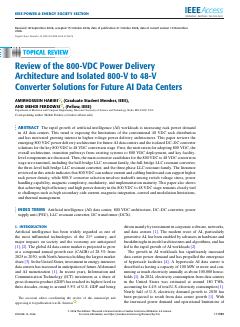
Review of the 800-VDC Power Delivery Architecture and Isolated 800-V to 48-V Converter Solutions for Future AI Data Centers
Define 800 VDC unipolar, ±400 VDC bipolar and 48/54 VDC busbar as separate voltage classes in the single-line diagram, each with its own conductor ampacity, breaker pole count and clearance (IEC 60664-1) checks.
- The OCP Open Rack V3 PSU specification targets above 97.5% peak efficiency and at least 96.5% across 30%-100% load.
arXiv preprint (University of Michigan) 2026
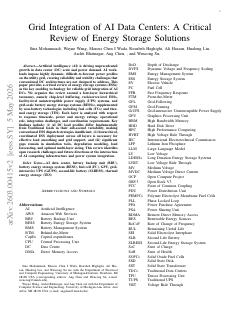
Grid Integration of AI Data Centers: A Critical Review of Energy Storage Solutions (arXiv preprint)
Layer storage by timescale (chip/server sub-ms to ms, rack ms to seconds, UPS and GiUPS sub-second to 10 s, BESS minutes to hours) and show each layer's duty in the coordination scheme.
- Rapid AI load variations often induce 5-10% voltage swings within milliseconds.
Advances in Applied Energy (Elsevier BV) 2026
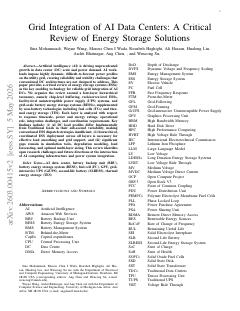
Grid Integration of AI Data Centers: A Critical Review of Energy Storage Solutions
Layer storage by timescale: GPU/server supercapacitors for sub-second swings, rack BBUs for minutes, facility GiUPS and BESS for grid services and longer durations; show each layer's duty and coordination separately in the architecture.
- BESS cost fell from about $7,500/kWh in 1991 to $133/kWh in 2024, with about $80/kWh projected by 2030.